
Hit by a Driver With No Insurance in Florida: What Are Your Options?
Your own insurance is almost always the first place to look. Florida requires your PIP coverage to pay 80 percent of your reasonable medical bills and 60 percent of your lost wages, up to $10,000 with an emergency medical condition (otherwise $2,500) and only if you get initial treatment within 14 days, regardless of who caused the crash, and if you bought uninsured motorist coverage, that policy can pay for what PIP does not cover, including pain and suffering if your injury is permanent. An attorney can also look beyond the crash report to find coverage you did not know existed, such as a household relative's policy, the vehicle owner's policy, or an employer's coverage if the driver was on the job.
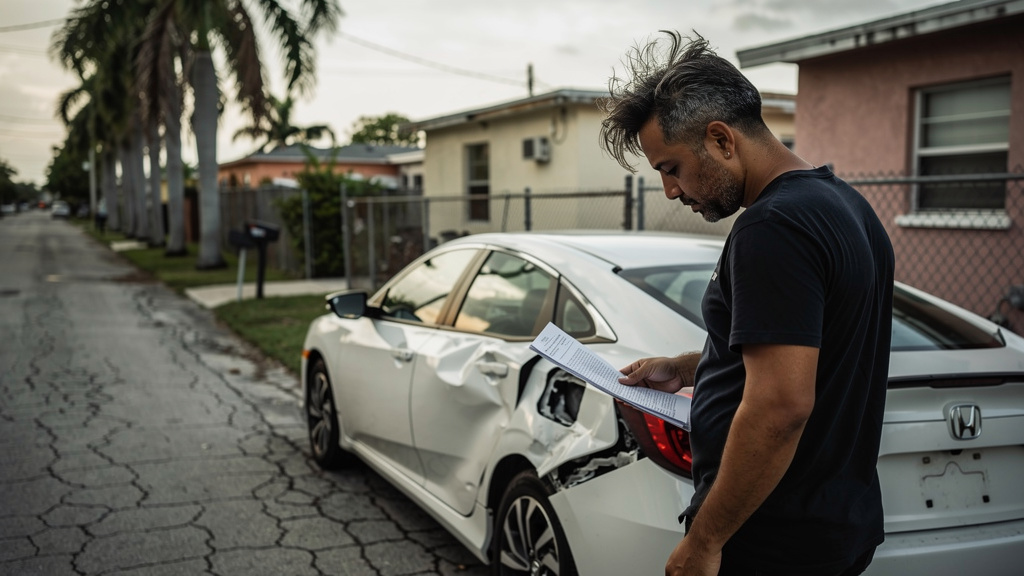
The driver who hit you has no insurance. Your case is not over. Your own insurance is almost always the first place to look, and Florida law creates several other potential sources of recovery that a crash report cannot show you. Here is what the law actually provides and what you should do this week.
What does ‘no insurance’ on the crash report actually mean?
A crash report saying the other driver had no insurance records what the officer observed at the scene. It does not tell you who owns the car, whether the driver was on the job, or whether a policy had simply lapsed by the time of the stop. Those distinctions matter in Florida, and each one can open a different path to recovery.
Under Florida’s dangerous instrumentality doctrine, when a driver borrows a vehicle with the owner’s permission, the vehicle owner can be held liable for the driver’s negligence. The owner’s insurance policy may respond even if the driver had none. If the driver was working at the time of the crash, the employer may be liable under the legal doctrine of respondeat superior. Florida also has a narrow dram-shop law: a bar that willfully and unlawfully served someone under the legal drinking age, or knowingly served a person habitually addicted to alcohol, can face liability for damages that person causes.
A common misconception is the claim that you cannot legally pursue a case because the other driver has no bodily injury insurance. That is wrong. Lack of insurance makes collection harder. It does not erase liability. The question shifts from whether you can recover to where you recover from.
One more practical note: under FS 316.066, Florida crash reports are confidential for 60 days after the crash, except to the parties, their insurers, and their attorneys. You can get your report. The public cannot.
Why does PIP come before anything else, and what is the 14-day deadline?
Florida’s Personal Injury Protection system pays your medical bills first, regardless of who caused the crash and regardless of whether the other driver has any insurance at all. PIP pays 80 percent of reasonable medical bills and 60 percent of lost wages, up to $10,000 if a medical provider determines you have an emergency medical condition. If no provider makes that finding, the cap drops to $2,500. This is your own coverage, and it activates immediately.
Under FS 627.736(4)(e), the order of whose PIP pays follows a specific rule. Your own PIP policy pays first. If you have no PIP policy, a household relative’s PIP policy pays next. Only if neither exists does the striking vehicle’s PIP apply, and only for a Florida-resident pedestrian or cyclist. The striking driver’s PIP does not come first.
The deadline you must know: under FS 627.736, you must receive initial medical treatment within 14 days of the crash. Miss that window and your PIP pays nothing, not the reduced amount, nothing. If your crash was yesterday, that clock is already running.
Florida’s 14-day PIP rule is one of the most commonly missed deadlines after a crash. If your medical bills are more than PIP covers, that gap is exactly what uninsured motorist coverage is designed to address.
Do I have uninsured motorist coverage, and how does it work?
Uninsured motorist (UM) coverage is optional in Florida, but the law under FS 627.727 requires your insurer to offer it at limits equal to your bodily injury liability limits. To decline it, you must reject it in writing on a state-approved form. If your insurer cannot produce that signed rejection, the law presumes the coverage is in force.
UM coverage pays what PIP does not: medical expenses beyond the PIP ceiling, lost wages beyond what PIP covers, future medical costs, and pain and suffering if your injury meets the permanent injury threshold. Under FS 627.737(2) and FS 627.727(7), non-economic damages require a permanent loss of an important bodily function, a permanent injury within a reasonable degree of medical probability, significant and permanent scarring or disfigurement, or death.
UM coverage follows the person, not the vehicle. If you were in a friend’s car, a rideshare, or on foot when the uninsured driver hit you, your own UM policy may still apply. Stacked UM combines coverage limits across multiple vehicles on your policy; non-stacked applies only the limit for one vehicle. Under FS 627.727(9), the non-stacked (limited) option applies only if you made an informed written selection of it. Check your declarations page.
One common point of confusion: UM bodily injury coverage and property damage coverage are separate lines. UM may not pay for vehicle damage. Read your declarations page for both.
A UM claim against your own insurer is generally treated as a contract claim, so its lawsuit deadline is generally five years under FS 95.11, compared to two years for a standard negligence claim under FS 95.11. That longer window matters, but do not wait. Before you accept a settlement from an underinsured driver’s liability carrier, Florida law requires you to give your UM insurer written notice of the proposed settlement first; settling without that notice can put your UM benefits at risk.
One warning: your own insurer evaluates a UM claim it may have to pay. That insurer is not acting against you, but it is not your advocate either. Do not give a recorded statement to any adjuster, including your own, before you speak with an attorney. Read more about what happens after filing an uninsured motorist claim in Florida.
Can I sue the uninsured driver directly, and is it worth it?
You can sue the uninsured driver directly. That option is always legally available. The honest answer is that it is rarely the primary path to real money, because drivers who could not afford insurance often lack assets a judgment can reach. A judgment is only as good as the defendant’s ability to pay.
A common misconception is the idea that a lawyer is useless when the other driver has no insurance. That misses the point. An attorney’s first job in this situation is a coverage investigation: who owns the vehicle, who employed the driver, what household policies exist, whether an umbrella policy applies. Those answers can change the entire picture.
If the uninsured driver does have assets or income, a Florida judgment can be renewed and pursued over time. It is not a one-time chance.
On fault: under FS 768.81(6), Florida uses modified comparative negligence. If you were partly at fault, your recovery is reduced by your percentage of fault. You are only barred from recovery if you were more than 50 percent at fault. If the other driver ran a red light on West 49th Street and you were not wearing a seatbelt, that does not end your claim.
The deadline to file a personal injury lawsuit for crashes on or after March 24, 2023 is two years from the date of the crash under FS 95.11. See Florida’s two-year statute of limitations for personal injury claims for how this deadline applies.
What should I actually do this week?
You can contact your own insurer and consult an attorney at the same time. These are not competing choices. Here is what to do now.
1. Get medical treatment within 14 days. This is the hard legal deadline under FS 627.736. Tell the provider exactly how you were hurt and every symptom you have, including pain that feels minor today. What you say in that first visit becomes part of your medical record.
2. Report the crash to your own insurer. Your policy likely requires prompt notice. Call and report the crash. Do not go further than that on the first call.
3. Give no recorded statement to any adjuster. This includes your own insurer. A recorded statement is taken by someone whose job is to evaluate the claim, not advocate for you. Speak with an attorney first. Read why in recorded statements and uninsured motorist claims in Florida.
4. Collect every declarations page in your household. Look for UM coverage, umbrella policies, and any policy covering a vehicle in your home. If you cannot find the documents, call your insurance agent.
5. Preserve every piece of evidence you have. Photos from the scene, the crash report number, witness names and phone numbers, dashcam footage, and any nearby surveillance camera locations. Evidence disappears fast, and surveillance footage is often overwritten within days.
6. Get your crash report. Under FS 316.066, the report is confidential for 60 days but available to you, your insurer, and your attorney. Do not wait for the public release window if you need it sooner.
7. Talk to an attorney before you sign anything. A free consultation costs you nothing and tells you what coverage sources exist in your specific situation. See your options when hit by an uninsured driver in Hialeah.
The two-year lawsuit deadline under FS 95.11 applies to negligence claims. The generally five-year window for contract claims under FS 95.11 usually applies to UM lawsuits. Neither of those windows should make you feel comfortable waiting.
Frequently asked questions
Will my own insurance rates go up if I file a UM claim after an uninsured driver hits me?
Florida law generally prohibits insurers from surcharging or penalizing a policyholder for a crash that was not their fault. Whether a specific insurer adjusts rates after a UM claim depends on the policy terms and the circumstances. Ask your insurer directly before assuming either way, and review your policy’s language on rate-affecting events.
What if the driver who hit me fled the scene and I never got their information?
A hit-and-run is treated as an uninsured motorist event under Florida law. Your own UM coverage may apply. Report the crash to police promptly and document everything you can about the other vehicle and the impact, because your policy terms and the facts determine how the claim is handled. Your policy language on hit-and-run claims is worth reading before you need it.
Can I recover for pain and suffering if the driver who hit me has no insurance?
Yes, through your own UM policy or a claim against the driver or another responsible party, but only if your injury meets the permanent injury threshold under FS 627.737(2): a permanent loss of an important bodily function, a permanent injury within a reasonable degree of medical probability, significant and permanent scarring or disfigurement, or death. PIP does not pay for pain and suffering. The uninsured driver’s nonexistent policy obviously does not either. UM is the primary vehicle for this category of damages.
I don’t think I have UM coverage. How do I find out for sure?
Pull your auto insurance declarations page, which your insurer must provide on request. Look for a line item labeled uninsured motorist or UM/UIM coverage. If you cannot find a signed written rejection in your policy file, ask your insurer to produce one. Under FS 627.727, if they cannot show a signed rejection on the state-approved form, the coverage may be presumed to exist at the same limits as your bodily injury liability coverage.
The other driver was using someone else’s car. Does that change anything?
It can work in your favor. Under Florida’s dangerous instrumentality doctrine, a vehicle owner who gives permission to a driver can be held liable for that driver’s negligence. The owner’s insurance policy may cover the crash even though the driver had none. The first question is whether the owner gave express or implied permission. That is a factual question worth investigating before you conclude there is no coverage.
Complete guide: Hit by an Uninsured Driver in Florida: What You Can Actually Do
Hurt in an accident in Hialeah? Call Wolfson & Leon at 305-965-3766 for a free consultation. We speak Spanish, and there is no fee unless we win.
Key facts
- Many Florida drivers carry no bodily injury liability insurance, and Wolfson & Leon says Hialeah has one of the higher uninsured motorist rates in Miami-Dade. Source: Wolfson & Leon
- Florida law requires only $10,000 in Personal Injury Protection and $10,000 in property damage liability to register a vehicle; bodily injury liability coverage, the coverage that pays people you hurt, is not mandatory for most Florida drivers. Source: FS 627.733
- PIP pays nothing if the injured person does not receive initial medical treatment within 14 days of the crash; benefits are capped at $2,500 unless a medical provider determines an emergency medical condition exists. Source: FS 627.736
- Uninsured motorist coverage under Florida law must be offered at limits equal to the policyholder's bodily injury liability limits; if the insurer cannot produce a signed written rejection, the coverage is presumed to be in force. Source: FS 627.727
- The deadline to file a personal injury lawsuit in Florida for crashes on or after March 24, 2023 is two years from the date of the crash; the deadline to sue your own insurer for uninsured motorist benefits is generally five years, because a UM claim is treated as a contract claim. Source: FS 95.11
Frequently asked questions
Will my own insurance rates go up if I file a UM claim after an uninsured driver hits me?
Florida law and most policy terms distinguish between a claim you cause and a claim where someone else is at fault. Filing a UM claim because an uninsured driver hit you is not the same as an at-fault accident, but rate effects depend on your specific insurer and policy. The concern about rates going up is worth discussing with your agent, but it should not stop you from reporting a crash your own insurer is contractually required to cover. An attorney can help you understand your policy obligations.
What if the driver who hit me fled the scene and I never got their information?
A hit-and-run by an unidentified driver is treated as an uninsured motorist situation under Florida law for purposes of a UM claim. Your policy terms and the facts of the crash determine how a hit-and-run UM claim is handled, so report the crash to law enforcement promptly and document what happened. If you have UM coverage and those conditions are met, your own UM policy is the primary avenue for compensation.
Can I recover for pain and suffering if the driver who hit me has no insurance?
Yes, but only if your injury meets Florida's serious injury threshold: a permanent injury within a reasonable degree of medical probability, significant and permanent scarring or disfigurement, permanent loss of an important bodily function, or death. Because your UM policy pays only what you are legally entitled to recover from the uninsured driver, the same threshold that would apply in a lawsuit against that driver applies to your UM claim. Economic losses like medical bills and lost wages are recoverable regardless of the threshold.
I don't think I have UM coverage, how do I find out for sure?
Pull every auto policy declarations page in your household, including policies held by a spouse or a relative you live with, because UM coverage follows the person and not just the car. If you declined UM coverage when you bought the policy, Florida law required you to sign a specific written rejection form approved by the Office of Insurance Regulation. If your insurer cannot produce that signed form, the law presumes UM coverage exists at the same limits as your bodily injury liability coverage. An attorney can request and review those documents quickly.
The other driver was using someone else's car, does that change anything?
It can significantly expand the available coverage. Under Florida's dangerous instrumentality doctrine, the owner of a vehicle can be held liable for the negligence of a driver they permitted to use it. That means the vehicle owner's insurance policy may respond to your claim even if the driver themselves had no coverage. If the driver was using the car for work, the employer may also be liable. These are among the first things to investigate before concluding there is no available coverage.
This article is general information about Florida law, not legal advice, and reading it does not create an attorney-client relationship. Every case is different and past results do not guarantee a similar outcome. For advice about your situation, call Wolfson & Leon at 305-965-3766 for a free consultation.
Also available in: Versión en español
 Personal injury
I Fell at Work in Hialeah: Do I Need Workers' Comp or a Personal Injury Lawyer?
Workers' compensation almost always covers a fall at work in Florida and is usually your only legal claim against your own employer. But if someone…
 Personal injury
How Much Does an Accident Lawyer Charge in Hialeah, Florida?
Personal injury lawyers in Hialeah charge nothing upfront and no attorney fee at all unless they recover money for you. The fee is a percentage of…
 Personal injury
Are Personal Injury Settlements Taxable in Florida? What Hialeah Residents Need to Know
For most Florida residents, compensation received for a physical injury or physical sickness is not subject to federal income tax under IRC Section…