
My Own Insurance Company Wants a Recorded Statement for My UM Claim, Do I Have To?
Unlike a recorded statement request from the at-fault driver's insurer, which you can refuse, your own insurance company's request is different: many Florida auto policies include a duty-to-cooperate clause that may require you to give a statement as a condition of receiving UM benefits. That does not mean you must call back unprepared and unrepresented; it means you should have a lawyer present before you say a word, because your insurer can use that recording against you just as aggressively as any opposing carrier would.
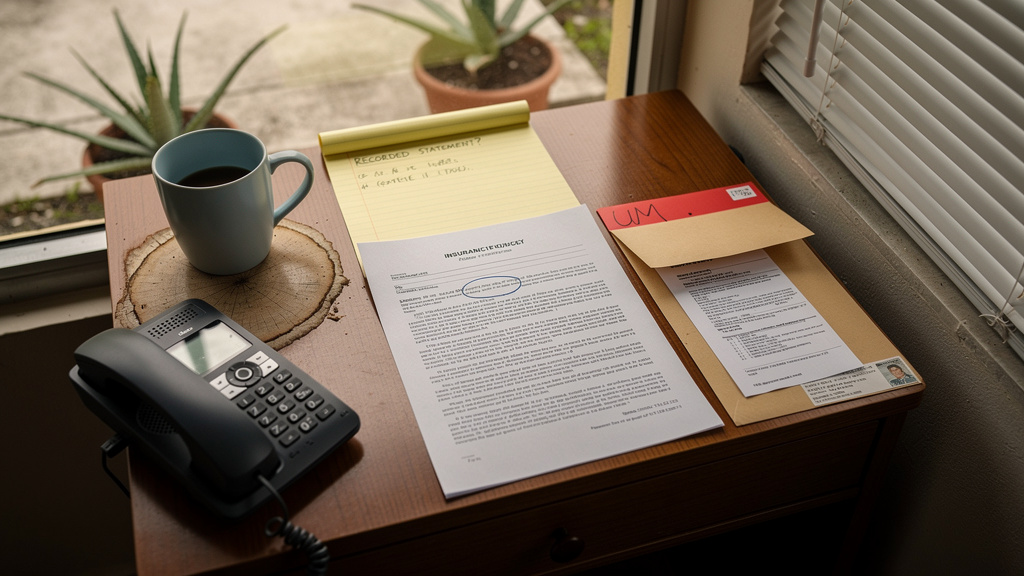
Unlike a recorded statement request from the at-fault driver’s insurer, which you can refuse, your own insurance company’s request is different. Many Florida auto policies include a duty-to-cooperate clause that may require you to give a statement as a condition of receiving uninsured motorist (UM) benefits. That does not mean you must call back unprepared and unrepresented. It means you should have a lawyer present before you say a word, because your insurer can use that recording against you just as aggressively as any opposing carrier would.
Why is this situation different from the other driver’s insurance calling me?
You have no contract with the at-fault driver’s insurer, so you owe it nothing. But you do have a contract with your own insurer. When you file a UM claim under Florida Statute § 627.727, you are making a first-party insurance claim, meaning you are asking your own company to pay for harm caused by someone who had no liability coverage. Your insurer then steps into the shoes of that uninsured driver and becomes your financial adversary, even though you pay it premiums. UM claims are adversarial by design. The two-year deadline in Florida Statute § 95.11 applies to a negligence lawsuit against the at-fault driver, while a UM claim against your own insurer is a contract claim with its own deadline that a lawyer should confirm, and your own carrier will scrutinize your claim as closely as if it represented the person who hit you. For contrast, see our guidance on recorded statements from the other driver’s insurer.
Does my policy actually require me to give a recorded statement?
The obligation comes from your insurance policy, not state law. Many Florida auto policies include a “duty to cooperate” clause that may require you to assist your insurer in investigating your claim. This may include giving a recorded statement or even submitting to a more formal examination under oath (EUO). Refusing to cooperate could give your insurer grounds to deny your UM claim outright. Florida Statute § 627.736(6)(g) shows how cooperation duties appear in personal injury protection (PIP) claims, and similar language often appears in UM sections. Policy language varies; read your own policy before assuming what is or is not required. If you are more comfortable speaking Spanish, it may be possible to arrange for the statement to be conducted in Spanish, and a Spanish-speaking attorney from our Hialeah office may be able to be present, ask about this when you call.
What is the adjuster actually listening for when they record you?
The adjuster has already reviewed your file and is listening for four key things. First, any admission that you share fault for the crash, even slightly, because under Florida’s modified comparative negligence rule (Fla. Stat. § 768.81), your recovery is reduced by your percentage of fault and eliminated entirely if you are more than 50 percent at fault. Second, mentions of prior injuries or conditions that mirror your current complaints, which the insurer can use to argue your pain isn’t new. Third, gaps in treatment that suggest your injuries weren’t serious. Fourth, inconsistencies between your story now and what medical records or the police report later show. Remember: your own UM insurer is handling this interview with the same professional intent as any opposing adjuster. They also care deeply about whether your injuries meet the permanent-injury threshold under Fla. Stat. § 627.737(2), because without that, your pain-and-suffering damages vanish.
Can my own insurance company raise the same defenses as the driver who hit me?
Yes. Under Florida Statute § 627.727, your UM insurer “steps into the shoes” of the uninsured driver and can raise every defense that driver would have had. That includes disputing liability, arguing you were partly at fault (Fla. Stat. § 768.81), challenging whether your injuries are truly permanent (Fla. Stat. § 627.737(2)), and even questioning whether the other driver was legally uninsured. If the crash involved a hit-and-run or phantom vehicle, the insurer may contest whether legal requirements were met. There’s also a critical trap: if you settle with the at-fault driver’s insurer without first giving your UM carrier written notice by certified mail and waiting 30 days under Fla. Stat. § 627.727(6), you may lose your UM claim entirely. While Florida’s unfair insurance trade practices law (Fla. Stat. § 626.9541) prohibits unfair claim settlement practices, aggressive but lawful defense of your claim is standard practice.
Will filing a UM claim get me canceled or raise my premium?
Florida law generally prohibits insurers from canceling your policy, refusing to renew it, or raising your premium solely because you filed a UM claim for an accident you did not cause. This protection falls under the state’s ban on unfair insurance trade practices in Fla. Stat. § 626.9541(1)(o). However, insurance contracts and rating plans can be complex. If you suspect retaliation after filing a legitimate UM claim, consult an attorney. Do not let fear of rate changes stop you from pursuing benefits you paid for, if the other driver had no insurance, your UM coverage exists precisely for this scenario.
How do you give a recorded statement safely if you have to give one?
First, do not call back the same day. Tell the adjuster you are scheduling the statement and will be in touch. Second, consult a personal injury attorney before the call, your lawyer can attend, set ground rules, and object to improper questions. Third, if Spanish is your preferred language, explore whether the statement can be conducted in Spanish with a Spanish-speaking attorney from our Hialeah office present, this may be possible, so ask when you call. Fourth, review the police report, your medical records, and a timeline of events beforehand. Fifth, answer only what is asked; do not volunteer information about prior injuries, treatment gaps, or fault. Sixth, if you do not know an answer, say so, do not guess. Seventh, stick to facts you personally observed; do not speculate about speed or the other driver’s intentions. Remember: your recorded statement is permanent and will be compared against every document in your file. Also, do not delay your 14-day PIP treatment window (Fla. Stat. § 627.736) while arranging the statement, and keep filing deadlines in mind: the two-year deadline in Fla. Stat. § 95.11 applies to suing the at-fault driver, and a lawyer can confirm the separate deadline for your UM claim.
Frequently asked questions
Can I bring a lawyer with me to a recorded statement for a UM claim?
Generally, yes. You can ask to have your attorney present during the statement. A lawyer can help ensure you are not misled, stop improper questioning, and keep your answers focused and accurate.
What happens if I refuse to give a recorded statement to my own UM insurer?
Your insurer may claim you breached the duty-to-cooperate clause in your policy, which could lead to denial of your UM claim. Because this obligation comes from your contract, not state law, you must review your specific policy language.
My insurer says the other driver’s crash was my fault too. Can they reduce my UM payout?
Yes. Under Florida’s modified comparative negligence rule (Fla. Stat. § 768.81), your recovery is reduced by your percentage of fault. If you are found more than 50 percent at fault, you cannot recover anything.
I already accepted a settlement from the at-fault driver’s insurer. Did I lose my UM claim?
Possibly. Florida law requires you to give your UM insurer written notice by certified mail before accepting any third-party settlement and allow them 30 days to respond under Fla. Stat. § 627.727(6). Skipping this step can waive your UM rights.
Does filing a UM claim count against me for future insurance rates?
Generally, no, if the accident was not your fault, Florida law protects you from premium increases or cancellation solely for filing a UM claim. If you believe your insurer retaliated unfairly, consult an attorney.
Related reading: The driver who hit me in Hialeah has no insurance. What now? · The other driver’s insurance adjuster wants a recorded statement. Do I have to give one? · The 14-day PIP rule in Florida: what happens if you wait to see a doctor after a Hialeah car accident
Hurt in an accident in Hialeah? Call Wolfson & Leon at 305-965-3766 for a free consultation. We speak Spanish, and there is no fee unless we win.
Key facts
- Florida Statute § 627.727 governs uninsured motorist coverage and requires insurers to offer it unless the named insured rejects it in writing. Source: Fla. Stat. § 627.727
- In a UM claim, your insurer steps into the shoes of the uninsured driver and may raise every defense that driver could have raised, including comparative fault. Source: Fla. Stat. § 627.727
- Florida's modified comparative negligence rule reduces your recovery by your share of fault and bars recovery entirely only if you are found more than 50 percent at fault. Source: Fla. Stat. § 768.81
- An insurer that uses unfair or deceptive claims-settlement tactics may be subject to Florida's prohibition on unfair insurance trade practices. Source: Fla. Stat. § 626.9541
- To recover pain and suffering damages from an uninsured driver (and therefore through your UM policy), the injured person generally must meet the permanent-injury threshold. Source: Fla. Stat. § 627.737(2)
Frequently asked questions
Can I bring a lawyer with me to a recorded statement for a UM claim?
Yes. There is no rule preventing you from having an attorney present during a recorded statement with your own insurance company, and doing so is strongly advisable. A lawyer can object to improper questions, help you avoid volunteering harmful information, and ensure the session stays within the scope of your policy's cooperation obligation. If you are in the Hialeah area, contact the firm to discuss having an attorney attend with you.
What happens if I refuse to give a recorded statement to my own UM insurer?
If your policy includes a duty-to-cooperate clause that specifically requires a recorded statement, refusing without a valid reason can give your insurer grounds to deny or delay your UM claim. Refusal is not the same as the situation with the at-fault driver's insurer, where you generally owe nothing. Read your policy carefully and speak with an attorney before deciding to refuse, because the consequences can be serious.
My insurer says the other driver's crash was my fault too. Can they reduce my UM payout?
Yes. Under Florida's modified comparative negligence law (Fla. Stat. § 768.81), your recovery is reduced by your percentage of fault. If you are found more than 50 percent responsible for the crash, you recover nothing. Because your UM insurer steps into the shoes of the uninsured driver under Fla. Stat. § 627.727, it can, and often does, argue that you share fault in order to reduce the amount it owes you.
I already accepted a settlement from the at-fault driver's insurer. Did I lose my UM claim?
Possibly, but not necessarily. Florida law requires you to give your UM carrier written notice by certified mail before finalizing a settlement with the at-fault driver's liability insurer, and the UM carrier has a statutory window to respond. If you signed a release without providing that notice, whether your UM claim survives depends on the specific facts, the policy language, and whether the carrier was prejudiced. Get an attorney to review the situation immediately, do not assume the claim is gone.
Does filing a UM claim count against me for future insurance rates?
Florida law prohibits certain unfair insurance practices under Fla. Stat. § 626.9541(1)(o), and insurers are generally not permitted to penalize you for filing a claim on an accident you did not cause. However, insurance rating practices can be complex, and results vary by carrier and circumstances. If you believe your insurer is retaliating against you for a legitimate UM claim, consult an attorney to evaluate whether the conduct crosses into prohibited territory.
This article is general information about Florida law, not legal advice, and reading it does not create an attorney-client relationship. Every case is different and past results do not guarantee a similar outcome. For advice about your situation, call Wolfson & Leon at 305-965-3766 for a free consultation.
Also available in: Versión en español
 Personal injury
 Seven Myths Hialeah Crash Victims Hear, and What Florida Law Actually Says
No, that four-year window closed on March 24, 2023. Under Fla. Stat. § 95.11, most Hialeah crash victims now have only two years from the date of…
 Personal injury
 What Happens After You File a UM Claim With Your Own Insurance Company
Once you file a UM claim, your own insurance company opens a file, assigns an adjuster, and immediately begins investigating the crash from the…
 Personal injury
 Your Bilingual Lawyer Usually Can't Interpret When You Testify Under Oath
Yes, even if your lawyer is fully bilingual, you will usually need a separate, qualified interpreter whenever you give sworn testimony. Your…