
How Much Does an Accident Lawyer Charge in Hialeah, Florida?
Personal injury lawyers in Hialeah charge nothing upfront and no attorney fee at all unless they recover money for you. The fee is a percentage of your recovery, capped by Florida Bar Rule 4-1.5(f)(4)(B) at 33⅓ percent before the defendant files an answer or demands arbitration, and at 40 percent after that point through trial, on the first one million dollars recovered. Case costs such as filing fees and expert witnesses are a separate item; many firms advance them on your behalf and deduct them from the recovery at the end, and your written agreement should say how costs are handled.
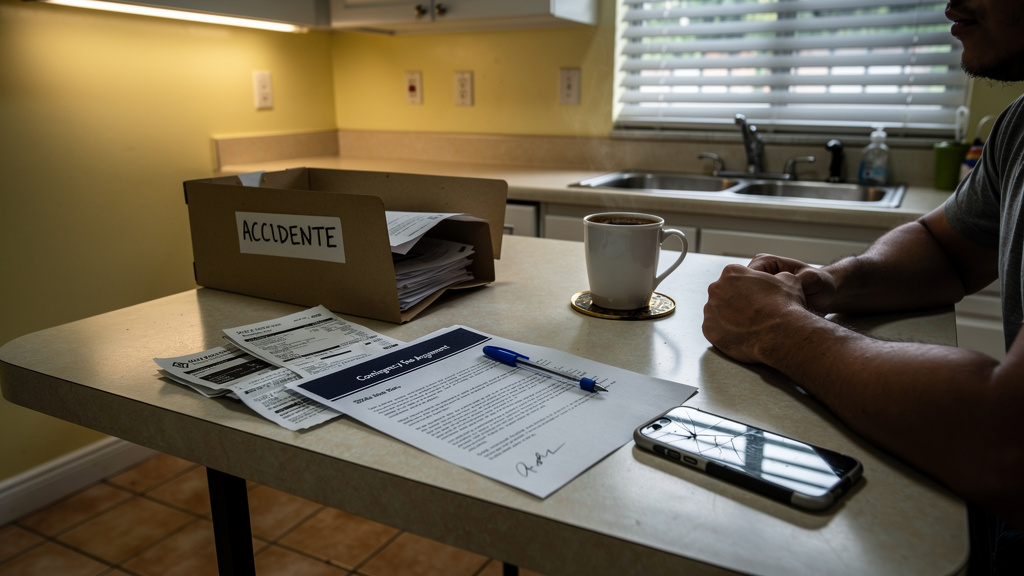
Personal injury lawyers in Hialeah charge nothing upfront and collect no attorney fee unless they recover money for you. The fee is a percentage of your recovery, capped by Florida Bar Rule 4-1.5(f)(4)(B), not set arbitrarily by the firm. That distinction matters: the ceiling on what any lawyer can charge you is set by the Florida Bar, and every agreement must state the exact percentage in writing before work begins.
What is the short answer on how Hialeah accident lawyers get paid?
The model is called a contingency fee. You pay nothing to start, nothing during the case, and no attorney fee at all if there is no recovery. Wolfson & Leon charges nothing upfront, and all consultations are free.
A common concern on legal forums goes something like this: “I don’t know whether a 33 percent fee actually buys me anything.” That is a fair question, and the answer is straightforward. Yes, the percentage comes out of the recovery. But no money leaves your pocket before then. The lawyer carries the financial risk of the case. If the case produces nothing, the lawyer collects nothing.
The Florida Bar, not the law firm, sets the maximum a lawyer can charge in a personal injury contingency case. The firm cannot simply name a number higher than the Bar allows. That cap is written into the rules that govern every Florida attorney.
What are the maximum percentages the Florida Bar allows?
Florida Bar Rule 4-1.5(f)(4)(B) sets two main tiers based on how far a case progresses.
Tier one applies before the defendant files an answer to a lawsuit or demands arbitration, whichever comes first. At that stage, the maximum fee is 33⅓ percent of the first one million dollars recovered.
Tier two applies after the defendant files an answer or demands arbitration, through trial. At that point, the maximum rises to 40 percent of the first one million dollars recovered.
For recoveries above one million dollars, the rule sets lower percentages on the portion above that amount. Ask the lawyer to show you in writing how those tiers would apply to your case.
These are caps, not automatic rates. Your written agreement must state which percentage applies at each stage. Before you sign anything, ask the lawyer directly: “What exact percentage applies if the case settles early, and what does it become if we file suit or go to trial?” If the answer is not in the written agreement, it should be.
Are case costs the same as the attorney fee, and who pays them while my case is active?
They are not the same, and the difference directly affects how much you take home.
The attorney fee is the percentage. Case costs are the actual out-of-pocket expenses the firm incurs to build your case. Those include court filing fees, police report requests, medical record retrieval, deposition transcripts, expert witness fees for accident reconstructionists and medical experts, and other investigation expenses. Many firms advance these costs so you pay nothing while the case is active; ask how the firm you are considering handles them. When costs are advanced, they are usually repaid from the recovery at closing, in addition to the attorney percentage.
Here is where the math matters. On a $100,000 settlement with $10,000 in costs, the amount you receive is different depending on whether costs are deducted before or after the fee percentage is applied. If costs come out first, the percentage is applied to $90,000. If costs come out after, the percentage is applied to the full $100,000 and then costs are deducted from what remains. On larger cases, that difference can be significant.
Florida Bar Rule 4-1.5(f) requires that the written agreement state how costs are handled, including whether they are deducted before or after the fee is calculated. Read that section carefully, and ask the lawyer which method applies to your agreement before you sign.
What happens if the lawyer does not recover anything, do I still owe a fee?
No attorney fee is owed if there is no recovery. That is the basic rule of a contingency arrangement, and it applies at Wolfson & Leon.
Advanced costs are a separate question, and it is one you must ask before signing. The written agreement must address what happens to costs the firm advanced on your behalf if the case produces no recovery. Some agreements hold the client responsible for those costs; others do not. Ask this question directly: “Who is responsible for advanced costs if there is no recovery?”
The no-fee-without-recovery structure also aligns the lawyer’s interest with yours. The lawyer only gets paid when you get paid. That alignment does not guarantee any result, but it does mean the lawyer has a direct financial reason to pursue the strongest possible outcome for your case.
Do not sign any agreement without getting a plain answer to the costs question.
How do medical liens and your own PIP coverage affect what you actually take home?
The gross settlement number is not your take-home amount. Before you receive a check, several deductions come out: the attorney fee, advanced costs, and then any medical provider liens or health insurance claims against your recovery.
Florida’s personal injury protection law, Florida’s 14-day PIP rule under FS 627.736, requires that you see a doctor within 14 days of the crash or your PIP pays nothing. PIP covers 80 percent of reasonable medical bills and 60 percent of lost wages, up to $10,000 when a treating doctor confirms an emergency medical condition. If no emergency medical condition is found, the cap drops to $2,500. Your own PIP policy pays first. If you have no PIP, a resident-relative’s policy in your household applies next. If neither exists, other rules decide whose PIP applies; for example, a pedestrian or cyclist who is a Florida resident may then be covered by the PIP of the vehicle that struck them.
A point many people miss: pain and suffering damages from the at-fault driver require proof of a permanent injury, significant scarring, or permanent loss of a bodily function under Florida’s serious injury threshold for pain and suffering. Settling before your doctor has made that determination can cost you access to those damages entirely.
Before you sign any release, ask your attorney two questions: “Will you negotiate my medical bills and liens down?” and “Will I receive a line-by-line disbursement sheet before I sign the release?” You are entitled to see every deduction before anything is final.
What questions should I bring to the free consultation?
Bring these six questions. Write them down. Do not leave the consultation without answers to each one.
- What exact percentage applies if the case settles before an answer is filed, and what does it become if we have to file suit or go to trial?
- Is the fee calculated before or after case costs are subtracted?
- Who advances case costs, and what do I owe for those costs if there is no recovery?
- Will you negotiate my medical bills and liens to increase my net recovery?
- Will I receive a written disbursement statement listing every deduction before I sign the release?
- Has the two-year deadline from the crash date been checked on my case?
That last question connects to Florida’s two-year statute of limitations under FS 95.11. For injuries that occurred on or after March 24, 2023, you have two years from the date of injury to file a negligence lawsuit. Miss that deadline and the right to recover is generally gone.
One more protection worth knowing: Florida Bar Rule 4-1.5(f) gives you three business days after signing a contingency fee agreement to cancel it in writing without penalty. You are not locked in the moment you sign.
Wolfson & Leon offers free consultations, handles cases in Spanish, and can meet you at the office at 1840 W 49th St, Suite 734, Hialeah. Learn what to expect at that first meeting before you call.
Frequently asked questions
Is it worth hiring a lawyer if the fee is 33 percent of my settlement?
No one can promise that hiring a lawyer will increase your recovery, but a lawyer can help you understand every type of damages Florida law allows and handle negotiations with the insurer. The more important question is whether the lawyer will negotiate your medical liens down and pursue all available damages, including pain and suffering under FS 627.737(2), which requires proof of a permanent injury and is harder to document without legal help. The value of representation depends on the facts of your specific case, which is why the consultation exists.
Does the percentage go up if my case goes to trial?
Yes. Under Florida Bar Rule 4-1.5(f)(4)(B), the maximum fee increases from 33⅓ percent to 40 percent of the first one million dollars recovered once the defendant files an answer or demands arbitration. Your written agreement must state both percentages so there are no surprises if the case moves forward.
What is the deadline to file a car accident lawsuit in Hialeah?
Under FS 95.11, you have two years from the date of injury to file a negligence lawsuit if your injuries occurred on or after March 24, 2023. Missing that deadline generally ends any right to recover through the courts. Check this date at your free consultation, not later.
Does my own insurance pay anything after a crash in Florida, even if the other driver caused it?
Yes. Florida is a no-fault state, and your own PIP coverage pays 80 percent of your reasonable medical bills and 60 percent of lost wages up to the applicable cap, regardless of who caused the crash. You must see a doctor within 14 days of the crash or PIP pays nothing. For more detail on how PIP coverage works after a Hialeah crash, review the linked resource.
What if the at-fault driver has no insurance or not enough coverage?
Your case is not over. If you have uninsured or underinsured motorist coverage, your own policy can pay when the at-fault driver’s coverage is absent or insufficient. That coverage must have been rejected in writing when you bought your policy, so many people have it without realizing it. If the at-fault driver carried no coverage at all, your options after being hit by an uninsured driver in Hialeah depend on your own policy and the specific facts of the crash.
Hurt in an accident in Hialeah? Call Wolfson & Leon at 305-965-3766 for a free consultation. We speak Spanish, and there is no fee unless we win.
Key facts
- Florida Bar Rule 4-1.5(f)(4)(B) caps contingency fees at 33⅓ percent of the first one million dollars recovered before the defendant files an answer or demands arbitration, and at 40 percent after that point through trial. Source: Rule Regulating The Florida Bar 4-1.5(f)(4)(B)
- A contingency fee agreement in a Florida personal injury case must be in writing, signed by both the client and the lawyer before work begins, and must state the exact percentage at each stage and how costs are handled. Source: Rule Regulating The Florida Bar 4-1.5(f)
- Florida law gives you three business days after signing a contingency fee agreement to cancel it in writing without penalty. Source: Rule Regulating The Florida Bar 4-1.5(f)
- Pain and suffering damages from the at-fault driver require proof of a permanent injury, significant scarring, or permanent loss of an important bodily function. Source: FS 627.737(2)
- A negligence lawsuit for injuries that occurred on or after March 24, 2023 must be filed within two years of the date of injury or the right to recover is generally lost. Source: FS 95.11
Frequently asked questions
Is it worth hiring a lawyer if the fee is 33 percent of my settlement?
No one can promise that hiring a lawyer will increase your recovery, but a lawyer can help you understand every type of damages Florida law allows and handle negotiations with the insurer. Insurance adjusters are trained negotiators, and without a lawyer you may not know, for example, that pain and suffering damages from the at-fault driver require proof of a permanent injury under Florida law. The contingency model also means the lawyer's financial interest is aligned with yours, they only get paid when you do. Whether representation makes sense in your specific case is a question to raise during the free consultation.
Does the percentage go up if my case goes to trial?
It can. Florida Bar Rule 4-1.5(f)(4)(B) sets one cap before the defendant files an answer or demands arbitration, and a higher cap after that point through trial. The exact percentage that applies at each stage must be written into your fee agreement before you sign. Always ask: 'What does the percentage become if we have to file suit, and again if we go to trial?'
What is the deadline to file a car accident lawsuit in Hialeah?
For injuries that occurred on or after March 24, 2023, Florida law gives you two years from the date of the injury to file a negligence lawsuit under FS 95.11. Missing that deadline generally eliminates the right to recover anything through the courts. Evidence also disappears and witnesses become harder to locate over time, so it is important to contact a lawyer as soon as possible after a crash.
Does my own insurance pay anything after a crash in Florida, even if the other driver caused it?
Yes. Florida's Personal Injury Protection law under FS 627.736 requires your own PIP coverage to pay first, regardless of who caused the crash. PIP covers 80 percent of reasonable medical bills and 60 percent of lost income, up to $10,000 if a treating doctor documents an emergency medical condition, or up to $2,500 otherwise. You must begin treatment within 14 days of the crash or PIP pays nothing. PIP does not cover pain and suffering, those damages come from the at-fault driver's liability coverage, and only if your injury meets the permanent-injury threshold under FS 627.737(2).
What if the at-fault driver has no insurance or not enough coverage?
Florida law under FS 627.727 allows drivers to purchase uninsured and underinsured motorist coverage, known as UM coverage, which can pay when the at-fault driver has no bodily injury policy or one with limits too low to cover your damages. UM coverage must be rejected in writing if you do not want it. If the at-fault driver's policy limits fall short, your own UM coverage may be the primary path to additional compensation, which is one reason it is important to review your own policy with a lawyer before accepting any offer.
This article is general information about Florida law, not legal advice, and reading it does not create an attorney-client relationship. Every case is different and past results do not guarantee a similar outcome. For advice about your situation, call Wolfson & Leon at 305-965-3766 for a free consultation.
Also available in: Versión en español
 Personal injury
I Fell at Work in Hialeah: Do I Need Workers' Comp or a Personal Injury Lawyer?
Workers' compensation almost always covers a fall at work in Florida and is usually your only legal claim against your own employer. But if someone…
 Personal injury
Hit by a Driver With No Insurance in Florida: What Are Your Options?
Your own insurance is almost always the first place to look. Florida requires your PIP coverage to pay 80 percent of your reasonable medical bills…
 Personal injury
Are Personal Injury Settlements Taxable in Florida? What Hialeah Residents Need to Know
For most Florida residents, compensation received for a physical injury or physical sickness is not subject to federal income tax under IRC Section…