
What Your Lawyer Does First After an Uber or Lyft Crash in Florida
In the first weeks after an Uber or Lyft crash, your lawyer's job is to find every insurance policy that could pay, lock down the app data that proves which one applies, and take over all calls from adjusters before you say something that shrinks your claim. Everything else, negotiating, filing suit, depends on getting those three things right immediately.
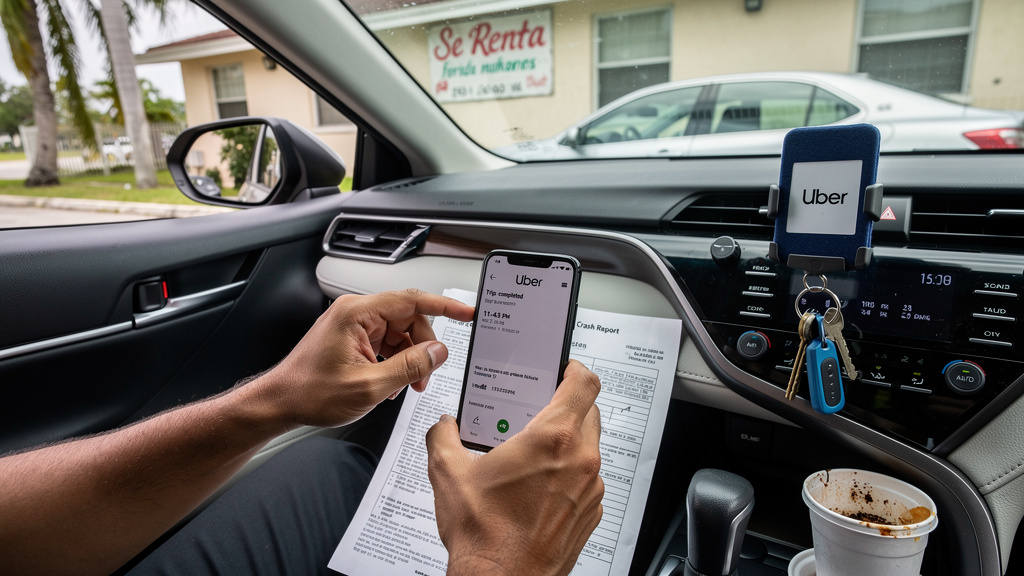
In the first weeks after an Uber or Lyft crash in Florida, your lawyer’s job is not to file a lawsuit. It is to find every insurance policy that could pay, lock down the app data that proves which one applies, and take over all calls from adjusters before you say something that shrinks your claim. Everything else, negotiating, filing suit, depends on getting those three things right immediately.
Which of the three app periods was the Uber or Lyft driver in when the crash happened?
Florida law divides every rideshare trip into three coverage periods. The exact moment of the crash determines which insurer is responsible and how much money is available. Period 1: the driver’s app is off. Only the driver’s personal auto policy applies; Uber and Lyft owe nothing. Period 2: the app is on, but the driver has not yet accepted a ride. Florida law requires at least $50,000 per person, $100,000 per accident, and $25,000 for property damage in liability coverage, plus PIP, which can come from the driver’s own policy, Uber’s or Lyft’s policy, or a combination. Period 3: the driver has accepted a trip or has a passenger in the vehicle through drop-off. Then, Uber or Lyft’s $1,000,000 commercial liability policy is primary, and the rideshare company’s PIP and uninsured/underinsured motorist coverage also apply. Insurers often dispute which period was active. That is why the app data matters so much. Get this wrong and your lawyer could spend weeks chasing the wrong insurer while deadlines pass.
How does a lawyer get Uber or Lyft to hand over the trip and app data?
The driver’s app data, GPS timestamps, trip status at impact, whether a ride had been accepted, is controlled by Uber or Lyft, not by the driver or passenger. Your lawyer must act fast. Platforms may not keep all of this data indefinitely. To stop this, your lawyer sends a preservation and litigation hold letter within the first day or two of being hired. This letter demands that Uber or Lyft keep GPS records, trip logs, driver activity logs, in-app messages, and any safety data tied to your crash. Without this step, key evidence could vanish before a subpoena arrives. While the exact internal response varies by company, sending this demand early is standard practice and critical to proving which coverage period applied.
What policies does your lawyer line up, and whose PIP actually pays first?
A rideshare crash involves multiple insurance layers. Your lawyer identifies and sequences them all: your own PIP policy, your own UM/UIM coverage, the driver’s personal auto policy, and the rideshare company’s commercial policy. Under Florida law, your own PIP pays first, not the driver’s. If you have no PIP, then a relative living with you may cover you. Only if neither exists does another vehicle’s PIP apply: for a passenger, usually the PIP on the vehicle you were riding in; for a pedestrian or cyclist who is a Florida resident, the PIP of the vehicle that struck them. PIP covers 80 percent of reasonable medical bills and 60 percent of lost income, up to $10,000 if a doctor finds an emergency medical condition; otherwise, it caps at $2,500. Uninsured/underinsured motorist (UM/UIM) coverage is optional but can pay when the at-fault driver lacks bodily injury coverage or has too little. Your household UM policy may still apply even if you were riding in someone else’s car. Wolfson & Leon advances case costs such as medical records and reports, so you do not pay them up front.
How does your lawyer get the crash report during the 60-day confidential period?
Florida law keeps crash reports confidential for 60 days after the crash. But parties, their insurers, and their attorneys can obtain a copy during that time. In Hialeah and unincorporated Miami-Dade, the report usually comes from the Hialeah Police Department or the Miami-Dade Sheriff’s Office, and copies are requested through the Florida Crash Portal; confirm the responding agency with the officer at the scene. Reports usually appear about ten days after the crash, though timing varies. Your lawyer requests it immediately on your behalf and does not wait for the 60 days to end. The report records the officer’s observations, witness names, vehicle details, and often a preliminary view of what happened. It is foundational to building your claim. The firm advances the cost to get it.
Why does your lawyer take over every adjuster call, and what happens if you talk to them yourself?
Multiple adjusters will call you quickly, your PIP carrier, the driver’s personal insurer, and Uber’s or Lyft’s commercial claims team. Each aims to reduce or deny payment. Adjusters may ask questions that make your injuries sound minor, pre-existing, or inconsistent with your story. Recorded statements become permanent evidence. You are not required to give a recorded statement to any insurer except your own, and even then, only about specific issues like PIP benefits. Once you hire us, all adjuster calls go to our office. Save any voicemails or emails from insurers and forward them to us without replying.
What do you still need to do while your lawyer handles the legal work?
You have three obligations no lawyer can fulfill for you. First, begin medical treatment within 14 days of the crash. Miss that deadline and your PIP pays nothing, even if you felt fine at first. Second, keep every follow-up appointment. Gaps in care let adjusters argue your injury healed quickly. Third, save all receipts: prescriptions, crutches, gas to get to appointments, anything out of pocket. These add up in your damages. And stay completely off social media. Any post showing you active, traveling, or smiling can be used against you. Do not mention the crash, your pain, or your recovery online until the case closes.
Frequently asked questions
I was a passenger in an Uber that got rear-ended in Miami. Whose insurance am I supposed to deal with?
Your own PIP pays your initial medical bills first, regardless of fault. If another driver rear-ended the Uber, that driver’s bodily injury coverage is the main fault-based claim; because you were on a trip (Period 3), Uber’s $1,000,000 liability policy applies if the Uber driver was at fault, and Uber’s uninsured motorist coverage may apply if the other driver has little or no coverage.
Should I just take what Uber is offering me and settle, or wait?
Do not accept any settlement offer before speaking with a lawyer. Early offers are often far below what your claim is worth. Medical bills, lost wages, and future pain may not be fully known yet.
Does it matter if the Uber driver was just waiting for a ride and hadn’t picked anyone up yet?
Yes. That would be Period 2. Required coverage drops to at least $50,000 per person, $100,000 per accident, and $25,000 for property damage, plus PIP, and it can come from the driver’s policy, the rideshare company’s policy, or both. Proving the exact app status at the moment of impact is essential, and requires preserved app data.
What if the other driver had no insurance and Lyft is saying their policy doesn’t apply?
Your own uninsured motorist (UM) coverage may apply, even as a passenger. Florida law allows this if you have UM on your own auto policy and did not reject it in writing. Your lawyer will also re-examine whether the crash fell into Period 3, where Lyft’s uninsured motorist coverage could respond.
How long do I have to file a lawsuit if the insurance companies won’t pay fairly?
For crashes on or after March 24, 2023, you have two years from the date of injury to file a negligence lawsuit under Florida Statute 95.11. This deadline is strict. Do not wait until the last month to seek legal help.
Related reading: I was in an Uber or Lyft accident in Hialeah. Whose insurance pays? · The driver who hit me in Hialeah has no insurance. What now? · After a truck crash, the trucking company’s evidence starts disappearing. Here is how a preservation letter stops it · I was a passenger in an Uber or Lyft that crashed in Hialeah. Who pays for my injuries?
Hurt in an accident in Hialeah? Call Wolfson & Leon at (305) 285-7071 for a free consultation. We speak Spanish, and there is no fee unless we win.
Key facts
- Florida law divides a rideshare trip into three coverage periods; the exact moment of the crash determines which policy, and how much money, is available to you. Source: Fla. Stat. § 627.748(7), (7)(b), (7)(c)
- Florida crash reports are confidential for 60 days after the crash, but parties, their insurers, and their lawyers may obtain a copy during that window. Source: Fla. Stat. § 316.066
- PIP pays 80 percent of reasonable medical bills and 60 percent of lost income up to $10,000 if a doctor finds an emergency medical condition, but only if you begin treatment within 14 days of the crash; miss that window and PIP pays nothing. Source: Fla. Stat. § 627.736(1)(a)
- Uninsured and underinsured motorist coverage is optional in Florida and must be rejected in writing; it can pay when the at-fault driver carries no bodily injury coverage or not enough to cover your injuries. Source: Fla. Stat. § 627.727
- Crash reports from Hialeah Police or the Miami-Dade Sheriff's Office are submitted through the Florida Crash Portal and typically become available roughly ten days after the crash; confirm the reporting agency with the officer at the scene. Source: Florida Crash Portal (verify agency name with responding officer)
Frequently asked questions
I was a passenger in an Uber that got rear-ended in Miami. Whose insurance am I supposed to deal with?
Your own PIP policy pays first for your initial medical bills, regardless of who caused the crash, not the Uber driver's insurer and not the other driver's insurer. If the Uber driver was on an active trip when the crash happened, Uber's commercial liability policy provides up to $1,000,000 in coverage for injuries caused by the rideshare driver's fault. If a third driver caused the crash, that driver's bodily injury liability coverage is the primary target. A lawyer sorts the sequence before you call anyone.
Should I just take what Uber is offering me and settle, or wait?
Do not accept any settlement offer before your treatment is complete and your doctor has assessed whether your injuries are permanent. Florida requires a permanent injury, significant scarring, or permanent loss of a bodily function to recover pain and suffering from an at-fault driver under Fla. Stat. § 627.737(2), and that determination takes time. Settling early locks you into a number that cannot be revisited even if your condition worsens. Let your lawyer evaluate the full value of the claim first.
Does it matter if the Uber driver was just waiting for a ride and hadn't picked anyone up yet?
Yes, it changes the coverage significantly. Under Fla. Stat. § 627.748(7)(b), when the driver is logged into the app but has not yet accepted a ride, the required coverage drops to at least $50,000 per person, $100,000 per incident, and $25,000 for property damage, plus PIP, and it can come from the driver's own policy, the rideshare company's policy, or a combination. Compare that to an active trip, where Uber and Lyft's full $1,000,000 commercial policy is primary. Which period applied at the exact moment of impact is the first question your lawyer investigates, using the driver's app data.
What if the other driver had no insurance and Lyft is saying their policy doesn't apply?
This is exactly the situation where your own uninsured motorist coverage under Fla. Stat. § 627.727 becomes critical. UM coverage is optional in Florida and must have been rejected in writing when you bought your policy; if you did not reject it, you likely have it. Your household UM policy can apply even when you were a passenger in someone else's vehicle. Your lawyer identifies every UM policy in your household as part of the initial coverage analysis.
How long do I have to file a lawsuit if the insurance companies won't pay fairly?
For crashes that occurred on or after March 24, 2023, Florida gives you two years from the date of the crash to file a negligence lawsuit under Fla. Stat. § 95.11. Missing that deadline permanently bars your claim no matter how strong it is. Because rideshare cases require gathering app data, crash reports, and medical records before a demand can even be sent, waiting until the deadline is close creates serious risk. Contact a lawyer as soon as possible after the crash.
This article is general information about Florida law, not legal advice, and reading it does not create an attorney-client relationship. Every case is different and past results do not guarantee a similar outcome. For advice about your situation, call Wolfson & Leon at (305) 285-7071 for a free consultation.
Also available in: Versión en español
 Uber and Lyft accidents
 Hurt in an Uber Crash and Still in the Hospital: How to Hire a Lawyer From Bed
Yes. A family member can call Wolfson & Leon on your behalf any time of day, and an attorney can come to your hospital room or your home for a free…
 Uber and Lyft accidents
 Do I Need a Lawyer for an Uber Accident Claim, or Can I Handle It Myself?
You can handle an Uber accident claim yourself when your injuries are minor, your medical bills stay within your PIP benefits (up to $10,000, or…
 Uber and Lyft accidents
 What to Bring to Your Uber Accident Lawyer Consultation in Hialeah
Bring your in-app trip receipt and screenshots, the crash report number from the agency that worked the scene, your auto insurance declarations…