
What Information Should I Collect After a Crash with a Semi-Truck?
A semi-truck crash requires a completely different checklist than a regular car accident. You need the truck's USDOT number, the carrier name printed on the cab door, the trailer and unit numbers, and the driver's commercial license details, information that does not appear on a standard crash form. Act within days: the trucking company's rapid-response team may already be at the scene, and electronic data that proves fault can be overwritten within weeks.
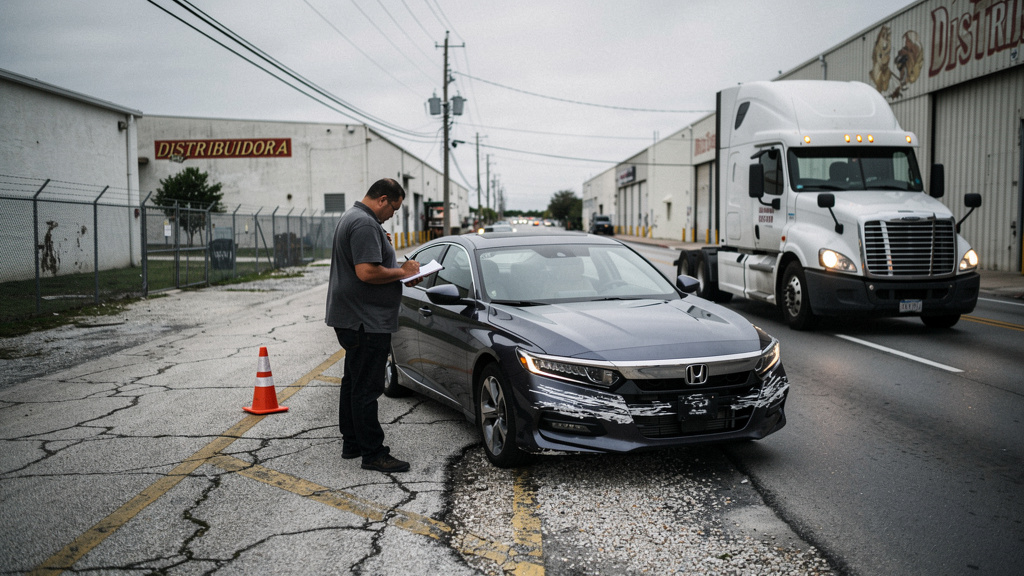
A semi-truck crash requires a completely different checklist than a regular car accident. You need the truck’s USDOT number, the carrier name printed on the cab door, the trailer and unit numbers, and the driver’s commercial license details, information that does not appear on a standard crash form. Act within days: the trucking company’s rapid-response team may already be at the scene, and electronic data that proves fault can be overwritten within weeks.
What truck-specific identifiers do I need to write down at the scene?
A regular car accident checklist won’t work for a semi-truck crash. Commercial trucks carry unique identifiers that are essential to tracing ownership, insurance, and compliance records. Police reports often omit these details, so photograph or write them down before the vehicles are moved. Here’s what to capture:
- USDOT number: Required on most commercial trucks; it usually appears on the cab doors, including the driver’s side.
- MC (Motor Carrier) number: May appear next to the USDOT number.
- Company name: Painted or decaled on the trailer door or side panel, note exact spelling; leased trailers sometimes show a different name than the tractor.
- Trailer number: Stenciled in large characters on the rear doors.
- Tractor/unit number: Usually on the cab door or visible through the windshield.
- License plates: Record both cab and trailer plates separately, including the issuing state, they may differ.
What driver information am I legally entitled to, and what if the truck leaves?
Under Florida law, every driver must provide their name, address, vehicle registration, and proof of insurance at the scene [Fla. Stat. § 316.062]. For a commercial truck driver, also ask for:
- CDL number and issuing state
- Employer name
- Dispatcher phone number
The CDL is critical because it links to a federal driver qualification file. If the truck leaves before you get this information, it may be a hit-and-run, a serious crime under [Fla. Stat. § 316.027]. Immediately call 911, stay on the line, and describe the truck’s USDOT number, company name, trailer number, direction of travel, and any dashcam footage from your vehicle. You can enter the USDOT number into the FMCSA’s Company Snapshot tool at safer.fmcsa.dot.gov to identify the carrier within minutes.
What photos matter in a truck crash that do not matter in a car crash?
Standard crash photos (all vehicle angles, skid marks, traffic signals, injuries) are necessary but not enough. In a truck crash, certain evidence disappears fast once the truck is moved or repaired. Take these truck-specific photos immediately:
- Underride damage: Show where your car slid under the trailer, photograph from the rear and side before separation.
- Cargo condition: Open or damaged doors, shifted load, or bill-of-lading paperwork visible in the cab or on the trailer.
- All trailer markings: USDOT, MC, company name, trailer number, and hazmat placards if present.
- Cab identifiers: USDOT and company name on the driver’s door, tractor plate, fleet number on the windshield.
- Tires and brakes: Photograph all accessible tires for tread wear and visible brake parts.
- Driver’s face and CDL if shown.
- Witnesses and surrounding area, including overhead cameras on poles or nearby businesses.
On Okeechobee Road near Hialeah, many warehouses have exterior security cameras. On the Palmetto Expressway or I-75, FDOT traffic cameras may exist, photograph the pole locations so your attorney can subpoena footage before it’s overwritten.
Who responds to the crash, and how do I get the official report?
In and around Hialeah, the responding agency depends on location; these are general patterns, so confirm with the officer:
- Hialeah city streets: Typically Hialeah Police Department.
- Okeechobee Road (US 27) within city limits: Usually Hialeah Police.
- Palmetto Expressway (SR 826): Generally Florida Highway Patrol (FHP).
- I-75 near Hialeah: Generally FHP.
- Unincorporated Miami-Dade areas near Hialeah: Typically the Miami-Dade Sheriff’s Office.
Ask the responding officer for the agency name and report number before leaving. Under [Fla. Stat. § 316.066], the crash report is confidential for 60 days except to the parties involved, their insurers, and their attorneys. You or your lawyer can request it immediately from the agency or through the FLHSMV crash portal. An attorney can also challenge errors in the report.
Why does seeing a doctor within 14 days matter more in a truck case than in a car crash?
Florida’s PIP rule is strict: you must receive initial medical treatment within 14 days of the crash, weekends included, or your own PIP coverage pays nothing [Fla. Stat. § 627.736(1)(a)]. PIP covers 80 percent of reasonable medical bills and 60 percent of lost wages, up to $10,000 if a qualified provider documents an emergency medical condition; otherwise, the cap drops to $2,500.
Your own auto insurance policy pays first. If you lack coverage, a household relative’s policy applies. The truck driver’s PIP does not come first.
Go to Hialeah Hospital (651 E 25th St) or Palmetto General Hospital (2001 W 68th St), both are close to major truck routes. Trucking-company adjusters monitor whether you sought prompt care and use delays to argue your injuries weren’t serious.
What is a rapid-response team and why must the truck’s data be preserved immediately?
Many large trucking companies use rapid-response teams, investigators, lawyers, and reconstruction experts, within hours of a crash. Their job is to secure evidence that favors the carrier before it vanishes. You need an attorney acting just as fast to send a preservation letter demanding key data be saved.
Under [Fla. Stat. § 316.302], Florida commercial trucks must follow federal FMCSA rules, which generate critical records:
- ELD data: Tracks driving hours; carriers must keep these records only for a limited time.
- Event Data Recorder: Captures speed, braking, throttle; may erase during routine maintenance.
- Dashcam footage: Often auto-deletes within days unless flagged.
- Driver qualification file: Includes CDL, medical certs, drug tests, must be kept per federal law but can disappear without a legal hold.
- Maintenance records: Brake and tire inspections at time of crash.
Without a timely preservation letter, this evidence can be lost forever.
Frequently asked questions
What if the semi-truck drove away before I could write down the information?
Call 911 immediately and describe everything you remember: direction of travel, partial license plate, company logo, trailer color, or USDOT number. Even one identifier can help police track the carrier. Leaving the scene of a crash that injures someone is a crime under Florida law.
The trucking company’s adjuster called me the same day. Do I have to talk to them?
No. You are not required to give a recorded statement or sign anything. The adjuster works for the trucking company and its insurer, not for you. Anything you say can be used to reduce or deny your claim.
Does it matter which hospital I go to after a truck crash near Hialeah?
Yes. Go to a facility that documents injuries thoroughly and promptly. Hialeah Hospital and Palmetto General Hospital are both near major roadways like Okeechobee Road and the Palmetto Expressway. Delaying treatment risks your PIP benefits and weakens your claim.
The crash happened on the Palmetto Expressway, which agency has my crash report?
Crashes on limited-access expressways like the Palmetto (SR 826) are typically handled by the Florida Highway Patrol. Ask the officer at the scene for the report number and confirm the agency before you leave.
How long do I have to file a lawsuit after a semi-truck crash in Florida?
For crashes occurring on or after March 24, 2023, you have two years to file a negligence lawsuit under [Fla. Stat. § 95.11]. This deadline is fixed, missing it bars your case entirely.
Related reading: A truck hit me in Hialeah. Is that different from a car accident? · I was in a car accident in Hialeah. What do I do now? · The 14-day PIP rule in Florida: what happens if you wait to see a doctor after a Hialeah car accident
Hurt in an accident in Hialeah? Call Wolfson & Leon at 305-965-3766 for a free consultation. We speak Spanish, and there is no fee unless we win.
Key facts
- Florida law requires every driver involved in a crash to give their name, address, vehicle registration, and insurance information to the other party and to law enforcement on request. Source: Fla. Stat. § 316.062
- A driver who leaves the scene of a crash involving injury or death commits a serious criminal offense under Florida's hit-and-run statute. Source: Fla. Stat. § 316.027
- Florida crash reports are confidential for 60 days after the crash except to the parties, their insurers, and their attorneys. Source: Fla. Stat. § 316.066
- PIP pays nothing if the injured person does not receive initial medical treatment within 14 days of the crash, the deadline is absolute with no weekend exclusions. Source: Fla. Stat. § 627.736(1)(a)
- Florida commercial trucks must comply with federal FMCSA safety regulations governing hours of service, vehicle maintenance, drug and alcohol testing, and cargo securement. Source: Fla. Stat. § 316.302
Frequently asked questions
What if the semi-truck drove away before I could write down the information?
Call 911 immediately and give the dispatcher every identifier you remember, company name, truck color, USDOT number, direction of travel, and any partial plate. Leaving the scene of a crash that injures someone is a criminal offense under Fla. Stat. § 316.027. Even a partial USDOT number or company name can be used to identify the carrier through the FMCSA's public database. If you or a bystander captured dashcam or phone video, preserve it immediately without editing or uploading it to social media.
The trucking company's adjuster called me the same day. Do I have to talk to them?
No. You are not required to give a recorded statement to the other side's insurer, and doing so before you understand your injuries and rights can seriously hurt your claim. Politely decline and do not accept any fast settlement offer before consulting a lawyer. Adjusters for large trucking companies may move quickly to build the carrier's version of events, and the same urgency that makes them call fast is the reason you need an attorney on the same timeline.
Does it matter which hospital I go to after a truck crash near Hialeah?
What matters most is that you go within 14 days of the crash, or PIP pays nothing under Fla. Stat. § 627.736(1)(a). Hialeah Hospital and Palmetto General Hospital are both close to the main truck corridors in the area. If you were transported by ambulance, your destination was determined by EMS, do not refuse transport solely to choose a facility. Follow up with your own doctor promptly even if you were discharged from the ER, because whether a qualified provider documents an emergency medical condition affects whether PIP covers up to $10,000 or only $2,500.
The crash happened on the Palmetto Expressway, which agency has my crash report?
Jurisdiction on limited-access expressways in the Miami-Dade area is generally handled by the Florida Highway Patrol, but the specific agency that responded determines which office holds your report. Ask the responding officer for their agency name, badge number, and report number before you leave the scene. Under Fla. Stat. § 316.066, the report is confidential for 60 days except to you, your insurer, and your attorney, so your lawyer can obtain it immediately even during that window.
How long do I have to file a lawsuit after a semi-truck crash in Florida?
For crashes on or after March 24, 2023, Florida's statute of limitations gives you two years from the date of the crash to file a personal injury lawsuit under Fla. Stat. § 95.11. That deadline may sound distant, but electronic evidence, black box data, ELD logs, dashcam footage, can be overwritten or lost, some of it within days. Waiting months to contact an attorney often means the most powerful evidence is already gone before anyone sends a preservation demand.
This article is general information about Florida law, not legal advice, and reading it does not create an attorney-client relationship. Every case is different and past results do not guarantee a similar outcome. For advice about your situation, call Wolfson & Leon at 305-965-3766 for a free consultation.
Also available in: Versión en español
 Truck accidents
 Truck Accident Claims in Florida: How They Differ From Car Accident Claims
A truck accident claim in Florida operates under an entirely different legal framework than a car accident claim: federal safety regulations apply,…
 Truck accidents
 Federal Trucking Rules That Decide a Truck Accident Case in Florida
Florida law adopts federal commercial vehicle safety regulations under Fla. Stat. § 316.302, which means every tractor-trailer on the Florida…
 Truck accidents
 Who Can You Hold Responsible After a Truck Crash in Florida?
After a truck crash in Florida, you can pursue every party whose negligence contributed to the collision, not just the driver. Depending on the…