
Who Can You Hold Responsible After a Truck Crash in Florida?
After a truck crash in Florida, you can pursue every party whose negligence contributed to the collision, not just the driver. Depending on the facts, that can include the trucking company, the truck owner, the trailer owner, the freight broker, the cargo loader, a third-party maintenance shop, or even a government entity if the truck was a city or county vehicle. Identifying all responsible parties matters because each one may carry its own insurance policy, and missing even one can leave serious compensation on the table.
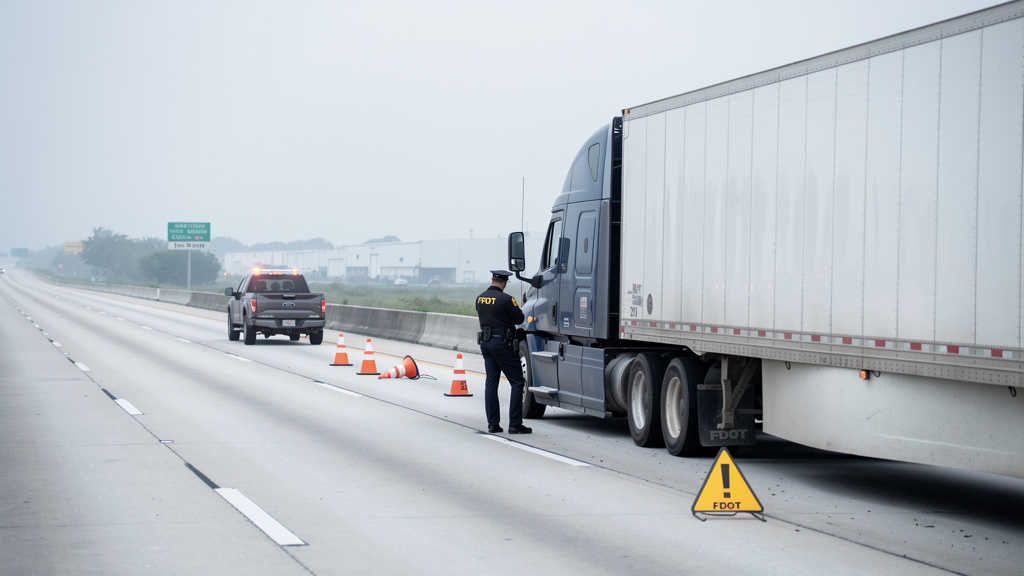
After a truck crash in Florida, you can pursue every party whose negligence contributed to the collision, not just the driver. Depending on the facts, that can include the trucking company, the truck owner, the trailer owner, the freight broker, the cargo loader, a third-party maintenance shop, or even a government entity if the truck was a city or county vehicle. Identifying all responsible parties matters because each one may carry its own insurance policy, and missing even one can leave serious compensation on the table.
Was the truck driver at fault, and what does that mean for the company that hired them?
The truck driver is directly liable if their actions caused or contributed to the crash, such as driving while fatigued, distracted, speeding, or violating federal hours-of-service rules. Florida law incorporates these federal regulations through Fla. Stat. § 316.302, which means violations of FMCSA rules like those on driver qualifications (49 CFR Part 391), safe operation (49 CFR Part 392), and hours-of-service (49 CFR Part 395) can be used as evidence of negligence. But the trucking company may also be liable under two legal theories: respondeat superior (if the driver was acting within the scope of employment) and direct negligence (for negligent hiring, retention, or supervision). For example, a carrier that schedules tight delivery windows along Okeechobee Road into the Medley industrial zone may pressure drivers to skip rest breaks, creating liability beyond the driver alone. Evidence like ELD data, dispatch logs, drug test results, and the police crash report can link both driver and company to the crash. Note that under Fla. Stat. § 316.066, the crash report is confidential for 60 days except to involved parties, insurers, and attorneys, making early legal help essential to obtain it.
What if someone other than the trucking company actually owns the truck or trailer?
The registered owner of the truck or trailer may be legally separate from the motor carrier operating it. Under Florida’s dangerous instrumentality doctrine, addressed in Fla. Stat. § 324.021(9)(b), the owner can be held liable when it lends or leases a commercial vehicle to another and harm results, even if the owner never drove the truck, although that statute limits the liability of some lessors. This means you must identify both the truck owner and the trailer owner; they might be different entities entirely. Key evidence includes the USDOT number on the cab, FMCSA registration records (searchable at safer.fmcsa.dot.gov), vehicle registration documents, and any lease agreements between owner and carrier. If it is safe to do so at the scene, take photos of the USDOT number and any company name displayed on the truck door. Ownership creates an independent path to recovery, and skipping this step could mean missing an entire insurance policy.
Can the cargo loader or freight broker be held responsible for the crash?
Yes, but with important distinctions. The shipper or cargo loader can be liable if improperly secured or overloaded freight caused the crash, such as a rollover due to shifting cargo. Federal securement standards under 49 CFR Part 393, Subpart I, apply in Florida through Fla. Stat. § 316.302, and violations support a negligence claim. Evidence includes bills of lading, weight tickets, loading dock records, and post-crash photos of the trailer interior.
Freight broker liability is less settled under Florida appellate law. Whether a broker can be held responsible depends on the specific facts and is an evolving area of law, an attorney must evaluate the broker’s actual role in your case. Brokers who select unsafe carriers or exert control over transport operations may face claims, but outcomes vary. Relevant evidence includes the broker-carrier contract, FMCSA authority documentation, and the broker’s carrier vetting practices.
Could a maintenance shop or parts manufacturer be responsible for what went wrong mechanically?
Mechanical failure, especially brake or tire problems, can contribute to truck crashes. If a third-party repair shop inspected or serviced the truck and missed a defect (or created one), it may be liable for negligent maintenance. Federal rules under 49 CFR Part 396, incorporated via Fla. Stat. § 316.302, require proper inspection and repair; violations support a negligence claim. Alternatively, if a defective part, like a faulty brake caliper or tire, caused the crash, the manufacturer may face strict product liability under Florida law, meaning you do not need to prove carelessness, only that the defect existed when the part left the factory and caused the crash. Critical evidence includes maintenance logs, repair invoices, parts serial numbers, and data from the truck’s electronic control module. Because trucks logging heavy miles in corridors like Okeechobee Road face intense wear, preservation of this evidence through a spoliation letter is urgent.
What if the truck that hit you was a city or county government truck?
Crashes involving City of Hialeah or Miami-Dade County garbage trucks (or other municipal fleet vehicles) trigger special legal rules. Under Fla. Stat. § 768.28(6), you must send written notice to the government agency before filing a lawsuit. Missing this notice step can bar your case. Additionally, Florida’s sovereign immunity law (Fla. Stat. § 768.28) sets other special rules for claims against government entities, and your attorney must confirm how they apply. Evidence includes the truck’s unit number (usually painted on the side), agency dispatch logs, public records requests, and the crash report. The same notice requirement applies if poor road design or maintenance by a government agency contributed to the crash. Contact a lawyer immediately after any collision involving a government vehicle.
What if you were partly at fault, can you still recover anything?
Yes, unless you are found more than 50 percent at fault. Florida follows a modified comparative negligence rule under Fla. Stat. § 768.81(6), which reduces your recovery by your assigned percentage of fault, but does not eliminate it unless your share exceeds half. For example, if total damages are $500,000 and you are 20 percent at fault, you recover $400,000. Defendants often try to shift blame to you or to non-parties not in the lawsuit to lower their own share. Be cautious: early statements to adjusters or recorded interviews with the trucking company’s insurer can be used to inflate your fault percentage. Do not give a recorded statement before consulting an attorney. And remember, the crash report under Fla. Stat. § 316.066 is confidential for 60 days, your lawyer can access it during that window to counter inaccurate fault assignments.
Frequently asked questions
How do I find out who owns the truck that hit me?
Check the USDOT number on the truck cab and search it at safer.fmcsa.dot.gov. The police crash report will list the carrier and possibly the owner, but it’s confidential for 60 days except to the parties, their insurers, and their attorneys. Vehicle registration and lease records can also identify the legal owner.
Can I sue the freight broker if a broker arranged the shipment?
It depends on the facts. Broker liability is not clearly settled in Florida law. An attorney must review whether the broker controlled operations or selected an unsafe carrier. Do not assume the broker is automatically liable, or immune.
What if the truck was a City of Hialeah or Miami-Dade County garbage truck?
You must send written notice to the city or county before suing, under Fla. Stat. § 768.28(6). Contact a lawyer right away, missing notice can bar your claim.
If I was partly at fault for the crash, can I still recover anything?
Yes, as long as you are not more than 50 percent at fault. Your recovery is reduced by your percentage of fault. At exactly 50 percent, you still recover half your damages.
What evidence should I try to preserve right after a truck crash?
Take photos of the truck (including USDOT number and company name), the crash scene, visible injuries, and cargo if spilled. Save your phone’s location history and call logs. Do not speak to insurers without a lawyer, and seek medical care within 14 days to protect your PIP benefits.
Related reading: A truck hit me in Hialeah. Is that different from a car accident? · The 14-day PIP rule in Florida: what happens if you wait to see a doctor after a Hialeah car accident · How long do I have to file an injury lawsuit in Florida? The two-year rule after HB 837 · The driver who hit me in Hialeah has no insurance. What now?
Hurt in an accident in Hialeah? Call Wolfson & Leon at (305) 285-7071 for a free consultation. We speak Spanish, and there is no fee unless we win.
Key facts
- Florida's commercial vehicle safety law, Fla. Stat. § 316.302, incorporates federal FMCSA regulations, including hours-of-service, driver qualification, and inspection rules, and violations of those regulations can be used as evidence of negligence against the driver or carrier. Source: Fla. Stat. § 316.302
- Under Fla. Stat. § 324.021(9)(b), the owner of a commercial vehicle who rents or lends it to another can face liability under Florida's dangerous instrumentality doctrine, meaning ownership alone can create exposure even when the owner was not driving. Source: Fla. Stat. § 324.021(9)(b)
- Claims against the City of Hialeah or Miami-Dade County, including crashes involving municipal garbage trucks, require written notice to the government entity before a lawsuit can be filed, under Fla. Stat. § 768.28(6). Missing this notice step can bar the claim entirely. Source: Fla. Stat. § 768.28(6)
- Under Florida's modified comparative negligence rule, an injured person's recovery is reduced by their share of fault and is completely barred only if they are found MORE THAN 50 percent at fault, not at exactly 50 percent. Source: Fla. Stat. § 768.81(6)
- The crash report required by Fla. Stat. § 316.066 is confidential for 60 days from the date it is filed, except to the parties involved, their insurers, and their attorneys, making early legal involvement critical to accessing this document during that window. Source: Fla. Stat. § 316.066
Frequently asked questions
How do I find out who owns the truck that hit me?
The USDOT number displayed on the truck's cab is your fastest starting point, it is publicly searchable in the FMCSA's SAFER database and will return the registered carrier, its address, and its safety record. The police crash report filed under Fla. Stat. § 316.066 should also identify the vehicle owner and carrier, though that report is confidential for 60 days except to parties, their insurers, and their lawyers. An attorney can pull FMCSA records, vehicle registration documents, and any lease agreements between the truck owner and the operating carrier immediately after the crash, before that evidence becomes harder to obtain.
Can I sue the freight broker if a broker arranged the shipment?
Whether a freight broker shares responsibility for a truck crash in Florida depends heavily on the specific facts, including how much control the broker exercised over carrier selection and transport operations, and this is a developing area of law that courts continue to address. Brokers who select carriers with known safety problems or who direct operations may face claims, but no specific outcome can be promised without reviewing the broker's actual contract and conduct. You should tell your attorney about any broker involvement as early as possible so the broker's records and carrier-vetting files can be preserved.
What if the truck was a City of Hialeah or Miami-Dade County garbage truck?
Crashes involving government-owned trucks, including Hialeah municipal garbage trucks and Miami-Dade County fleet vehicles, require you to send written pre-suit notice to the government entity before you can file a lawsuit, under Fla. Stat. § 768.28(6). Missing that notice step can bar the claim, so it is a time-sensitive step in a government-truck case. Florida's sovereign immunity law under Fla. Stat. § 768.28 also sets other special rules for these claims, and an attorney must confirm how they apply to your case. Do not wait to contact a lawyer if a government vehicle was involved.
If I was partly at fault for the crash, can I still recover anything?
Yes, as long as you are not found MORE THAN 50 percent at fault. Under Fla. Stat. § 768.81(6), Florida uses modified comparative negligence: your recovery is reduced by your percentage of fault, but it is only completely barred if your share exceeds 50 percent. For example, if you are found 25 percent at fault and your damages are $400,000, you recover $300,000. Trucking company adjusters frequently try to inflate the injured person's fault percentage using early recorded statements, which is one reason attorneys advise against speaking to the carrier's insurer before getting legal advice.
What evidence should I try to preserve right after a truck crash?
Photograph the truck's USDOT number, company name, and license plate before the truck leaves the scene. Get the police report number, the full crash report under Fla. Stat. § 316.066 is confidential for 60 days but becomes available to parties and their attorneys immediately. An attorney can send a spoliation letter to the carrier within days of the crash demanding preservation of the truck's black box data, ELD logs, maintenance records, and dashcam footage, some of these records can be overwritten or discarded if no demand is made. Witness names, business surveillance camera angles, and your own photos of road conditions and vehicle damage are also critical.
This article is general information about Florida law, not legal advice, and reading it does not create an attorney-client relationship. Every case is different and past results do not guarantee a similar outcome. For advice about your situation, call Wolfson & Leon at (305) 285-7071 for a free consultation.
Also available in: Versión en español
 Truck accidents
 Hit by a Rental Truck in Hialeah: Who Pays for Your Injuries?
When a rental box truck or cargo van hits you in Hialeah, the renter's personal auto insurance is often the first liability source, ahead of the…
 Truck accidents
 National, Trucking-Only, or Local Miami-Dade Firm: Which Should You Hire After a Truck Crash?
There is no single right answer, but the choice turns on three concrete things: who will actually handle your file day to day, how familiar that…
 Truck accidents
 Where to Find a Truck Accident Lawyer in Miami-Dade and What to Do First
Start with personal referrals, the Florida Bar's online member directory, legal directories like Avvo or Martindale-Hubbell, and the websites of…