
Federal Trucking Rules That Decide a Truck Accident Case in Florida
Florida law adopts federal commercial vehicle safety regulations under Fla. Stat. § 316.302, which means every tractor-trailer on the Florida Turnpike, I-75, or the Palmetto Expressway must follow FMCSA rules on driving hours, driver qualifications, drug testing, and vehicle maintenance. When a trucking company or driver breaks one of those rules and a crash follows, that violation becomes powerful evidence of negligence in your civil claim. Understanding which rule was broken, and demanding that evidence before it disappears, is often what separates a strong case from one that stalls.
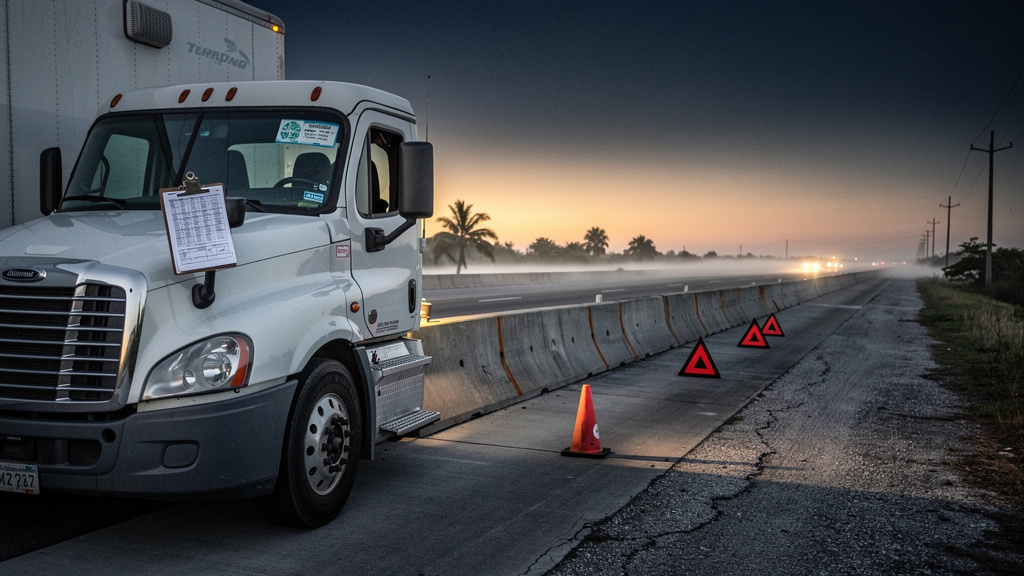
Florida law adopts federal commercial vehicle safety regulations under Fla. Stat. § 316.302, which means every tractor-trailer on the Florida Turnpike, I-75, or the Palmetto Expressway must follow FMCSA rules on driving hours, driver qualifications, drug testing, and vehicle maintenance. When a trucking company or driver breaks one of those rules and a crash follows, that violation becomes powerful evidence of negligence in your civil claim. Understanding which rule was broken, and demanding that evidence before it disappears, is often what separates a strong case from one that stalls.
Why do federal rules apply to a truck crash that happened on a Florida highway?
Florida did not write its own commercial vehicle safety code from scratch. Instead, Fla. Stat. § 316.302 adopts the federal FMCSA regulations in Title 49 of the Code of Federal Regulations and makes them enforceable under state law. This applies to both interstate carriers (those crossing state lines) and intrastate carriers operating only within Florida. That means every big rig moving freight into or out of Miami-Dade on the Florida Turnpike, I-75, or SR 826 (Palmetto Expressway) must obey these rules. The Florida Highway Patrol investigates many commercial vehicle crashes on these highways, and when they find a violation, it is not just a citation, it is evidence the driver or company failed to meet the legal standard of care required in court.
What do hours-of-service rules and ELD data actually show after a crash?
Federal hours-of-service rules limit how long a driver can be behind the wheel. For interstate drivers hauling property, the rules allow up to 11 hours of driving after 10 straight hours off duty, but no driving past the 14th consecutive hour on duty. They also require a 30-minute break after 8 cumulative driving hours and cap work at 60 or 70 hours per week depending on the schedule. Florida’s intrastate rules, found in Fla. Stat. § 316.302(2)(b) and (c), allow slightly more: up to 12 hours of driving after 10 off-duty hours, no driving after the 16th hour on duty, and weekly limits of 70 or 80 hours. An electronic logging device (ELD) automatically records engine use, location, and driver status, creating a hard-to-falsify record. If the ELD shows the driver exceeded legal limits before crashing on the Palmetto or I-75, that supports a claim of fatigue-based negligence. Carriers who pressure drivers to break these rules share responsibility. Because carriers do not keep this data forever, it should be preserved quickly.
What is a driver qualification file and why does it matter to your case?
Every commercial driver must have a driver qualification file maintained by the carrier. Under 49 CFR Part 391 (incorporated by Fla. Stat. § 316.302), this file includes a valid commercial driver’s license (CDL), a current medical examiner’s certificate proving physical fitness, and at least three years of driving history. These documents show whether the driver was legally qualified to operate the truck and whether the carrier knew about past crashes, suspensions, or violations. If the file reveals red flags, like repeated traffic convictions or a lapsed medical card, and the carrier still put that driver on a busy corridor like I-75, the company could face a negligent hiring or retention claim. These files are not handed over automatically. They must be requested early through a preservation demand or discovery.
What are the drug and alcohol testing rules for commercial drivers after a crash?
Federal rules require post-accident drug and alcohol testing when a crash involves a fatality, or when the truck driver is cited and someone is treated for an injury away from the scene or a vehicle must be towed. Under 49 CFR Part 382 (incorporated by Fla. Stat. § 316.302), these tests must be completed within strict, short time windows after the crash. A driver who does not remain available for testing can be treated as having refused it. A positive result can be strong evidence; a missing or never-conducted test suggests the carrier ignored its safety duties. This is separate from random or pre-employment testing. The driver’s full testing history may also matter if it shows prior issues the carrier overlooked. Because the deadlines are tight, contacting an attorney right after the crash helps ensure the carrier cannot sidestep this obligation.
How do inspection and maintenance violations become evidence in a truck accident claim?
Federal rules require carriers to inspect trucks before every trip and keep written records of those inspections and any repairs. Under 49 CFR Part 396 (incorporated by Fla. Stat. § 316.302), those inspections cover parts such as brakes, tires, and lights. If inspection logs show known brake defects before a crash, or maintenance records reveal repeated deferrals, that connects the carrier’s neglect to the collision. Florida Highway Patrol and other agencies conduct roadside checks and can place trucks “out of service” for safety violations. Roadside inspections regularly find trucks with defects serious enough to take them off the road. On high-load routes like the Turnpike and I-75, brake and tire wear are real risks, and paper trails prove whether the carrier addressed them.
Why does demanding this evidence immediately matter more than the two-year lawsuit deadline?
You generally have two years from the crash date to file a negligence lawsuit in Florida under Fla. Stat. § 95.11, but that changed from four years for injuries on or after March 24, 2023. However, critical evidence like ELD data, dashcam footage, and maintenance logs is not kept forever, and some of it, such as dashcam video, can be overwritten quickly. A formal written preservation demand puts the carrier on notice to keep it. Once you send that letter, the carrier must hold all relevant records, including driver qualification files, drug test results, inspection reports, and black box data, or risk sanctions. If they destroy evidence after receiving the demand, a judge may instruct the jury to assume the missing proof would have hurt the trucking company. Do not wait. explains exactly what to demand and how.
Frequently asked questions
Do these federal trucking rules apply if the truck that hit me was only driving within Florida and not crossing state lines?
Yes. Florida law incorporates federal FMCSA rules for both interstate and intrastate commercial carriers under Fla. Stat. § 316.302. Intrastate drivers follow slightly different hours-of-service limits set by Florida statute, but the same federal standards on drug testing, driver files, and vehicle maintenance apply.
How can I tell if the truck driver was over their hours-of-service limit before the crash?
You cannot tell from the police report alone. The answer lies in the ELD data, logbooks, and dispatch records. Only an attorney can formally demand this evidence and analyze it against the correct federal or state limits.
What if the trucking company says the driver was an independent contractor and not their employee?
Florida courts look beyond labels. If the company controlled the driver’s schedule, routes, or equipment, they may still be liable regardless of contract wording. Federal safety rules apply to the carrier regardless of employment classification.
The company has not been tested for drugs after the crash, does that hurt my case or theirs?
It can hurt theirs. Federal rules require post-accident testing after certain crashes. Failure to test, especially if the window passed, can be used as evidence the carrier violated safety protocols. It may support a claim of negligence even without a positive result.
I already talked to the insurance adjuster and said I was okay. Did I hurt my case?
Saying you were “okay” does not end your claim. Adrenaline masks pain after a crash, and injuries often appear days later. Do not give any recorded statement without speaking to a lawyer first. You still have rights if you act quickly.
Related reading: A truck hit me in Hialeah. Is that different from a car accident? · The 14-day PIP rule in Florida: what happens if you wait to see a doctor after a Hialeah car accident · How long do I have to file an injury lawsuit in Florida? The two-year rule after HB 837 · The driver who hit me in Hialeah has no insurance. What now?
Hurt in an accident in Hialeah? Call Wolfson & Leon at (305) 285-7071 for a free consultation. We speak Spanish, and there is no fee unless we win.
Key facts
- Florida Statute § 316.302 incorporates federal FMCSA regulations for commercial vehicles operating in Florida, including intrastate carriers, making those federal rules enforceable under state law. Source: Fla. Stat. § 316.302
- A property-carrying driver in interstate commerce may drive a maximum of 11 hours after 10 consecutive hours off duty and may not drive past the 14th consecutive hour on duty; intrastate Florida drivers follow different limits set by Fla. Stat. § 316.302(2)(b) and (c). Source: 49 CFR Part 395; Fla. Stat. § 316.302(2)(b)-(c)
- Post-accident drug and alcohol testing is required after qualifying crashes; federal regulations specify time windows within which testing must be completed, a driver who does not remain available for testing can be treated as refusing it. Source: 49 CFR § 382.303
- Florida's two-year statute of limitations for negligence lawsuits applies to truck accident claims arising on or after March 24, 2023. Source: Fla. Stat. § 95.11
- ELD data, driver qualification files, and maintenance records are kept only for limited periods and can be lost if not formally preserved with a written demand to the carrier. Source: 49 CFR Part 395; 49 CFR Part 396; industry practice documented in research sources
Frequently asked questions
Do these federal trucking rules apply if the truck that hit me was only driving within Florida and not crossing state lines?
Yes. Under Fla. Stat. § 316.302, Florida adopts the FMCSA federal regulations for intrastate commercial vehicle operations as well as interstate ones, though intrastate carriers follow slightly different hours-of-service numbers set by the Florida statute. A rastra that travels only within Florida, say, from a Hialeah warehouse to a distribution center in Tampa, is still subject to rules on driver qualifications, drug testing, vehicle inspections, and maintenance. The key distinction affects the specific hours a driver may legally operate, not whether federal rules apply at all.
How can I tell if the truck driver was over their hours-of-service limit before the crash?
You generally cannot tell from the crash scene alone, which is why ELD data is so important. An electronic logging device records the truck's engine activity and the driver's duty status automatically, creating a timestamped log that an attorney or accident reconstruction expert can read. If that log shows the driver exceeded the legal driving window before impact, it is direct evidence of fatigue. Because that data is not kept forever, your attorney needs to send a written preservation demand to the carrier as soon as possible after the crash.
What if the trucking company says the driver was an independent contractor and not their employee?
The independent contractor label does not automatically eliminate the carrier's liability. Florida recognizes the dangerous instrumentality doctrine, which can hold the owner of a commercial vehicle liable for damages caused by anyone it permitted to operate that vehicle. Additionally, federal regulations place compliance obligations on the motor carrier itself, not just the individual driver, so a carrier that failed to maintain a proper driver qualification file or drug testing program may face direct liability regardless of how the driver was classified on paper. An attorney can investigate the actual relationship between the driver and carrier beyond the label used on a contract.
The company has not been tested for drugs after the crash, does that hurt my case or theirs?
Under federal regulations incorporated by Fla. Stat. § 316.302, post-accident drug and alcohol testing is mandatory when a crash meets certain severity thresholds. A driver who does not remain available for that testing can be treated as having refused it under the regulations. A carrier's failure to test its driver after a qualifying crash may itself be evidence that the company did not follow required safety protocols, and your attorney can argue it raises an inference about what the test would have shown. Contact an attorney immediately so that the failure to test is documented before more time passes.
I already talked to the insurance adjuster and said I was okay. Did I hurt my case?
Possibly, but it depends on what you said, when you said it, and what your actual injuries turned out to be. Early statements minimizing injury can be used by insurers to reduce or deny claims. Separately, Florida Statute § 316.066 keeps crash reports confidential for 60 days except to the parties, their insurers, and their lawyers. More importantly, to claim pain and suffering from the at-fault driver under Florida law, you generally need to show a permanent injury under Fla. Stat. § 627.737(2), and that medical determination often takes time. Speak with an attorney before giving any further recorded statements to any insurer.
This article is general information about Florida law, not legal advice, and reading it does not create an attorney-client relationship. Every case is different and past results do not guarantee a similar outcome. For advice about your situation, call Wolfson & Leon at (305) 285-7071 for a free consultation.
Also available in: Versión en español
 Truck accidents
 Who Can You Hold Responsible After a Truck Crash in Florida?
After a truck crash in Florida, you can pursue every party whose negligence contributed to the collision, not just the driver. Depending on the…
 Truck accidents
 Hit by a Rental Truck in Hialeah: Who Pays for Your Injuries?
When a rental box truck or cargo van hits you in Hialeah, the renter's personal auto insurance is often the first liability source, ahead of the…
 Truck accidents
 National, Trucking-Only, or Local Miami-Dade Firm: Which Should You Hire After a Truck Crash?
There is no single right answer, but the choice turns on three concrete things: who will actually handle your file day to day, how familiar that…