
8 Questions to Ask Before You Sign With a Spanish-Speaking Lawyer in Hialeah
A 'Se habla español' sign on W 49th St or Okeechobee Road tells you someone in that office speaks Spanish, it does not tell you whether the attorney handling your case does. Before you sign anything, ask eight specific questions that pin down who speaks Spanish, which documents get explained in Spanish, and who pays case costs if you lose. The answers will separate a genuinely bilingual practice from one that uses language as a marketing tool.
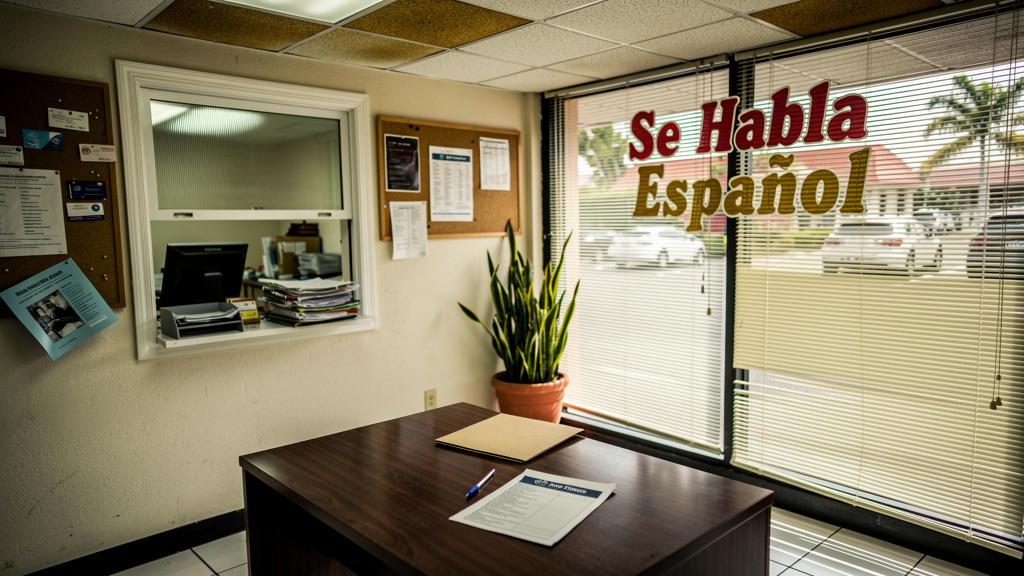
A ‘Se habla español’ sign on W 49th St or Okeechobee Road tells you someone in that office speaks Spanish, it does not tell you whether the attorney handling your case does. Before you sign anything, ask eight specific questions that pin down who speaks Spanish, which documents get explained in Spanish, and who pays case costs if you lose. The answers will separate a genuinely bilingual practice from one that uses language as a marketing tool.
Why does ‘Se habla español’ on a Hialeah storefront not answer the real question?
Driving down W 49th Street or Okeechobee Road in Hialeah, you will see many offices advertising ‘Se habla español’. That promise may be true for the receptionist, intake coordinator, or paralegal, but not necessarily for the attorney who will file your lawsuit, negotiate with the insurance company, or explain a settlement offer in court. Online directories like abogado.com and usa.elabogado.com list lawyers by city, but a listing does not by itself show whether a lawyer actually works cases from that location or speaks Spanish fluently. A listing there is not proof of either. The only way to know if your attorney communicates directly with you in Spanish is to ask the right questions before signing a contract.
Questions 1 and 2: Who actually speaks Spanish, and will they explain the fee contract before I sign?
Ask this directly: Will the abogado assigned to my case speak Spanish with me personally during depositions, negotiations, and strategy calls, or will I go through a staff member? If the firm hesitates or gives a vague answer, take that as your answer. Second, ask: Will the contingency fee agreement be explained to me in Spanish before I sign? Florida Bar rules require that fee agreements be in writing and clearly state the attorney’s percentage and what case costs may come out of your recovery. You have the right to understand every line. A trustworthy firm will sit down and read through the entire contract with you in Spanish, not just hand you a document to sign. Remember, the net amount you receive after fees, costs, and liens is what matters, not just the headline settlement number.
Questions 3 and 4: Who calls me with updates, and does the firm handle the insurance company, or do I?
Ask: Who will contact me with case updates, how often, and in what language? Will it be the attorney, a paralegal, or an off-site call center? A firm that cannot give a clear answer during your consultation is showing you what communication will look like for months to come. Then ask: Once I hire you, will the insurance adjuster still call me directly? They should not. After you retain a lawyer and the insurer is notified, the adjuster will usually communicate through your attorney. This stops adjusters from pressuring you into quick settlements or recorded statements you may not fully understand. That protection only works if your lawyer actually handles all communication, not just puts their name on letterhead.
Questions 5 and 6: Which documents will arrive in English, and who will explain them, and what happens at a deposition or in court?
Ask: What documents will I receive in English, and who will walk me through them in Spanish before I respond or sign? This includes insurer letters, medical record requests, demand packages, court filings, and especially settlement releases. Once you sign a release, your claim is usually over for good. Do not sign anything you do not understand. Also ask: If I have a deposition or go to court, will there be an interpreter? Interpreter availability, cost, and who arranges it can vary by firm and proceeding type. Get the firm’s policy in writing before signing. Ask specifically whether your attorney will be present and bilingual, or whether everything will go through a third-party interpreter.
Questions 7 and 8: Can the firm come to me, and who pays case costs if we lose?
If you are recovering at home or in Hialeah Hospital after a crash, ask: Can someone from the firm meet me where I am? Find out if that person is the attorney or a non-lawyer staff member, and whether they speak Spanish fluently. Then ask the most important financial question: Who pays case costs if we do not win? Attorney fees under a contingency agreement are typically zero if there is no recovery. But case costs, filing fees, medical record copies, expert reports, deposition transcripts, are separate. Some firms absorb those costs if the case loses; others expect you to repay them. Ask for the policy in writing, in Spanish, before you sign anything.
How Wolfson & Leon answers each of the eight questions
- Most of Wolfson & Leon’s attorneys and staff speak Spanish, and partner Alfonso “Alfie” Leon often works with Hialeah clients in Spanish. Ask which attorney will handle your case.
- The contingency fee is explained in writing before you sign, and you can ask for that explanation in Spanish.
- Ask during the free consultation who will call you with updates. The firm’s phone, 305-965-3766, is answered by a person 24/7.
- Once you hire the firm, communication with the insurer generally goes through your attorney.
- You can ask for any document that arrives in English to be explained to you in Spanish before you sign or respond.
- Ask during the consultation how an interpreter would be handled at a deposition or hearing.
- If you cannot travel, an attorney can visit you at home or in the hospital.
- Wolfson & Leon advances case costs and does not charge you if there is no recovery.
Wolfson & Leon serves clients throughout Hialeah and Miami-Dade County. Initial consultations are available in Spanish.
Frequently asked questions
Is it a red flag if the attorney I meet at the consultation is not the one who will handle my case?
Yes. In personal injury cases, the attorney you meet should be the one managing your case. If they refer you to another lawyer you have not met, ask why and confirm that person speaks Spanish if that is important to you.
Can I ask for the fee agreement in Spanish before I sign it?
Yes. You have the right to understand every part of the contingency fee agreement before signing. Ask the firm to review it with you in Spanish, line by line.
What if the insurance company calls me directly after I hire a lawyer?
Tell them you have retained an attorney and give them your lawyer’s contact information. After that, they should communicate only with your lawyer. If they keep calling you, inform your attorney immediately.
How do I verify that a lawyer listed on abogado.com or usa.elabogado.com actually has an office in Hialeah and speaks Spanish?
Call the office and ask to speak directly with the attorney in Spanish. Ask where your case files will be kept and who will handle negotiations. A directory listing alone proves nothing.
What is the difference between attorney fees and case costs, and do I owe anything if my case does not recover money?
Attorney fees are typically a percentage of your recovery and are waived if you get nothing. Case costs cover expenses like filing fees and medical records. Some firms require repayment of those costs even if you lose. Always ask for the policy in writing.
Hurt in an accident in Hialeah? Call Wolfson & Leon at 305-965-3766 for a free consultation. We speak Spanish, and there is no fee unless we win.
Key facts
- Directory sites such as abogado.com and usa.elabogado.com list lawyers by city; a listing alone does not confirm the attorney speaks Spanish or that the office address shown is where your case will actually be worked. A lawyer's license status can be checked with The Florida Bar. Source: Wolfson & Leon
- Florida Bar contingency fee agreements must be in writing; the client has a right to a clear written explanation of the fee percentage and what costs may be deducted from any recovery. Source: Florida Bar Rules of Professional Conduct
- PIP pays 80 percent of reasonable medical bills and 60 percent of lost income, up to $10,000 when a doctor finds an emergency medical condition, or only up to $2,500 otherwise; initial treatment must happen within 14 days of the crash. Source: FS 627.736
- A personal injury lawsuit for injuries on or after March 24, 2023 must be filed within two years of the incident. Source: FS 95.11
- Whether an interpreter is required at a deposition or court proceeding, and who arranges and pays for that interpreter, varies by firm and by proceeding type; confirm the firm's specific practice before signing. Source: Wolfson & Leon
Frequently asked questions
Is it a red flag if the attorney I meet at the consultation is not the one who will handle my case?
Not necessarily, larger firms often have multiple attorneys, and the intake attorney may hand off to a case attorney. The red flag is when the firm cannot tell you clearly who will handle your case day to day. Ask by name: who will negotiate with the insurer, who will call me with updates, and does that person speak Spanish? If the firm cannot answer those questions specifically, that is worth paying attention to before you sign.
Can I ask for the fee agreement in Spanish before I sign it?
Yes, and you should. A contingency fee agreement is a binding contract that specifies the attorney's percentage of any recovery and which costs may be deducted from your share before you receive anything. Florida Bar rules require this agreement to be in writing. A firm that will not provide a Spanish-language explanation of every line before you sign is showing you something about how it will communicate with you throughout the case.
What if the insurance company calls me directly after I hire a lawyer?
Once you have retained an attorney and the insurer knows it, the insurer will usually communicate through your attorney rather than contacting you directly. If an adjuster calls you anyway, you are not obligated to speak with them, tell them you have an attorney and give them the firm's contact information. Do not give a recorded statement to any insurer without your attorney present or instructing you to do so.
How do I verify that a lawyer listed on abogado.com or usa.elabogado.com actually has an office in Hialeah and speaks Spanish?
A listing on a directory site like abogado.com or usa.elabogado.com does not by itself confirm an attorney's language ability or that the office address listed is where your case will actually be worked. Call the number listed, ask to speak with the attorney personally in Spanish, confirm the physical office address, and ask who will handle your file day to day. A Florida Bar license search will confirm whether the attorney is in good standing, but it will not tell you who speaks Spanish.
What is the difference between attorney fees and case costs, and do I owe anything if my case does not recover money?
Attorney fees on a contingency case are typically a percentage of whatever is recovered, if nothing is recovered, the fee is generally zero. Case costs are different: these include filing fees, charges for obtaining medical records, expert witness fees, and deposition expenses. Some firms advance these costs and waive them if the case is lost; others require the client to repay costs regardless of outcome. Ask this question directly and get the answer in writing in Spanish before you sign the retainer agreement.
This article is general information about Florida law, not legal advice, and reading it does not create an attorney-client relationship. Every case is different and past results do not guarantee a similar outcome. For advice about your situation, call Wolfson & Leon at 305-965-3766 for a free consultation.
Also available in: Versión en español
 Personal injury
 The Other Driver Only Has $10,000 in Coverage, Can I Get the Rest?
Yes, if you carry uninsured/underinsured motorist (UM) coverage on your own policy, you can claim the gap between the at-fault driver's limit and…
 Personal injury
 Hit by an Uninsured Driver in Hialeah: What PIP, UM, and a Lawsuit Actually Pay
Your own PIP pays first, covering 80 percent of your medical bills and 60 percent of your lost wages up to $10,000 (or only $2,500 if no doctor…
 Personal injury
 Hit by an Uninsured Driver in Miami-Dade: Every Source of Payment, In Order
When an uninsured driver hits you in Miami-Dade, money can come from up to five places: your own PIP coverage, your uninsured motorist (UM)…