
Hit by an Uninsured Driver in Hialeah: What PIP, UM, and a Lawsuit Actually Pay
Your own PIP pays first, covering 80 percent of your medical bills and 60 percent of your lost wages up to $10,000 (or only $2,500 if no doctor finds an emergency medical condition). After PIP runs out, your uninsured motorist coverage, if you bought it, steps into the at-fault driver's shoes and can pay medical bills, lost wages, and pain and suffering above what PIP covered. Suing the driver personally is legal but rarely produces full payment, because Florida does not require most drivers to carry bodily injury liability insurance and many who skip it have few collectible assets.
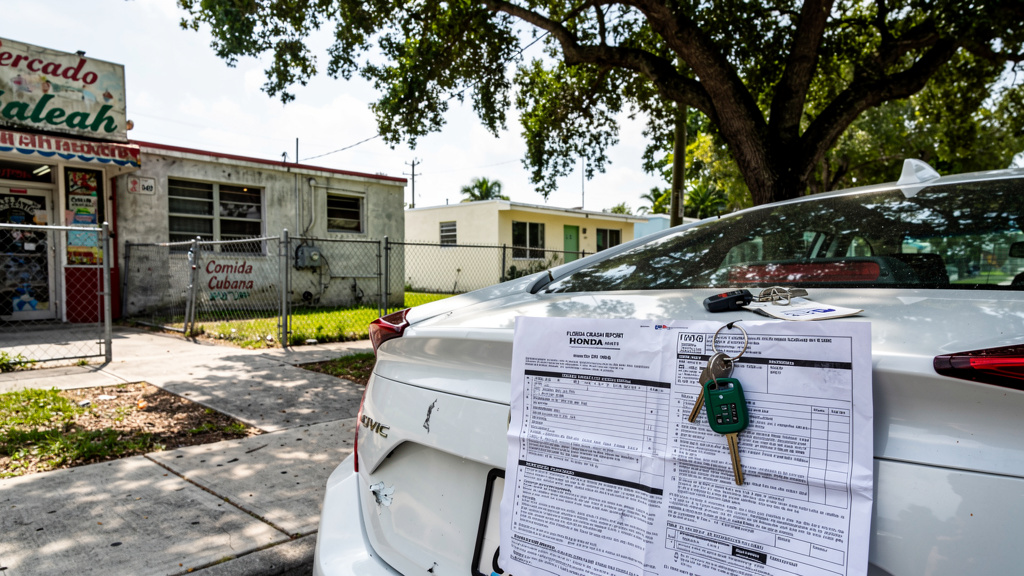
Hit by an uninsured driver in Hialeah? Your own PIP coverage pays first, not the other driver’s. It covers 80 percent of your medical bills and 60 percent of lost wages up to $10,000, if a doctor confirms an emergency medical condition, otherwise just $2,500. After PIP runs out, your uninsured motorist (UM) coverage, if you bought it, can step in for additional medical costs and lost income, and for pain and suffering if your injury meets Florida’s permanent-injury threshold. Suing the driver personally is possible, but most who skip insurance also lack assets to collect from.
What does each source actually pay, and what is the catch?
| Damage type | PIP | UM | At-fault driver personally | Your health insurance |
|---|---|---|---|---|
| Medical bills | 80% of reasonable and necessary expenses; full $10k only with EMC | Pays what at-fault driver would owe above PIP | Yes in theory | Yes after PIP exhausted |
| Lost wages | 60% of gross lost income; counted within same $10k limit | Pays amounts exceeding PIP reimbursement | Yes in theory | No |
| Pain and suffering | Not covered | Yes, but only if injury meets permanent-injury threshold under § 627.737(2) | Yes in theory, same threshold applies | No |
| Car damage | Not covered | Generally not covered, standard UM is for bodily injury only | Yes via lawsuit or their $10k PDL policy | No |
| Policy limit | $10,000 with EMC; $2,500 without | Whatever UM limit you purchased | Unlimited in theory, but collectability is low | Plan-specific |
EMC = Emergency Medical Condition per Fla. Stat. § 627.736(1)(a). UM can be left off a policy only by a written rejection. Health insurers may seek repayment (subrogation) from any recovery.
How does PIP actually work after a crash on W 49th Street in Hialeah?
Imagine you’re rear-ended at the red light on W 49th Street near Palm Avenue. The other driver has only Florida’s minimum: $10,000 in PIP and $10,000 in property damage liability, but no bodily injury coverage. You’re taken by ambulance to Hialeah Hospital.
Your own PIP activates immediately under [Fla. Stat. § 627.736(4)(e)], not the other driver’s. If the ER doctor documents an emergency medical condition (EMC), you get access to the full $10,000 PIP limit. Say your ER bill and imaging total $12,500. PIP pays 80% of reasonable covered expenses up to its $10,000 benefit limit, so here it pays $10,000 (80% of $12,500), leaving $2,500 unpaid and your PIP limit used up.
If you miss two weeks of work, PIP also covers 60% of your gross lost wages, but those payments come out of the same $10,000 pool already used for medical bills. Crucially, if you wait more than 14 days to see a doctor, PIP pays nothing at all under [Fla. Stat. § 627.736(1)(a)]. That deadline is absolute.
After PIP runs out, what does UM cover, and what is the permanent-injury catch?
Once PIP is exhausted, your uninsured motorist (UM) coverage, if you have it, steps into the shoes of the at-fault driver under [Fla. Stat. § 627.727]. It can pay for medical bills beyond what PIP covered, additional lost wages, and crucially, pain and suffering, but only if your injury meets Florida’s legal threshold in § 627.737(2).
That means one of three things: a permanent injury within reasonable medical probability, significant and permanent scarring or disfigurement, or permanent loss of an important bodily function. A minor neck strain that heals in weeks usually doesn’t qualify. A herniated disc requiring surgery likely does.
Your own insurer can challenge whether the other driver was truly at fault, whether your injury meets the threshold, and your share of blame under Florida’s modified comparative negligence rule (§ 768.81). Your recovery is reduced by your fault percentage and cut off entirely only if you’re found more than 50% at fault.
Also, check if your UM is “stacked.” If you have multiple cars on your policy and chose stacked coverage, your UM limits add together. If non-stacked, you’re limited to the UM amount on the vehicle you were driving. You can confirm this by reviewing your declarations page, or ask your attorney.
Who pays to fix your car, and why UM usually does not?
Standard UM coverage in Florida covers bodily injuries, not vehicle damage. For your car, the first source is the other driver’s property damage liability (PDL) policy, which Florida requires them to carry in at least $10,000. In our W 49th Street crash, that $10,000 PDL would cover repairs up to that amount.
If repairs cost more, or if the driver skipped even PDL, you’ll need your own collision coverage (if you bought it). Collision pays regardless of fault, minus your deductible.
Florida law may allow insurers to sell a separate UM property damage endorsement, but it’s not standard. Check your declarations page or call your carrier to confirm what you have. Do not assume your UM policy covers your car. Without collision coverage and with inadequate PDL, your only recourse is a personal lawsuit against the driver, which brings us to collectability.
Can you actually collect from the uninsured driver personally?
Yes, you have the legal right to sue the uninsured driver. Under Fla. Stat. § 95.11, you generally have two years from the crash date (for injuries on or after March 24, 2023) to file a lawsuit. If you win, Florida law may allow tools like wage garnishment, bank levies, and liens on non-exempt property to enforce the judgment, subject to exemptions.
But in practice, many uninsured drivers lack steady income or own only exempt assets, like a homesteaded home under Florida’s strong constitutional protection. This often results in a “paper judgment” you can’t collect.
Comparative fault still applies: if you’re found 30% at fault, your recovery drops by 30%. If you’re more than 50% at fault, you recover nothing. An attorney can investigate the driver’s assets through discovery to assess whether suing is worthwhile.
What order do these sources pay in, and why does the sequence affect your settlement?
Payment flows in this order: (1) your PIP pays first for medical and wage losses; (2) your UM covers remaining bodily injury damages up to its limit; (3) health insurance fills leftover medical bills, but will likely seek repayment (subrogation) from any settlement; (4) a personal lawsuit against the driver is last.
This sequence matters. You cannot skip PIP, it must be used first. Also, if you ever settle with another party (less relevant here since the driver has no BI insurance, but critical in underinsured cases), you must give your UM carrier written notice under § 627.727. Settling without notice can void your UM claim.
UM does not double-pay what PIP already covered. It only covers the gap. And if your UM insurer unreasonably denies benefits, you may send a civil remedy notice, but that process has strict procedural steps.
Frequently asked questions
What if I didn’t get medical treatment until three weeks after the crash, do I lose my PIP?
Yes. Florida law requires initial treatment within 14 days of the crash. If you miss that window, your PIP pays nothing, even if you’re badly hurt. This rule is strictly enforced.
My ER doctor didn’t use the words ‘emergency medical condition’, am I stuck with only $2,500 in PIP?
Possibly. The EMC finding must come from a qualified provider, usually a physician or dentist, and must appear in the medical record. If it’s missing, your PIP limit drops to $2,500. Ask your treating doctor to document it if appropriate.
Will filing a UM claim cause my own insurance rates to go up?
Not necessarily. Rate practices vary by insurer, so ask your insurer or agent how a UM claim for a crash you did not cause would be treated. Fear of a rate increase is not a reason to leave serious injury bills unpaid.
Can I get pain and suffering from my UM policy for a herniated disc?
Yes, if the herniation causes a permanent injury within reasonable medical probability, such as ongoing nerve damage or required surgery. Temporary pain alone is not enough.
The other driver said he would pay me cash on the spot, should I take it?
Do not accept cash settlements at the scene. You don’t yet know the full extent of your injuries or losses. Accepting money may waive your right to pursue PIP, UM, or other valid claims later.
Related reading: The driver who hit me in Hialeah has no insurance. What now? · I was in a car accident in Hialeah. What do I do now? · The 14-day PIP rule in Florida: what happens if you wait to see a doctor after a Hialeah car accident · I was in a car accident in Hialeah. What do I do now? · Partly at Fault for a Hialeah Crash? Here Is What You Can Still Recover
Hurt in an accident in Hialeah? Call Wolfson & Leon at 305-965-3766 for a free consultation. We speak Spanish, and there is no fee unless we win.
Key facts
- Florida requires only $10,000 in PIP and $10,000 in property damage liability to register a vehicle, bodily injury liability coverage is not required for most drivers. Source: Fla. Stat. § 627.736(1); Fla. Stat. § 324.022
- PIP pays 80 percent of reasonable and necessary medical expenses and 60 percent of lost wages, up to $10,000 total, but only $2,500 if no licensed provider documents an emergency medical condition. Source: Fla. Stat. § 627.736(1)(a)
- Initial medical treatment must occur within 14 days of the crash or PIP pays nothing at all. Source: Fla. Stat. § 627.736(1)(a)
- UM coverage is not mandatory but must be offered with every auto policy that includes bodily injury liability; a named insured can reject it only by signing a written form approved by the Office of Insurance Regulation. Source: Fla. Stat. § 627.727
- Recovery for pain and suffering from an uninsured driver requires proof of a permanent injury, significant and permanent scarring or disfigurement, or permanent loss of an important bodily function. Source: Fla. Stat. § 627.737(2)
Frequently asked questions
What if I didn't get medical treatment until three weeks after the crash, do I lose my PIP?
Yes. Florida law under § 627.736(1)(a) requires that you receive initial medical services and care within 14 days of the crash. If you wait longer than 14 days, PIP pays nothing, not a reduced amount, but zero. This is one of the most damaging mistakes injured drivers make, and it cannot be fixed after the fact.
My ER doctor didn't use the words 'emergency medical condition', am I stuck with only $2,500 in PIP?
Possibly, but not necessarily. The EMC determination must be made by a licensed provider, a physician, osteopathic physician, dentist, or certain advanced practice providers, and it must be documented in your records. If the records reflect the finding even without that exact phrase, it may still qualify. If the finding is absent or ambiguous, the insurer can limit you to $2,500 under § 627.736(1)(a). An attorney can review the records and dispute an incorrect EMC determination.
Will filing a UM claim cause my own insurance rates to go up?
UM is a first-party claim on your own policy for a crash you did not cause. Rate practices vary by insurer, and Florida law does not uniformly prohibit premium increases after a UM claim. Ask your insurer or agent directly before making assumptions either way. Fear of a rate increase is not a reason to leave serious injury bills unpaid.
Can I get pain and suffering from my UM policy for a herniated disc?
Possibly, if the disc injury meets the permanent-injury threshold under § 627.737(2). A herniated disc that requires surgery or causes permanent nerve damage may meet the threshold; one that resolves fully with conservative treatment typically will not. The key is documented medical evidence, preferably from an orthopedic specialist or neurologist, establishing permanency within a reasonable degree of medical probability.
The other driver said he would pay me cash on the spot, should I take it?
No. Accepting cash and signing anything at the scene can be treated as a release of your claims, even for injuries you have not yet discovered or bills you have not yet received. Spinal injuries in particular may not produce full symptoms for hours or days. Get the driver's information, call police, seek medical care within 14 days, and consult an attorney before signing or accepting anything from the at-fault driver.
This article is general information about Florida law, not legal advice, and reading it does not create an attorney-client relationship. Every case is different and past results do not guarantee a similar outcome. For advice about your situation, call Wolfson & Leon at 305-965-3766 for a free consultation.
Also available in: Versión en español
 Personal injury
 Hit by an Uninsured Driver in Miami-Dade: Every Source of Payment, In Order
When an uninsured driver hits you in Miami-Dade, money can come from up to five places: your own PIP coverage, your uninsured motorist (UM)…
 Personal injury
 Does My Lawyer Take a Cut of My PIP or Car Repair Money?
In a standard Florida personal injury contingency agreement, the percentage fee applies to the injury claim recovery, money from the at-fault…
 Personal injury
 Hit by an Uninsured Driver in Hialeah: Your Real Recovery Options
Your own PIP coverage pays first, regardless of who caused the crash, covering 80 percent of medical bills and 60 percent of lost wages up to…