
Is Paying a Lawyer's Percentage for a UM Claim Actually Worth It?
The honest answer is not about the percentage, it is about what you net. For a minor crash where PIP already covered everything, you may not need one. But once injuries exceed PIP limits, fault is disputed, or you have multiple policies in play, the mistakes you can make on your own can cost more than a contingency fee.
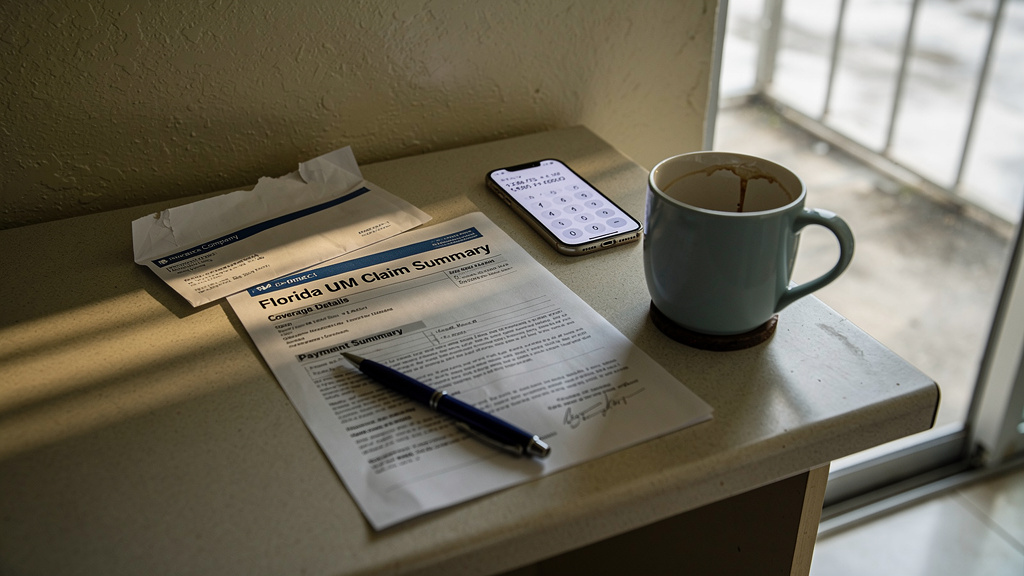
Is paying a lawyer’s percentage for an uninsured motorist (UM) claim worth it? The answer is not about the fee but what you take home. If your crash caused only minor injuries that PIP covered fully, you might not need a lawyer. But once medical bills exceed $10,000, fault is contested, or multiple insurance policies apply, going it alone can cost far more than a contingency fee.
When might you actually be fine handling this on your own?
You can handle a UM claim yourself only in narrow situations. First, if there was no bodily injury at all, just property damage. Note that UM coverage in Florida pays for bodily injury, not vehicle repairs; those go through collision coverage instead. Second, if your injury was minor, treatment started within 14 days, PIP paid 80 percent of all medical bills and 60 percent of lost wages up to $10,000 without dispute, your care is complete, and you are not claiming a permanent injury under Florida law. Third, you must already know that no other UM policy applies, no stacking, no household relative’s coverage, no underinsured motorist (UIM) layer. Many people hesitate because they see serious vehicle damage but little injury. Even then, a free review of your insurance declarations page at Wolfson & Leon’s Hialeah office, or at your home in Spanish, can confirm whether your case is truly simple.
When do the stakes get high enough that going it alone gets expensive?
Four common scenarios turn a small mistake into a large loss. First, when medical bills exceed PIP limits. After $10,000 (or $2,500 if no emergency condition was found), you must look to UM coverage, and your own insurer now acts like an opposing party. Second, when permanency is disputed. Pain and suffering damages require proof of a permanent injury, significant scarring, or loss of function. Insurers often challenge this, and the difference in what the claim is worth can dwarf an attorney’s fee. Third, comparative fault matters. If an adjuster argues you were 40 percent at fault on a $200,000 claim, you lose $80,000. Push it past 50 percent, and you recover nothing. Fourth, some insurers may use tactics such as delaying responses, misstating policy terms, or pressuring quick settlements. Despite the myth that “your insurance company is automatically on your side,” in a UM claim, your insurer has every incentive to pay less. Many people worry that a fee will leave them with less. Whether it does depends on how much additional coverage and value can be documented in your case.
What is the consent-to-settle trap in an underinsured motorist claim?
Under Florida Statute § 627.727(6), you cannot accept a settlement from the at-fault driver’s insurer without first notifying your own UM carrier and getting their written consent. Here is how it works: the at-fault driver has a small bodily injury policy, say $10,000. Your total damages are $50,000. Their insurer offers the full $10,000. If you accept it without your UM insurer’s written approval, you may permanently lose your right to collect the remaining $40,000 from your own UM/UIM coverage. Some policies also require your UM insurer to have a chance to pay the at-fault amount itself to preserve its right to later seek repayment. Before you cash any check from any insurer, call a lawyer. Once you sign a release, this mistake may not be fixable.
What coverage are you likely to miss when you handle this yourself?
Two sources of extra UM coverage are commonly overlooked. First is stacking. If you insure two or more vehicles and chose stacked UM coverage, your limits combine. For example, two cars with $50,000 UM each could give you $100,000 total. If you rejected stacking, you are limited to per-vehicle amounts. Many drivers do not know what their policy says, and only the declarations page shows this. Second is household-relative policies. UM coverage follows the person, not the car. A sibling, parent, or spouse living with you may have a policy that covers you even if you were on foot, on a bike, or in someone else’s car. If your household has more than one licensed driver or vehicle, a declarations-page review is essential. Wolfson & Leon offers this review free in Spanish, either at our Hialeah office or at your home.
How do you compare what you actually net, not just the percentage?
Focus on take-home dollars, not the fee percentage. Imagine two outcomes. Scenario A: you settle alone for $25,000. No attorney fee, but you missed stacking and a household policy. After repaying medical liens, you keep maybe $18,000. Scenario B (hypothetical): a lawyer finds additional coverage and the claim resolves for $75,000. At a one-third fee, the fee is $25,000. If expenses were, say, $4,000, your net before liens would be roughly $46,000. Results depend on the facts and the coverage available, and no outcome can be promised. Expenses may be deducted before or after the fee; ask which method your agreement uses. There is one narrow case where a lawyer may not add value: when a full coverage search confirms only a small policy exists, your damages far exceed it, and the insurer will pay the limit regardless. Then a fee reduces an already inadequate sum. A coverage review can show whether that is your situation. Remember, the settlement number is never what you take home, liens, fees, and expenses come out first. The real question is: which gross amount are those deductions applied to? A free declarations-page review in Hialeah can help you find out.
What does it actually mean that your own insurer is now the other side?
The idea that “your insurance company is automatically on your side” is a myth. In a UM claim, you are suing your own insurer for damages caused by an uninsured driver. They evaluate your claim with the same goal as any opposing insurer: pay as little as possible. Tactics include disputing whether your injury is permanent (required for pain and suffering under Fla. Stat. § 627.737(2)), blaming pre-existing conditions, or arguing you were partly at fault to slash or block your recovery under Florida’s 51% rule. Florida law prohibits unfair claims practices like misrepresenting policy terms or refusing to negotiate in good faith (Fla. Stat. § 626.9541). If your insurer unreasonably denies or lowballs your claim, you may have grounds for a separate bad faith lawsuit, though results depend on the facts of your case. Also, the police crash report is confidential for 60 days except to parties, insurers, and attorneys, so your insurer may already have it. You should know what it says.
Frequently asked questions
If I file a UM claim, will my own insurance rates go up?
Florida law limits an insurer’s ability to surcharge a policyholder solely because they filed a UM claim for a crash that was not their fault, but policy terms and insurer practices vary. Ask a lawyer to review your situation before you settle.
What if I already accepted a payment from the at-fault driver’s insurer, did I lose my UM claim?
Possibly. If you settled without your UM insurer’s written consent and your damages exceed that payment, you may have forfeited your UIM claim under Fla. Stat. § 627.727(6). A lawyer can review your release to see if options remain.
Does UM coverage fix my car?
No. UM coverage pays only for bodily injury, medical bills, lost wages, and pain and suffering. Vehicle repairs are handled through collision coverage or the at-fault driver’s property damage liability, if they have it.
How long do I have to file a UM lawsuit in Florida?
A UM claim against your own insurer is a contract claim, so it is not governed by the two-year negligence deadline in Fla. Stat. § 95.11 that applies to injury lawsuits against an at-fault driver for crashes on or after March 24, 2023. Your policy may also require prompt notice, so have a lawyer confirm the deadline that applies to you.
Can I have UM coverage I don’t know about, maybe through a family member’s policy?
Yes. If you live with a relative who has auto insurance with UM coverage, that policy may protect you even if you don’t own a car. This includes parents, siblings, or spouses in the same household.
Related reading: The driver who hit me in Hialeah has no insurance. What now? · Stacked vs. non-stacked uninsured motorist coverage in Florida: what the checkbox on your policy actually means · Partly at Fault for a Hialeah Crash? Here Is What You Can Still Recover · The 14-day PIP rule in Florida: what happens if you wait to see a doctor after a Hialeah car accident
Hurt in an accident in Hialeah? Call Wolfson & Leon at 305-965-3766 for a free consultation. We speak Spanish, and there is no fee unless we win.
Key facts
- Florida PIP pays 80 percent of reasonable medical bills and 60 percent of lost wages up to $10,000 when a doctor finds an emergency medical condition, and nothing at all if you wait more than 14 days to seek treatment. Source: Fla. Stat. § 627.736(1)
- Florida does not require most drivers to carry bodily injury liability coverage, which is why UM coverage matters; UM coverage is optional and can be left off a policy only by a written rejection. Source: Fla. Stat. § 627.727
- To recover pain and suffering damages from the at-fault driver, the injured person must prove a permanent injury, significant scarring, or permanent loss of an important bodily function. Source: Fla. Stat. § 627.737(2)
- Under Florida's modified comparative negligence rule, a claimant's recovery is reduced by their share of fault and is completely barred only if they are found more than 50 percent responsible. Source: Fla. Stat. § 768.81(6)
- In an underinsured motorist case, before accepting a settlement of the at-fault driver's liability limits, the injured person must give written notice to their UM insurer, which may consent or pay that amount itself to preserve its rights against the at-fault driver. Source: Fla. Stat. § 627.727(6)
Frequently asked questions
If I file a UM claim, will my own insurance rates go up?
Florida law limits an insurer's ability to surcharge a policyholder solely because they filed a UM claim for an accident that was not their fault. However, policy terms and insurer practices vary, so the impact is not uniform across all carriers. If you are concerned about a rate change, ask the insurer directly before accepting any settlement, or consult an attorney.
What if I already accepted a payment from the at-fault driver's insurer, did I lose my UM claim?
Possibly. Under Fla. Stat. § 627.727(6), accepting the at-fault driver's policy limits without first obtaining your UM carrier's written consent to settle can forfeit your underinsured motorist claim entirely. Whether a signed release already ended your claim depends on the exact language of that document and when you notified your own insurer. If you have already accepted payment and have not yet signed a full release, contact a lawyer immediately, the window to protect remaining coverage may still be open.
Does UM coverage fix my car?
Generally no. Florida UM coverage is designed to compensate for bodily injury, medical bills, lost wages, and pain and suffering, not vehicle damage. Property damage to your car is typically handled through your collision coverage or the at-fault driver's property damage liability policy. In short: UM is for your body, collision is for your car.
How long do I have to file a UM lawsuit in Florida?
A UM claim against your own insurer is a contract claim, so it is not governed by the two-year negligence deadline in Fla. Stat. § 95.11 that applies to injury lawsuits against an at-fault driver for crashes on or after March 24, 2023. Your policy may also impose notice requirements, and settlement talks do not by themselves protect your rights, so have a lawyer confirm the deadline that applies to your claim.
Can I have UM coverage I don't know about, maybe through a family member's policy?
Yes. UM coverage follows the person, not the car, and it commonly extends to resident relatives in the same household. A sibling's policy, a spouse's policy, or a parent's policy on a different vehicle can all potentially provide an additional layer of UM coverage even if you were not driving that vehicle and are not a named insured. The declarations page of every policy in your household is the starting point for finding out whether this applies to you.
This article is general information about Florida law, not legal advice, and reading it does not create an attorney-client relationship. Every case is different and past results do not guarantee a similar outcome. For advice about your situation, call Wolfson & Leon at 305-965-3766 for a free consultation.
Also available in: Versión en español
 Personal injury
 Spanish-Speaking Injury Lawyer vs. Interpreter: Which Setup Actually Protects You in Hialeah
It depends on the stage of your case. A certified interpreter can handle sworn testimony adequately, but for the daily conversations that shape your…
 Personal injury
 What Does an Uninsured Motorist Attorney Near Hialeah Actually Charge?
A UM attorney near Hialeah charges nothing upfront and collects no fee unless you recover money. The fee is a percentage of your recovery, typically…
 Personal injury
 Can a Family Member Interpret When Your Parent Talks to a Personal Injury Lawyer?
A family member can be there for emotional support, but having them serve as your interpreter when you speak with your personal injury lawyer…