Stacked vs. non-stacked uninsured motorist coverage in Florida: what the checkbox on your policy actually means
Stacked uninsured motorist (UM) coverage in Florida multiplies your UM limits by the number of vehicles on the policy and covers you in any vehicle, while non-stacked UM applies a single limit and excludes some situations, such as being hurt in another car you own that is not on the policy. Florida law requires UM coverage to be stacked unless the insured signs a specific written rejection of stacking (Fla. Stat. § 627.727(9)); if the insurer cannot produce a valid rejection form, the higher stacked limits apply.

Florida does not require the driver who hits you to carry a dollar of bodily injury insurance. It requires $10,000 of PIP and $10,000 of property damage liability, and that is all. In Miami-Dade, a large share of drivers carry exactly that. Which is why, in six decades of injury work, I have found that the most valuable coverage in most of my clients’ cases was not the other driver’s. It was their own uninsured motorist coverage. And whether it was stacked or non-stacked has, more than once, been the difference between a modest recovery and a fair one.
What uninsured motorist coverage does
Uninsured motorist (UM) coverage on your own auto policy pays what the at-fault driver’s bodily injury insurance would have paid if they had any: medical bills beyond PIP, lost wages, and, for a permanent injury, pain and suffering. Underinsured motorist (UIM) coverage, sold together with UM in Florida, pays when the at-fault driver has some coverage but not enough. Florida requires every insurer to offer UM in amounts equal to your own bodily injury limits and to obtain a written rejection if you decline it (Fla. Stat. § 627.727(1)).
Stacked vs. non-stacked
Stacked UM coverage multiplies your per-person and per-accident limits by the number of vehicles insured on the policy, and it follows you into any vehicle and onto the sidewalk. Two cars with $50,000/$100,000 in stacked UM means $100,000/$200,000 available for one crash. If you have UM on more than one policy in your household, stacked coverage can generally be combined across those policies too.
Non-stacked UM coverage applies once, at the stated limit, no matter how many cars are on the policy. It also carries exclusions that stacked coverage does not, most importantly for injuries while occupying a vehicle you own that is not insured on that policy.
Non-stacked is cheaper. That is why it exists and why agents sell it.
Florida presumes stacked
Under Fla. Stat. § 627.727(9), UM coverage is stacked unless the named insured signs a specific rejection of stacking, on the form approved by the Office of Insurance Regulation, acknowledging the limitations. If the insurer cannot produce that signed form, or the form was defective, the coverage is stacked regardless of what the declarations page says or what premium was charged. In our experience insurers do not always have the paperwork, and when they do not, the stacked limits apply. We ask for the rejection form in every UM case.
How this plays out after a Hialeah crash
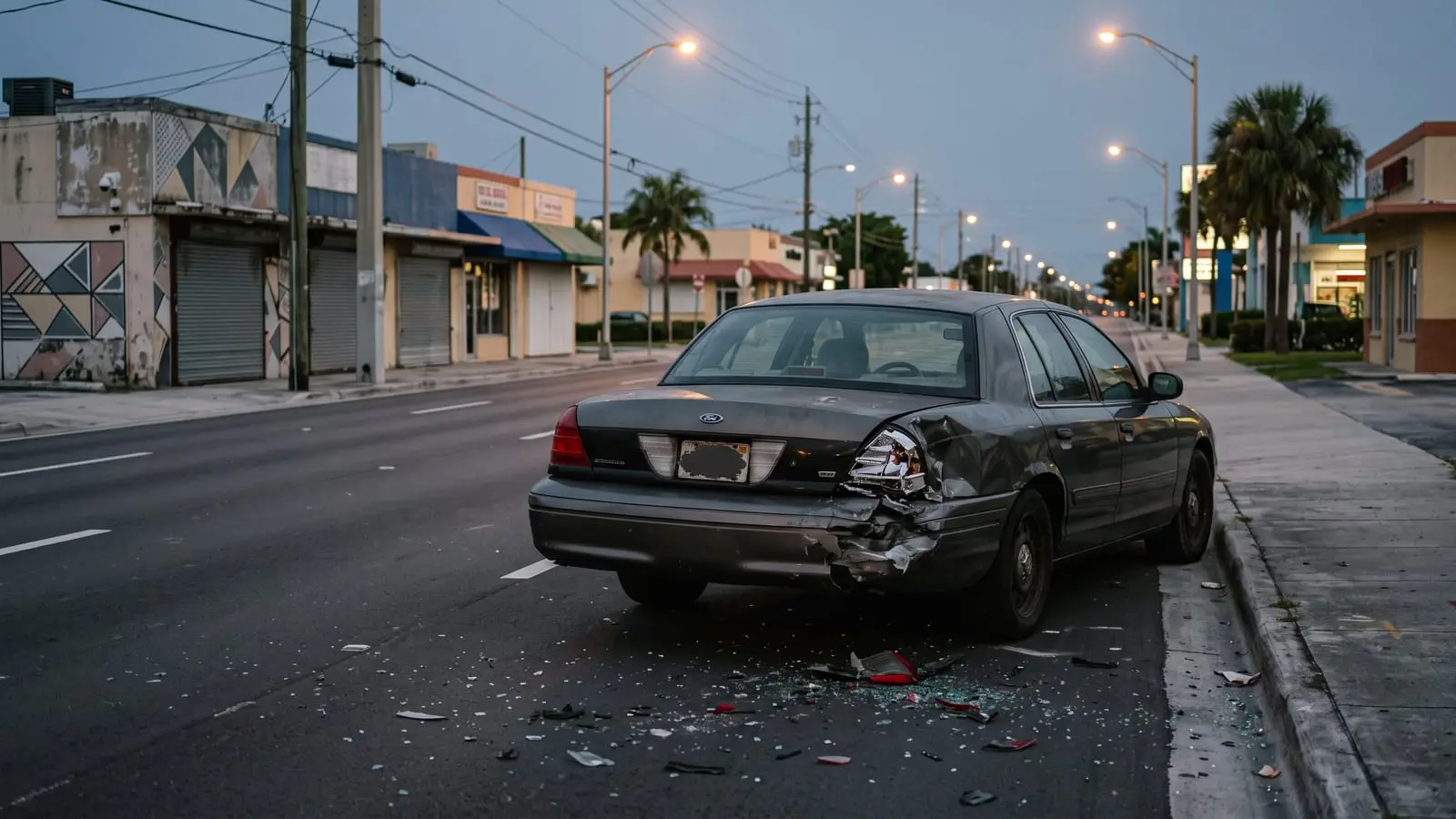
A client is rear-ended on the Palmetto by a driver with no bodily injury coverage. She has herniated discs and needs injections. PIP pays $10,000 and is gone. Her policy shows $25,000 in UM, “non-stacked,” on a two-car policy. We request the policy file. The insurer cannot produce a signed stacking rejection. The available UM is now $50,000, and because the coverage is stacked, the exclusion the insurer had raised about the second car no longer applies. Same premium, same policy, twice the coverage, because of a form. This is not unusual.
Making a UM claim
A UM claim is a claim against your own insurer, and your insurer is entitled to the same defenses the at-fault driver would have had: comparative fault, the permanent-injury threshold, causation. It will ask for a recorded statement or examination under oath, and it will use it. Cooperate, but with a lawyer. Your insurer cannot cancel, non-renew, or surcharge you for making a UM claim on a crash you did not cause (Fla. Stat. § 626.9541(1)(o)3).
If the at-fault driver has some coverage, the underinsured claim requires a specific procedure: notify your UM insurer of the tender, give it the statutory period to decide whether to substitute its own payment and pursue the driver, and only then release the driver (Fla. Stat. § 627.727(6)). Settling with the at-fault driver without that step can forfeit the UM claim entirely.
What to check today, before you need it
Look at your declarations page. Find the UM line. If it says “rejected,” “non-stacked,” or shows limits lower than your bodily injury limits, call your agent and ask what it costs to fix. Then look at the policies of relatives who live with you. If you were already hurt, call us and we will read all of it. (305) 285-7071. Free consultation, English or Spanish, no fee unless we recover money for you.
Key facts
- Insurers must offer UM coverage and obtain a written rejection if the insured declines it. Source: Fla. Stat. § 627.727(1)
- UM coverage is stacked unless the insured signs a specific rejection of stacking on the approved form. Source: Fla. Stat. § 627.727(9)
- Florida does not require private drivers to carry bodily injury liability coverage; only PIP and $10,000 property damage liability are mandatory. Source: Fla. Stat. § 324.022, § 627.733
- An insurer may not cancel, non-renew, or surcharge a policy solely because the insured made a UM claim for a crash they did not cause. Source: Fla. Stat. § 626.9541(1)(o)3
Frequently asked questions
Where do I find whether my UM is stacked?
On the declarations page of your auto policy, next to "Uninsured Motorist" or "UM/UIM," it will say stacked or non-stacked and show the limits per person and per accident. If it does not say, ask the insurer in writing for the policy and any UM selection or rejection form.
I have one car. Does stacking matter?
Less for the multiplier, but yes for scope: stacked coverage follows you when you are a pedestrian, a passenger, or driving a car you do not own, with fewer exclusions than non-stacked.
The other driver had $10,000 in bodily injury coverage. How does UM work then?
That is underinsured motorist coverage. You accept the $10,000 limits with your UM insurer's consent, following the procedure in Fla. Stat. § 627.727(6), and then claim against your own UM for the rest. Done wrong, the procedure can forfeit the UM claim, which is a reason to have a lawyer.
Will my rates go up if I make a UM claim?
Florida law prohibits an insurer from canceling, non-renewing, or surcharging you solely because you made a UM claim for a crash you did not cause (Fla. Stat. § 626.9541(1)(o)3).
This article is general information about Florida law, not legal advice, and reading it does not create an attorney-client relationship with Wolfson & Leon. Every case is different and prior results do not guarantee a similar outcome. If you were hurt, talk to a lawyer about your own situation.