
How an Uber Accident Settlement Works and Where the Money Goes
After an Uber accident in Florida, your attorney sends a demand package to the insurer, the parties negotiate a number, and you sign a release that permanently ends your claim against those parties. Before any money reaches you, the gross settlement is reduced by the attorney fee, case costs advanced by the firm, and any outstanding medical liens, so the settlement amount and the check you deposit are two different figures. The two-year deadline under Fla. Stat. § 95.11 drives every step of the timeline, because missing it bars your claim entirely.
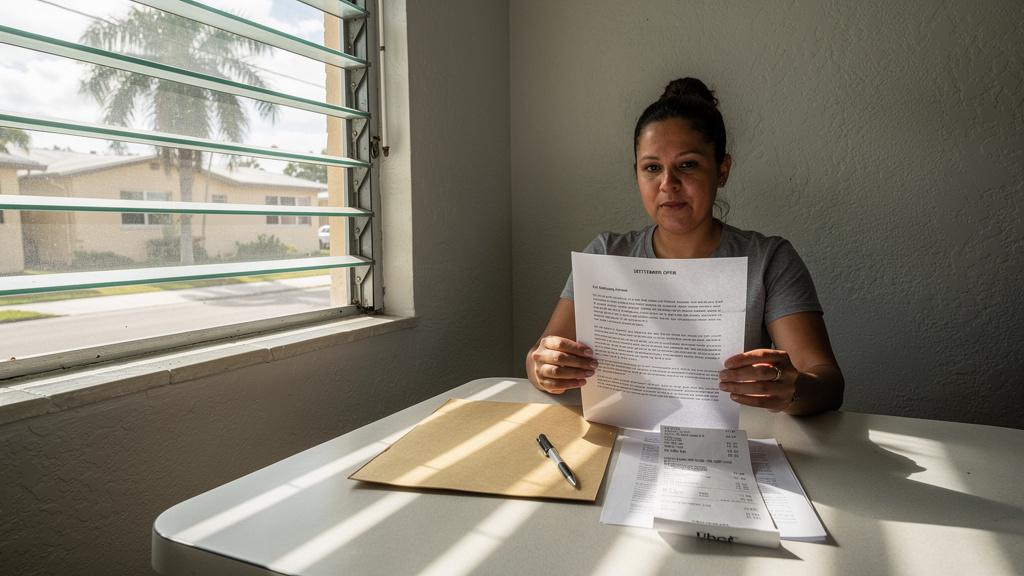
After an Uber accident in Florida, your attorney sends a demand package to the insurer, the parties negotiate a number, and you sign a release that permanently ends your claim against those parties. Before any money reaches you, the gross settlement is reduced by the attorney fee, case costs advanced by the firm, and any outstanding medical liens, so the settlement amount and the check you deposit are two different figures. The two-year deadline under Fla. Stat. § 95.11 drives every step of the timeline, because missing it bars your claim entirely.
What goes into the demand package, and how does the insurer respond?
A demand package is a formal submission your attorney sends to the insurance company to begin serious settlement talks. It typically includes a demand letter stating the amount sought, medical records and bills, proof of lost wages, photos of injuries or vehicle damage, the police crash report, and a written explanation of how the injuries have disrupted your life. Note that under Fla. Stat. § 316.066, the official crash report is confidential for the first 60 days and only available to the involved parties, their insurers, and their lawyers. Once received, the insurer assigns an adjuster who reviews everything and responds, usually with a low initial offer, a request for more documentation, or rarely, a denial. Corporate insurance carriers move fast to minimize their payout for long-term injuries. Initial offers can change substantially through negotiation. During an active trip, from when the driver accepts the ride to when you are dropped off, Florida law requires Uber to carry at least $1 million in third-party liability coverage under Fla. Stat. § 627.748, which is often the main source of payment in a serious rideshare claim, though other coverage may also apply.
What happens when negotiation stalls, and when does a lawsuit get filed in Miami-Dade?
If the insurer’s offers stop increasing or the gap between what they offer and what your case is worth remains too wide, your attorney will file a personal injury lawsuit. In Miami-Dade County, that means filing in the 11th Judicial Circuit Court. Filing suit does not mean your case is headed to trial, most cases settle after a lawsuit is filed, often during the discovery phase. Discovery includes depositions, written questions (interrogatories), and requests for documents, which can uncover new evidence that pushes the insurer to raise its offer. Your attorney may file suit even while settlement talks continue just to meet the two-year deadline under Fla. Stat. § 95.11. Once in court, the defense will formally assert arguments like your share of fault under Florida’s modified comparative negligence rule (Fla. Stat. § 768.81(6)), which reduces your recovery if you are found partially at fault, but cuts it off entirely only if you are more than 50 percent responsible. You do not need to “try the insurance company first” before hiring a lawyer; early legal involvement often leads to better outcomes.
Why does the two-year deadline control everything on the calendar?
Under Fla. Stat. § 95.11, you have two years from the date of the accident to file a personal injury lawsuit if your crash happened on or after March 24, 2023. Before that date, the deadline was four years. This clock starts ticking the day of the crash, not when you finish treatment or hire a lawyer. If you miss this deadline, your claim is permanently barred, no matter how clear the other driver’s fault or how severe your injuries. Because of this hard cutoff, your attorney must plan every step, gathering records, sending the demand, negotiating, and deciding whether to file suit, around that two-year window. In complex cases involving ongoing medical treatment, disputed liability, or multiple parties (like Uber, the driver, and another motorist), time runs faster than many expect. Waiting too long to act can leave no option but a rushed or incomplete claim.
What exactly are you giving up when you sign the release?
A settlement release is a binding contract that permanently closes your right to sue the named parties for anything related to this accident. Once you sign it, that decision cannot be undone, even if your condition worsens, new symptoms appear, or future surgery becomes necessary. You give up all future claims against those released parties in exchange for the settlement payment. This is why attorneys usually advise waiting until you reach maximum medical improvement or a stable understanding of your long-term prognosis before accepting a final offer. The release also specifies exactly who is protected, signing one with Uber’s insurer does not automatically release a separate negligent driver involved in the crash. The scope of who is released and what claims are covered is part of the negotiation. Never sign a release based only on early estimates of your injuries.
Where does the money actually go before it reaches you?
The settlement number you agree to is the gross amount. What you receive is the net after three types of deductions. First, the attorney fee is taken out. Wolfson & Leon works on a contingency basis, you pay no fee unless we recover money, and the percentage is clearly stated in your written fee agreement. Second, the firm is reimbursed for case costs it paid upfront, such as court filing fees, medical record copies, expert witness fees, and deposition costs. Third, any valid medical liens or reimbursement obligations are resolved. These can include claims from health insurers, Medicare conditional payments, Florida Medicaid (under Fla. Stat. § 409.910), hospital liens, or balances owed to doctors under letters of protection. The exact amounts depend on your specific treatment and insurance coverage and are not always predictable upfront. Only after these three categories are satisfied do you receive your net check.
Does a minor’s settlement require court approval, and what about timing?
Often, yes. Under Fla. Stat. § 744.387, a minor’s settlement above the amount set in the statute must be reviewed and approved by a Florida circuit court before it becomes final. A petition is filed, a hearing is scheduled, and a judge must confirm the deal is in the child’s best interest. This adds weeks or months to the process. Overall timing varies widely: straightforward Uber accident claims with clear liability and minor injuries may resolve within several months after treatment ends. Complex cases, serious injuries, disputed fault, or involvement of multiple insurers, can take a year or longer. Filing suit in the 11th Judicial Circuit adds time due to court scheduling and discovery. Every case moves at its own pace.
Frequently asked questions
Should I take Uber’s first offer or wait?
Almost never. First offers are typically far below the true value of your claim, especially if you are still treating or have not yet documented all your losses. Accepting too soon locks in that low number permanently.
Can I settle my Uber accident claim without a lawyer and keep more money?
You might avoid a fee, but you also risk undervaluing your claim or missing critical deadlines like the two-year statute of limitations. Insurers generally aim to keep payouts low. An experienced attorney often recovers enough additional compensation to outweigh the fee.
What happens if the two-year deadline passes before my case settles?
Your right to sue is almost always permanently lost. Even strong cases with clear liability cannot proceed after the deadline under Fla. Stat. § 95.11.
Why is my settlement check less than the amount I agreed to?
Because the gross settlement is reduced by attorney fees, case costs the firm advanced, and any medical liens or reimbursement obligations that must be paid from the recovery.
My child was hurt in an Uber crash. Is the settlement process different?
Yes. A minor’s settlement may need approval by a Florida circuit court under Fla. Stat. § 744.387, depending on its amount, to ensure it serves the child’s best interests. This adds procedural steps and time before funds can be released.
Related reading: I was in an Uber or Lyft accident in Hialeah. Whose insurance pays? · How long does a personal injury case take in Miami-Dade? · How long do I have to file an injury lawsuit in Florida? The two-year rule after HB 837 · The 14-day PIP rule in Florida: what happens if you wait to see a doctor after a Hialeah car accident
Hurt in an accident in Hialeah? Call Wolfson & Leon at 305-965-3766 for a free consultation. We speak Spanish, and there is no fee unless we win.
Key facts
- Florida's statute of limitations for personal injury negligence claims arising on or after March 24, 2023 is two years from the date of the accident. Source: Fla. Stat. § 95.11
- A settlement release permanently extinguishes the injured person's right to sue the released parties again, even if injuries later prove worse than expected. Source: Fla. Stat. § 768.041
- When a minor's personal injury settlement exceeds the threshold set by Florida law, a court must approve the settlement before it is binding. Source: Fla. Stat. § 744.387
- During an active Uber trip (ride accepted through passenger drop-off), Florida law requires at least $1 million in third-party liability coverage to be in place. Source: Fla. Stat. § 627.748
- Under Florida's modified comparative negligence rule, a claimant who is more than 50 percent at fault for their own injuries recovers nothing; at 50 percent or less, the award is reduced by their share of fault. Source: Fla. Stat. § 768.81(6)
Frequently asked questions
Should I take Uber's first offer or wait?
A first offer from an insurer is a starting position, not a final number. Offers often change substantially through negotiation. You should not accept any offer before you understand the full extent of your injuries, your future medical needs, and all available insurance coverage. Once you sign a release, your claim against the released parties is permanently closed.
Can I settle my Uber accident claim without a lawyer and keep more money?
You can negotiate on your own, but insurers deal with claims daily and you likely do not. The concerns about attorney fees are real, but at Wolfson & Leon the fee is contingency-based, explained in writing upfront, and nothing is owed if there is no recovery. Unrepresented claimants often miss coverage layers, sign releases too early, or undervalue future medical costs, mistakes that can cost far more than a legal fee.
What happens if the two-year deadline passes before my case settles?
Under Fla. Stat. § 95.11, if a lawsuit is not filed within two years of the accident date (for claims arising on or after March 24, 2023), the right to sue is permanently lost. The insurer has no legal obligation to pay anything after the deadline passes, no matter how serious the injuries or how clear the fault. This deadline runs from the crash date, not from when treatment ends, so tracking it from day one is essential.
Why is my settlement check less than the amount I agreed to?
The agreed settlement number is the gross recovery. Before the check reaches you, the attorney fee (a percentage set out in your written contingency agreement), case costs the firm advanced, and medical liens or reimbursement claims from health insurers, Medicare, Medicaid, or treating providers under letters of protection are all deducted. What remains after those reductions is your net recovery. Understanding this distinction before you sign a release is important.
My child was hurt in an Uber crash. Is the settlement process different?
Yes. Under Fla. Stat. § 744.387, settlements involving a minor may require approval by a Florida circuit court to be valid. A petition is filed, a hearing is scheduled, and a judge reviews whether the settlement is in the child's best interest before signing an order. This adds procedural steps and time to the process beyond a standard adult claim.
This article is general information about Florida law, not legal advice, and reading it does not create an attorney-client relationship. Every case is different and past results do not guarantee a similar outcome. For advice about your situation, call Wolfson & Leon at 305-965-3766 for a free consultation.
Also available in: Versión en español
 Uber and Lyft accidents
 Are Online Uber Accident Settlement Ranges and Calculators Accurate?
Online Uber accident settlement averages and calculators are not accurate for any individual Florida case because they cannot see the five variables…
 Uber and Lyft accidents
 Does It Matter Whether the Uber Driver Had a Ride When the Crash Happened?
Yes, the Uber driver's app status at the exact moment of impact controls which insurance policy responds and how much coverage is available. Florida…
 Uber and Lyft accidents
 Was the Uber Driver on the App When They Hit You? How to Find Out
Whether the Uber or Lyft driver was logged into the app at the moment they hit you is the single fact that decides which insurance policy pays and…