
Is Lane Splitting Legal in Florida? What It Means for Your Motorcycle Claim
Lane splitting is illegal in Florida under FS 316.209, and an insurer will use that violation against you, but it does not automatically end your claim. Florida's modified comparative fault rule bars recovery only if you are found more than 50 percent at fault, so the other driver's negligence still counts. If the driver failed to signal, check mirrors, or made an unsafe lane change, their share of fault can keep your share well below that threshold.
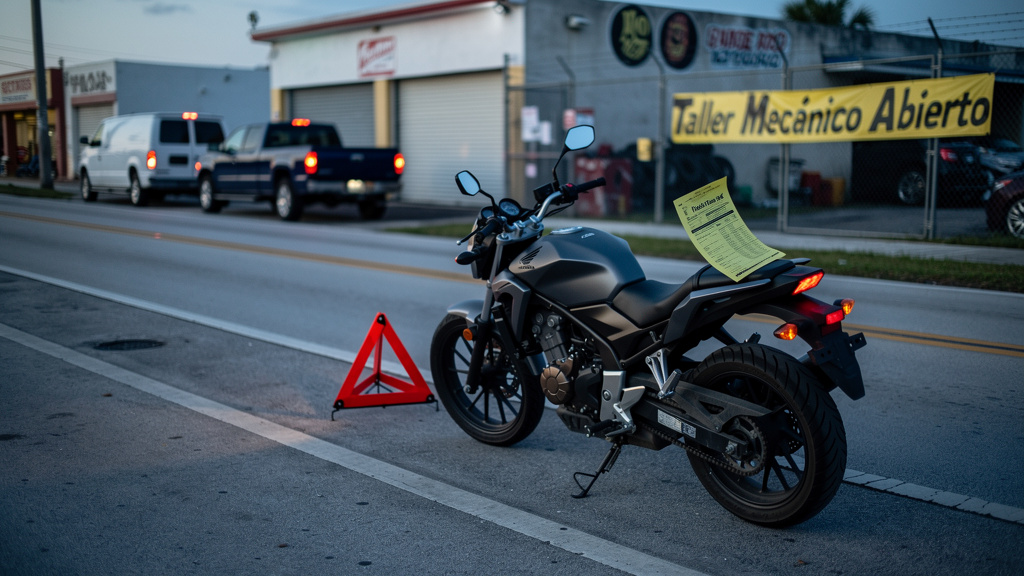
Is lane splitting actually illegal in Florida, or is it just rarely enforced?
Lane splitting is illegal in Florida, full stop. Florida Statute 316.209 prohibits a motorcyclist from overtaking and passing a vehicle within the same lane and from operating between lanes of traffic or between adjacent lines or rows of vehicles. That language covers both lane splitting at highway speeds and lane filtering at red lights. Florida draws no distinction between the two.
A post circulating on X describes lane splitting in Miami as “not legal like it is in California, but tolerated.” That description is legally meaningless. Tolerance by other drivers or by individual officers in a given moment is not a statutory exception. The law on the books in Tallahassee governs, not the informal habits of Palmetto Expressway traffic. If you were splitting lanes when the crash happened, the other driver’s insurer will point to FS 316.209 the moment it gets the police report.
One important distinction: the same statute expressly permits two motorcycles to ride side by side within a single lane. That is lane sharing, and it is lawful. Lane splitting, riding between lanes or between a lane and a line of stopped vehicles, is not.
What exactly does FS 316.209 say about how motorcycles must use a lane?
FS 316.209 works in both directions. It limits what a rider can do, but it also protects the rider’s right to the road.
On the protection side: a motorcycle is entitled to full use of a lane. No other vehicle may deprive a rider of that full lane. A car that drifts into a motorcycle’s lane, crowds the rider toward the shoulder, or forces the bike out of its path violates the statute.
On the restriction side: a rider may not overtake and pass a vehicle that occupies the same lane, and may not operate between lanes or between adjacent rows of vehicles. FS 316.209(3) addresses the between-lanes prohibition specifically. Two motorcycles abreast in one lane is the only side-by-side configuration the statute permits. Three or more abreast is not permitted.
Narrow exceptions exist for law enforcement officers and firefighters acting in an official capacity. Those exceptions do not apply to civilian riders.
Some other states allow lane filtering in limited circumstances, but Florida law does not. The statute in force today is what governs your claim.
How does a lane-splitting allegation change who is at fault for the crash?
It raises your fault percentage. It does not end your claim.
Florida uses modified comparative negligence under FS 768.81(6). Your recovery is reduced by your share of fault, and you are barred from recovering anything only if you are found more than 50 percent at fault. To be precise: more than 50 percent and you recover nothing; 50 percent or below and you recover the proportionate remainder.
Put it in plain numbers. If your proven damages total a certain amount and a jury finds you 30 percent at fault, you recover 70 percent of that amount. If the jury finds you more than 50 percent at fault, you recover zero.
Florida shifted from pure comparative negligence to this modified standard in a 2023 law that generally applies to negligence cases filed after March 24, 2023. If your case was filed before that date, a different standard may apply and you should discuss it with an attorney.
The insurer’s playbook is to push your fault percentage as high as possible. It will argue that the lane-splitting violation placed you in a dangerous position and that the crash flows from that choice. But fault and causation are two separate questions. The operative legal question is whether the lane splitting actually contributed to how this specific collision happened. A driver who changed lanes without signaling, without checking mirrors, without confirming the lane was clear, carries fault for that conduct regardless of where your bike was. A driver who rear-ended a stopped motorcycle is not automatically cleared because the rider had been splitting lanes earlier in the same ride.
Driver conduct worth examining: failure to signal before a lane change, failure to check mirrors or blind spots, distracted driving, speeding, or drifting across a lane line without looking. Any of those can shift meaningful fault back toward the driver and keep your share well below the more-than-50-percent bar.
What about riding two abreast, is that the same as lane splitting?
No. FS 316.209 explicitly allows up to two motorcycles to ride side by side within a single lane. The bikes occupy one marked lane together. That is lane sharing, and it is lawful.
Lane splitting is different because the rider is operating between lanes or between a lane and a row of adjacent vehicles. If two motorcycles are riding abreast within a marked lane and a car strikes one of them, the lane-splitting prohibition is not triggered by the abreast riding alone. The analysis shifts to the duties of care each party owed under the circumstances. Three or more motorcycles abreast in one lane is not permitted under the statute, so that configuration carries a different analysis. If you are unsure which category describes your crash, a Florida motorcycle accident claim review can sort that out.
What should I do if the insurer says I was lane splitting and tries to deny or minimize my claim?
The insurer’s first move is predictable. It will declare you at fault based on the FS 316.209 violation, issue an early settlement offer before you know your full medical picture, argue that the lane splitting placed you in the path of danger even if the driver’s own negligence caused the collision, and request a recorded statement hoping you describe your riding behavior in a way that confirms its version of events.
Here is what to do instead.
Do not give a recorded statement to the other driver’s insurer without an attorney present. The adjuster who called within hours of your crash was not calling to help you. A recorded statement is a tool to lock you into a description that benefits the insurer, not you.
Preserve video immediately. Helmet cam footage, dashcam footage, nearby business security cameras, and traffic cameras can be overwritten within days. Once that footage is gone, it is gone.
Get the police report. Under FS 316.066, crash reports are confidential for 60 days after the report is filed, but you, your insurer, and your attorney can access the report during that period. Read it carefully. A police report is not the final word on fault; it is one piece of evidence, and it is sometimes wrong.
Document all medical treatment and connect it clearly to the crash. Florida does not require motorcycle riders to carry PIP, so riders usually have no personal injury protection paying 80 percent of medical bills regardless of fault. You are working from a different set of coverages: the at-fault driver’s bodily injury liability policy, your own uninsured and underinsured motorist coverage (if your policy includes bodily injury liability coverage, FS 627.727 requires a written rejection for UM to be absent, so check your policy), and MedPay if your motorcycle policy includes it. Identify all of those before you talk numbers with anyone.
On the deadline: for crashes on or after March 24, 2023, FS 95.11 gives you two years from the crash date to file a negligence lawsuit. Two years sounds like a long time. It is not, once you account for finding witnesses, preserving security footage, obtaining medical records, and building a liability case. Waiting until the deadline approaches means losing the ability to gather that evidence.
For a fuller look at how Florida motorcycle accident claims work, including what coverages apply when PIP is off the table, that resource walks through the process step by step.
Frequently asked questions
Does a lane-splitting ticket automatically mean I lose my motorcycle accident claim in Florida?
No. A ticket for violating FS 316.209 raises your share of fault in the comparative negligence analysis, but it does not automatically bar your recovery. Under FS 768.81(6), your claim is barred only if you are found more than 50 percent at fault. If the other driver’s negligence, such as an unsignaled lane change or distracted driving, contributed to the crash, your share of fault may remain well below that threshold.
Is lane filtering at a red light legal in Florida?
No. FS 316.209 prohibits operating between lanes of traffic or between adjacent lines or rows of vehicles. That language covers both splitting at speed and filtering between stopped vehicles at a light. Florida currently draws no distinction between the two, and as of 2026 no filtering exception has been enacted into law. You can read more about Florida motorcycle accident deadlines and claim rules for 2026.
Can I recover compensation if I was lane splitting and got hit by a driver who changed lanes without signaling?
Whether you can recover depends on how fault is apportioned between you and the other driver under Florida’s modified comparative negligence rule. If the driver’s failure to signal, check mirrors, or confirm the lane was clear contributed substantially to the collision, their share of fault may keep your share from going over 50 percent. Causation matters: the question is not only whether you were splitting lanes, but whether that conduct actually contributed to how this specific crash happened. A free consultation can help you understand how the facts of your situation weigh out.
Why doesn’t PIP cover my motorcycle accident injuries in Florida?
Florida’s no-fault law does not require motorcycle riders to carry PIP, so riders usually have no PIP. PIP exists to pay a portion of medical bills and lost wages quickly, regardless of fault, but that benefit usually is not available to motorcycle riders. That makes the at-fault driver’s bodily injury liability policy, your own MedPay coverage, and your uninsured or underinsured motorist coverage under FS 627.727 the primary sources of recovery for your medical expenses. Understanding what coverages apply after a motorcycle crash in Florida is an important early step.
How long do I have to file a lawsuit after a motorcycle accident in Florida?
For crashes on or after March 24, 2023, FS 95.11 sets a two-year deadline to file a negligence lawsuit. Missing that deadline generally means losing the right to sue, regardless of how strong your case is. Two years passes faster than most people expect, especially while recovering from serious injuries, so gathering evidence and speaking with an attorney early protects your options.
Complete guide: Motorcycle Accidents in Hialeah: What Every Injured Rider Needs to Know
Hurt in an accident in Hialeah? Call Wolfson & Leon at 305-965-3766 for a free consultation. We speak Spanish, and there is no fee unless we win.
Key facts
- Florida Statute 316.209 prohibits a motorcyclist from operating between lanes of traffic or between adjacent lines or rows of vehicles, covering both lane splitting at speed and lane filtering at red lights. Source: FS 316.209
- Under Florida's modified comparative negligence rule, an injured rider is barred from recovering any damages only if they are found MORE THAN 50 percent at fault, not merely partially at fault. Source: FS 768.81(6)
- Florida does not require motorcycle riders to carry PIP, so injured riders usually have no PIP to cover immediate medical bills and often must pursue the at-fault driver's bodily injury liability coverage or their own optional coverages such as MedPay or UM/UIM. Source: FS 627.736
- For crashes on or after March 24, 2023, an injured motorcyclist has two years from the crash date to file a negligence lawsuit in Florida. Source: FS 95.11
- FS 316.209 expressly permits two motorcycles to ride side by side within a single lane, this is legal lane sharing, not lane splitting. Source: FS 316.209
Frequently asked questions
Does a lane-splitting ticket automatically mean I lose my motorcycle accident claim in Florida?
No. A traffic citation for lane splitting is evidence of a violation, but it is not a final determination of civil liability. Florida's modified comparative fault system under FS 768.81(6) allows a rider to recover as long as they are not more than 50 percent at fault. The driver's own negligence, failure to signal, distracted driving, an unsafe lane change, still factors into the fault calculation. A ticket makes the claim harder, but it does not end it.
Is lane filtering at a red light legal in Florida?
No. Florida Statute 316.209 prohibits operating a motorcycle between adjacent lines or rows of vehicles, and that language covers stopped cars at a traffic signal just as it covers moving traffic on a highway. Some states allow lane filtering as a narrower, distinct practice, but Florida law does not. A rider who moves to the front of a stopped line at a light is committing the same infraction as one splitting lanes at highway speed.
Can I recover compensation if I was lane splitting and got hit by a driver who changed lanes without signaling?
Possibly, yes. The key question under Florida's comparative fault rule is how much of the crash each party caused. If the driver made an unsafe lane change without signaling or checking their mirrors, their negligence is a contributing cause regardless of your lane position. If your share of fault is determined to be 50 percent or less, you can recover a proportionate share of your damages. The specific facts, speed, traffic conditions, visibility, whether the driver looked, determine how those percentages are divided.
Why doesn't PIP cover my motorcycle accident injuries in Florida?
Florida's no-fault law does not require motorcycle riders to carry Personal Injury Protection, so riders usually have no PIP. This means there is usually no automatic first-party medical coverage attached to your motorcycle policy the way there is for car owners. Instead, injured riders typically must pursue the at-fault driver's bodily injury liability coverage, their own optional MedPay coverage, or their own uninsured/underinsured motorist (UM/UIM) coverage under FS 627.727. Because of this gap, carrying MedPay and robust UM/UIM limits matters more for motorcyclists than for drivers of cars.
How long do I have to file a lawsuit after a motorcycle accident in Florida?
For crashes that occurred on or after March 24, 2023, Florida Statute 95.11 gives you two years from the date of the crash to file a negligence lawsuit. Missing that deadline generally means losing the right to sue entirely. Do not wait until the deadline is close, witnesses become hard to find, surveillance footage disappears, and physical evidence gets repaired or discarded. If your crash happened before March 24, 2023, a different limitations period may apply, so confirm the applicable deadline with an attorney as soon as possible.
This article is general information about Florida law, not legal advice, and reading it does not create an attorney-client relationship. Every case is different and past results do not guarantee a similar outcome. For advice about your situation, call Wolfson & Leon at 305-965-3766 for a free consultation.
Also available in: Versión en español
 Motorcycle accidents
Crashed Your Motorcycle in Florida With No Insurance: What Happens Next
You can still file a claim against the driver who caused the crash even if you were riding without insurance, Florida's fault-based system applies…
 Motorcycle accidents
Motorcycle Accidents in Hialeah: What Every Injured Rider Needs to Know
Florida's no-fault PIP system does not cover motorcyclists, so after a crash in Hialeah there is usually no automatic payment for your medical…
 Motorcycle accidents
What to Bring to Your Motorcycle Accident Attorney Consultation: A Printable Checklist
Bring your crash report number and agency, photos and witness contacts from the scene, your motorcycle insurance declarations page, the declarations…