
Partly to Blame for a Florida Crash? How the More-Than-50% Fault Rule Works
Yes, being partly at fault does not automatically end your claim in Florida. Under Fla. Stat. § 768.81(6), your recovery is reduced by your share of fault, and you are only completely barred from collecting anything if a judge or jury finds you were more than 50 percent responsible for your own harm. A finding of exactly 50 percent still lets you recover half your damages.
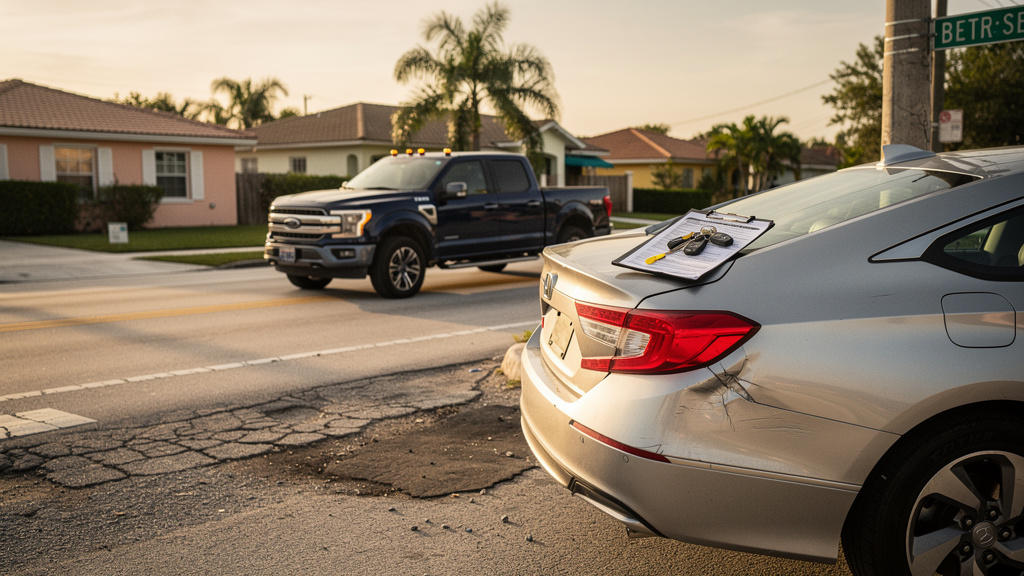
Being partly at fault for a crash does not automatically end your claim in Florida. Under Fla. Stat. § 768.81(6), your recovery is reduced by your share of fault, and you are only completely barred from collecting damages if a judge or jury finds you were more than 50 percent responsible for your own harm. A finding of exactly 50 percent still allows you to recover half your damages.
What does the more-than-50% fault rule actually mean in one sentence?
Florida law states that “any party found to be greater than 50 percent at fault for his or her own harm may not recover any damages.” That is the operative language from Fla. Stat. § 768.81(6), and the precision matters.
Many websites shorthand this as the “51% rule.” That framing is close enough to be useful, but it is not quite right. The actual threshold is anything greater than 50 percent. A plaintiff found exactly 50 percent at fault still collects half their damages. A plaintiff found 50.1 percent at fault collects nothing. That single decimal point is a cliff, not a slope.
The widespread myth that any shared fault kills a claim is simply wrong. Shared fault reduces what you recover. Only fault above that threshold eliminates it entirely. If an insurance adjuster or a friend tells you that being partly to blame means you get nothing, they are describing a different state’s law, or nothing at all.
How does my share of fault actually reduce what I can recover?
The reduction is proportional. Your award is cut by your percentage of fault, and you lose everything only if that percentage crosses the threshold.
Here is a hypothetical for arithmetic only, using percentages rather than any real case. Say a jury decides the total value of your damages.
If the jury finds you 20 percent at fault, your recovery is reduced by 20 percent. You collect 80 percent of your damages.
If the jury finds you exactly 50 percent at fault, your recovery is cut in half. You collect 50 percent of your damages, because the bar under Fla. Stat. § 768.81(6) requires more than 50 percent.
If the jury finds you 51 percent at fault, you collect zero. Not a reduced amount. Nothing.
That last outcome is why the fault percentage has become the central battlefield in every Florida injury claim filed after March 24, 2023. The difference between 50 percent and anything more than 50 percent is not a small adjustment to a check. It is the entire recovery.
What changed in March 2023, and does it affect my crash?
Before March 24, 2023, Florida followed pure comparative negligence. A plaintiff found 90 percent at fault for their own crash could still sue the other driver and recover 10 percent of their damages. That system penalized careless plaintiffs but never completely cut them off.
House Bill 837, signed into law as Chapter 2023-15 on March 24, 2023, replaced that with modified comparative negligence under Fla. Stat. § 768.81(6). The more-than-50-percent bar now applies.
One point that confuses people: two different dates control two different questions, and you cannot swap them.
For the fault bar, what matters is when the cause of action was filed. Cases filed after March 24, 2023 are subject to the new rule, even if the crash happened slightly before that date.
For the Florida statute of limitations for personal injury, what matters is when the injury occurred. A crash on or after March 24, 2023 gives you two years to file under Fla. Stat. § 95.11. A crash before that date generally falls under the older four-year window.
These are separate questions with separate answers. Do not let anyone conflate them.
Who decides how much of the crash was my fault?
A jury does, not an insurance adjuster. Comparative negligence is an affirmative defense. The defendant must plead it and prove your share of fault by the greater weight of the evidence. That happens at trial, and only if the case does not settle before then.
When an adjuster calls you within 48 hours of a crash on the Palmetto Expressway and says “our review puts you at 60 percent,” that person has made a settlement negotiating position, not a legal finding. It has no binding legal effect. What it does have is a practical effect if you accept it or say something that supports it.
Evidence shapes the fault number that actually matters, whether at settlement or at trial. Photographs of vehicle positions, skid marks, debris fields, and sight lines. Surveillance and dashcam video, which must be preserved immediately because footage is routinely overwritten within days. Event data recorder data, which captures pre-impact speed and braking. Witness names and contact information gathered before people leave the scene. The Hialeah Police Department crash report, which under Fla. Stat. § 316.066 is confidential for 60 days except to the parties, their insurers, and their lawyers.
Adjusters also mine recorded statements and social media posts for admissions. A phrase like “I didn’t see them coming” can be used to push your fault percentage higher. Do not give the other driver’s insurer a recorded statement to the other driver’s insurance company before speaking with a lawyer.
Does the rule work differently in a medical malpractice case?
Yes. Fla. Stat. § 768.81(6) contains an express carve-out. The more-than-50-percent bar “does not apply to an action for damages for personal injury or wrongful death arising out of medical negligence pursuant to chapter 766.” Medical malpractice claims under Chapter 766 remain under pure comparative fault.
What that means in practice: a patient found 75 percent at fault for a bad outcome, perhaps by repeatedly ignoring a surgeon’s post-operative instructions, is not barred from recovering. That patient can still collect the remaining 25 percent from a negligent provider.
Run the same numbers in an ordinary Hialeah car crash case and the outcome flips. Seventy-five percent fault means zero recovery under Fla. Stat. § 768.81(6).
The carve-out is narrow. It covers Chapter 766 medical negligence claims only. General premises liability at a clinic, or a product defect in a medical device, falls under the standard § 768.81 framework. Those claims are subject to the more-than-50-percent bar like any other negligence case.
What should you do right now if the insurer is blaming you?
Get medical care within 14 days. Under Florida’s 14-day PIP rule, your own PIP coverage pays 80 percent of reasonable medical bills and 60 percent of lost wages up to $10,000, when a qualified provider finds an emergency medical condition, regardless of who caused the crash. Miss the 14-day window and those benefits are forfeited entirely, not reduced. PIP draws first from your own policy, then from a resident relative’s policy in the same household. The cap drops to $2,500 if no emergency medical condition is found.
Preserve evidence immediately. Photographs, video, witness contact information, and a written preservation letter to any business with surveillance cameras must happen in the first hours and days after a crash near locations like Okeechobee Road or West 49th Street. Footage disappears fast.
Decline a recorded statement from the other driver’s insurer. Politely say you need to speak with a lawyer first. One carelessly worded sentence can add fault percentage points that cost real money, or push you past the threshold and cost you everything.
Understand the adjuster’s incentive. Under the old pure comparative system, disputing your fault only changed how much the insurer paid. Under the current rule, pushing you above 50 percent means the insurer pays nothing at all. That gives every adjuster a strong financial reason to argue you were mostly to blame. That is a negotiating position. A jury decides the actual number.
Watch the filing deadline. For crashes on or after March 24, 2023, you have two years to file under Fla. Stat. § 95.11. Waiting to see how an injury develops is understandable, but the clock starts on the day of the crash, not when you decide the injury is serious enough to pursue.
A free consultation with a car accident attorney in Hialeah costs you nothing and gives you a clear picture of where your fault percentage actually stands, based on evidence, not an adjuster’s opening offer.
Frequently asked questions
If I was 50 percent at fault for a Florida crash, do I get anything?
Yes. Florida Statute § 768.81(6) bars recovery only for a plaintiff found to be more than 50 percent at fault. At exactly 50 percent, your damages are reduced by half, but you still recover the remaining half. The bar applies to any share of fault above 50 percent, not to 50 percent itself.
Can the other driver’s insurance company decide my fault percentage?
No. An adjuster can assert a fault percentage as part of settlement negotiations, but that number has no legal binding effect. The fault percentage that actually controls your recovery under Fla. Stat. § 768.81(6) is determined by a jury at trial, or agreed to in a settlement that you choose to accept. You are never required to accept an adjuster’s fault assessment.
Does Florida’s no-fault system mean my fault percentage doesn’t matter?
Not entirely. Your PIP coverage pays regardless of fault, which handles a portion of your medical bills and lost wages up to the policy limit. But PIP does not cover pain and suffering, and it does not cover damages above its limits. When you pursue a claim against the at-fault driver for those additional damages, your fault percentage under Fla. Stat. § 768.81(6) becomes the deciding factor in whether you can collect and how much.
I was hurt in a crash before March 2023. Does the more-than-50% bar apply to me?
It depends on when the cause of action was filed, not only when the crash occurred. Chapter 2023-15 applies the modified comparative negligence rule to causes of action filed after March 24, 2023. If your crash predated that date but your case was filed afterward, the new rule may apply. The separate question of which statute of limitations governs your case turns on the date of injury, not the filing date. An attorney can tell you which rules apply to your specific timeline.
What if I was hurt by a negligent doctor? Does the more-than-50% bar apply to my malpractice case?
No. Fla. Stat. § 768.81(6) expressly excludes medical malpractice claims brought under Chapter 766 from the more-than-50-percent bar. Those claims remain under pure comparative fault, meaning a patient can recover even when found more than 50 percent responsible for their own outcome. The recovery is reduced by the patient’s share of fault, but it is not eliminated. This carve-out applies only to Chapter 766 medical negligence, not to other claims involving a medical setting.
Hurt in an accident in Hialeah? Call Wolfson & Leon at 305-965-3766 for a free consultation. We speak Spanish, and there is no fee unless we win.
Key facts
- A Florida plaintiff found more than 50 percent at fault for their own harm recovers nothing; at exactly 50 percent or less, their award is reduced by their fault percentage but not eliminated. Source: Fla. Stat. § 768.81(6)
- This modified comparative negligence rule applies to negligence causes of action filed after March 24, 2023, when House Bill 837 (Chapter 2023-15) was signed into law. Source: Chapter 2023-15, Laws of Florida, § 30
- Medical malpractice claims under Chapter 766 are expressly excluded from the more-than-50-percent bar and remain governed by pure comparative fault, meaning a patient can still recover even if found more than 50 percent at fault. Source: Fla. Stat. § 768.81(6)
- PIP pays 80 percent of reasonable medical bills and 60 percent of lost wages up to $10,000 (or $2,500 without an emergency medical condition finding), regardless of who caused the crash, but only if the injured person sought initial treatment within 14 days. Source: Fla. Stat. § 627.736
- Most Florida personal injury lawsuits must be filed within two years of the date the injury occurred for crashes that happened on or after March 24, 2023. Source: Fla. Stat. § 95.11
Frequently asked questions
If I was 50 percent at fault for a Florida crash, do I get anything?
Yes. Under Fla. Stat. § 768.81(6), the bar only applies to a party found to be more than 50 percent at fault. A plaintiff found exactly 50 percent at fault is not barred, they recover their damages reduced by 50 percent. Any explanation that says a 50-50 crash pays nothing in Florida is incorrect. The difference between 50 percent and anything greater is the difference between half your damages and zero.
Can the other driver's insurance company decide my fault percentage?
No. An adjuster calling within days and citing a fault percentage is stating a settlement position, not making a legal finding. Under Florida law, comparative negligence is an affirmative defense that the defendant must plead and prove by the greater weight of the evidence. The percentage that actually counts under Fla. Stat. § 768.81(6) is determined by a judge or jury if the case goes to trial, or negotiated as part of a settlement if it resolves beforehand. Do not treat an adjuster's early fault estimate as a final answer.
Does Florida's no-fault system mean my fault percentage doesn't matter?
No, that is a common and costly misconception. Florida's no-fault Personal Injury Protection (PIP) under Fla. Stat. § 627.736 pays your initial medical bills and a portion of lost wages regardless of fault, but it covers only up to $10,000 (or $2,500 without an emergency medical condition diagnosis) and does not compensate pain and suffering. Any claim beyond PIP, against the at-fault driver for pain, suffering, or damages that exceed PIP limits, is subject to the modified comparative fault rule under Fla. Stat. § 768.81(6), meaning your fault percentage matters a great deal.
I was hurt in a crash before March 2023. Does the more-than-50% bar apply to me?
It depends on when your lawsuit was filed, not when the crash happened. The modified comparative negligence bar under Fla. Stat. § 768.81(6) applies to causes of action filed after March 24, 2023. If your lawsuit was already filed before that date, the older pure comparative fault system, under which you could recover even if more than 50 percent at fault, generally governs your case. Speak with a lawyer about how the transition rules apply to your specific situation.
What if I was hurt by a negligent doctor, does the more-than-50% bar apply to my malpractice case?
No. Fla. Stat. § 768.81(6) expressly excludes medical negligence actions governed by Chapter 766. Medical malpractice claims remain under pure comparative fault, meaning a patient found more than 50 percent responsible for a bad outcome is not barred from recovering their remaining damages from a negligent provider. This carve-out applies only to Chapter 766 medical negligence, not to every claim that happens to involve a healthcare setting.
This article is general information about Florida law, not legal advice, and reading it does not create an attorney-client relationship. Every case is different and past results do not guarantee a similar outcome. For advice about your situation, call Wolfson & Leon at 305-965-3766 for a free consultation.
Also available in: Versión en español
 Personal injury
I Fell at Work in Hialeah: Do I Need Workers' Comp or a Personal Injury Lawyer?
Workers' compensation almost always covers a fall at work in Florida and is usually your only legal claim against your own employer. But if someone…
 Personal injury
Hit by a Driver With No Insurance in Florida: What Are Your Options?
Your own insurance is almost always the first place to look. Florida requires your PIP coverage to pay 80 percent of your reasonable medical bills…
 Personal injury
How Much Does an Accident Lawyer Charge in Hialeah, Florida?
Personal injury lawyers in Hialeah charge nothing upfront and no attorney fee at all unless they recover money for you. The fee is a percentage of…