
Slipped in a Florida Supermarket? You Can Sue If the Store Knew
Yes, you can sue a Florida supermarket if the store knew about the hazard or should have known about it and failed to clean it up or warn you. Florida law under Fla. Stat. § 768.0755 requires you to prove the store had actual or constructive knowledge of the dangerous condition, not just that you fell. If you can show the spill sat long enough for a reasonable store to have caught it, or that similar hazards happen there regularly, you have a case worth pursuing.
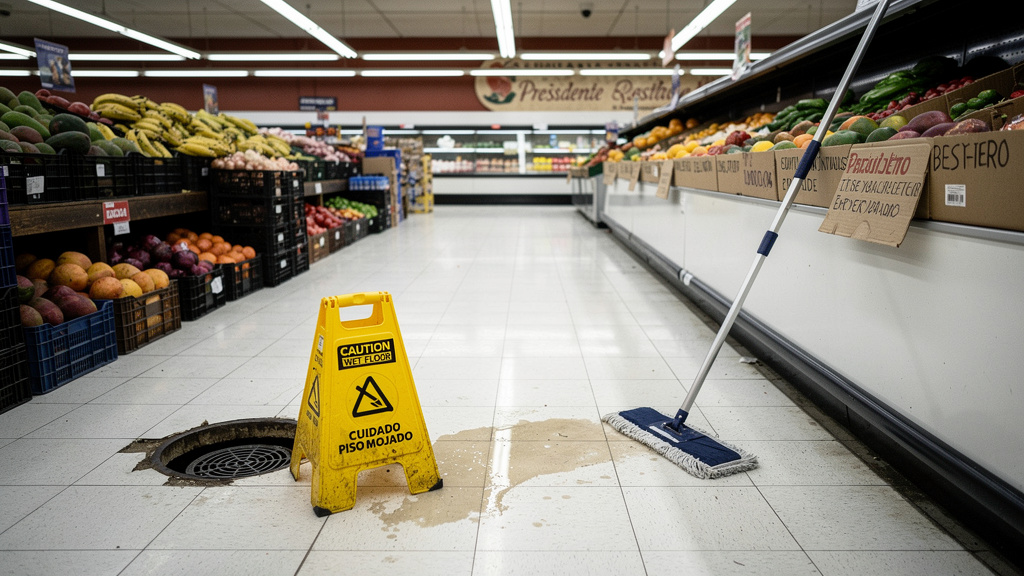
Slipped in a Florida supermarket? You can sue, but only if the store knew or should have known about the hazard that caused your fall. Florida law does not hold stores automatically responsible just because someone fell. Under Fla. Stat. § 768.0755, you must prove the store had actual or constructive knowledge of the dangerous condition and failed to fix it or warn customers. Winning a slip-and-fall lawsuit against a Florida store almost never comes down to whether you fell, it comes down to proving the store knew, or should have known, about the hazard in time to fix it.
Can I really sue the supermarket, or does falling on their floor not count?
Yes, you can sue, but not just because you fell. Florida is not a strict-liability state. The law requires proof that the supermarket knew or should have known about the spill, wet floor, or other transitory foreign substance before your fall. This rule comes from Fla. Stat. § 768.0755. In Hialeah, this often means recurring hazards like rainwater tracked inside during afternoon aguaceros, especially along busy corridors like W 49th St, Okeechobee Road, and W 68th St. Supermarkets in these areas should expect wet entrances during rainy season and take steps like placing absorbent mats or posting warning signs. If they do not, and you fall on water they should have anticipated, you may have a valid claim.
What does it mean that the store had to ‘know’ about the hazard?
Actual knowledge means an employee saw the hazard or was told about it and did nothing. Constructive knowledge means the hazard existed long enough, or happened often enough, that a reasonably careful store should have found and fixed it. Florida courts accept circumstantial evidence like dried edges around a spill, track marks through liquid, or video showing employees passing the spot without cleaning it. For example, evidence of a large puddle next to an identifiable source, such as a leaking cart, with employees working nearby, or of an item left on the floor for several minutes while workers walked past, can be enough for a jury to decide whether the store had constructive knowledge. Sweep logs and camera footage dominate these cases, they show how long a hazard sat and whether staff ignored it.
What exactly do I have to prove to win my case?
You must prove the four elements of negligence: the store owed you a duty of care; it breached that duty by failing to address a known hazard; that breach caused your injury; and you suffered real damages. For slips on liquids, produce, or tracked-in rain, Fla. Stat. § 768.0755 adds a key requirement, you must show the store had actual or constructive knowledge of the transitory foreign substance. Medical treatment at Hialeah Hospital or Palmetto General creates records linking your injuries to the fall. Even without broken bones, documented soft-tissue injuries, physical therapy, and lost wages count as damages. But medical records alone are not enough, you also need scene evidence like photos, witness statements, or surveillance. Do not assume the store’s lack of an incident report kills your claim; independent evidence can still support it.
What if I was partly at fault, looking at my phone, wearing the wrong shoes, or walking past a wet-floor sign?
Florida uses modified comparative negligence under Fla. Stat. § 768.81. If a jury finds you more than 50 percent at fault, you recover nothing. If you are 50 percent or less at fault, your recovery is reduced by your share. Stores will argue you were distracted by your phone, wore slippery shoes, or ignored a wet-floor sign to push your share past the midpoint, that is a complete win for them. But having one of these factors does not automatically end your case. For example, if you glanced at your phone but the spill was hidden behind a shelf with no warning, a jury might assign you only 20 percent fault. The key is how the jury divides fault between you and the store.
How long do I have to file a lawsuit, and what should I do in the next 30 days?
If your fall happened on or after March 24, 2023, you have two years from the date of injury to file a lawsuit under Fla. Stat. § 95.11. But waiting risks losing critical evidence. Surveillance footage is often overwritten within days or weeks. Sweep logs disappear. Memories fade. Take action now: photograph the hazard and surrounding area before it is cleaned; get the manager’s name and incident report number before leaving the store; send a written preservation request for video footage specifying the exact time, aisle, and a window of at least 30 minutes before and after your fall; seek medical care even if pain seems minor; and do not give a recorded statement to the store’s insurer until you speak with a lawyer. If you did not report the fall immediately, that does not end your claim, but you must act fast to preserve what evidence remains. Our office at 1840 W 49th St, Suite 734, Hialeah, is minutes from the supermarkets on W 49th St, Okeechobee Road, and W 68th St. Learn more about preserving evidence after a supermarket fall.
How does Wolfson & Leon handle these cases, and what does it cost?
We offer a free consultation and handle every part of your case in Spanish if you prefer. There is no attorney fee unless we recover money for you. Some injured people say they contacted two law offices and were turned away. That does not mean their case lacks merit, it may reflect challenges proving liability, limited insurance coverage, or low visible injuries. A second opinion is reasonable, especially when local knowledge matters. We focus on Hialeah and Miami-Dade and understand the supermarket corridors where falls happen most. Every case depends on its facts, but Florida law does allow stores to be held accountable when they knew or should have known about a danger and ignored it.
Frequently asked questions
Is the supermarket automatically responsible because I fell on their floor?
No. Florida law requires proof the store knew or should have known about the hazard. Falling alone does not create liability.
What if there were no witnesses and the store says it has no record of the incident?
Your claim can still move forward with photos, surveillance footage, medical records, or circumstantial evidence like dried spill edges. Lack of a store report is common but not fatal.
I slipped near the entrance because rain had been tracked in. Does that count?
Yes, if afternoon storms regularly bring water inside and the store fails to use mats or warnings, that may show constructive knowledge under Fla. Stat. § 768.0755(1)(b).
I do not have broken bones. Do I still have a claim?
Yes. Soft-tissue injuries, back pain, missed work, and ongoing treatment all qualify as damages if properly documented by a doctor.
How long do I have to sue the supermarket?
Two years from the date of your fall if the injury occurred on or after March 24, 2023, under Fla. Stat. § 95.11.
Related reading: I fell in a store in Hialeah. Can I make a claim? · The 14-day PIP rule in Florida: what happens if you wait to see a doctor after a Hialeah car accident · How long do I have to file an injury lawsuit in Florida? The two-year rule after HB 837
Hurt in an accident in Hialeah? Call Wolfson & Leon at (305) 285-7071 for a free consultation. We speak Spanish, and there is no fee unless we win.
Key facts
- Florida law requires the injured person to prove the store had actual or constructive knowledge of the dangerous condition and should have remedied it. Source: Fla. Stat. § 768.0755(1)
- Constructive knowledge can be proven by showing the hazard existed long enough that a reasonably careful store should have found it, or that the same type of hazard happens there regularly. Source: Fla. Stat. § 768.0755(1)(a)-(b)
- If a jury finds you more than 50 percent at fault for your own fall, you recover nothing; if 50 percent or less at fault, your recovery is reduced by your share of fault. Source: Fla. Stat. § 768.81
- For injuries on or after March 24, 2023, you have two years from the date of the fall to file a negligence lawsuit. Source: Fla. Stat. § 95.11
- Constructive knowledge can be shown with circumstantial evidence, such as how long a hazard sat on the floor or whether employees walked past it. Source: Fla. Stat. § 768.0755(1)(a)
Frequently asked questions
Is the supermarket automatically responsible because I fell on their floor?
No. Florida is not a strict-liability state. Under Fla. Stat. § 768.0755, falling on a store's floor is not enough on its own. You must prove the store had actual or constructive knowledge of the dangerous condition and failed to act. The fact that a spill or wet surface existed only matters legally if the store knew about it or should have discovered it through reasonable care.
What if there were no witnesses and the store says it has no record of the incident?
The case can still go forward. Courts have accepted circumstantial evidence, the size of a puddle, an identifiable source like a leaking freezer or restocking float, an employee stationed nearby, as sufficient to create a jury question on constructive knowledge. A written preservation demand sent promptly after the fall may also recover surveillance footage before it is overwritten, even without a formal incident report.
I slipped near the entrance because rain had been tracked in. Does that count?
It can. Afternoon rainstorms are a regular occurrence in South Florida's rainy season, and tracked-in water at store entrances is a foreseeable, recurring hazard. Under Fla. Stat. § 768.0755(1)(b), a condition that occurs with regularity is foreseeable, meaning the store can be charged with constructive knowledge even without proof of how long that particular puddle sat. Document the weather conditions, the location of the fall, and any absence of mats or wet-floor signs.
I do not have broken bones. Do I still have a claim?
Yes. Florida slip-and-fall claims can include soft-tissue injuries, documented treatment, physical therapy, lost wages, and pain and suffering even without fractures. The key is contemporaneous medical documentation. Seeking care promptly at a facility like Hialeah Hospital or Palmetto General creates the medical record that links the fall to your injuries before symptoms appear to fade.
How long do I have to sue the supermarket?
For falls on or after March 24, 2023, Florida gives you two years from the date of the injury to file a negligence lawsuit under Fla. Stat. § 95.11. Missing that deadline generally bars the claim no matter how strong it is. Because stores and insurers can drag out negotiations for months, consult an attorney well before that clock runs out.
This article is general information about Florida law, not legal advice, and reading it does not create an attorney-client relationship. Every case is different and past results do not guarantee a similar outcome. For advice about your situation, call Wolfson & Leon at (305) 285-7071 for a free consultation.
Also available in: Versión en español
 Slip and fall
 Where to Find a Slip and Fall Lawyer Near You in Hialeah
Wolfson & Leon has a Hialeah office at 1840 W 49th St, Suite 734, where Spanish- and English-speaking attorneys offer free consultations with no fee…
 Slip and fall
 I Fell at Work in Hialeah: Do I Need a Workers' Comp or Personal Injury Lawyer?
Workers' comp almost always covers a fall at work in Florida, and it is usually your only claim against your own employer. But if someone other than…
 Slip and fall
 What Florida Statute 768.0755 Requires You to Prove After a Grocery Store Slip
Under Fla. Stat. § 768.0755, slipping on something in a grocery store is not enough on its own, you must prove the store had actual or constructive…