
I Slipped at Someone Else's Store While Working, Can I Sue the Property Owner?
Yes. Workers' comp from your employer covers your medical bills and lost wages, but it does not protect the property owner where you were hurt. If that owner's negligence caused your fall, a wet floor, broken loading dock, poor lighting, you can bring a separate premises-liability lawsuit against them at the same time you receive comp benefits.
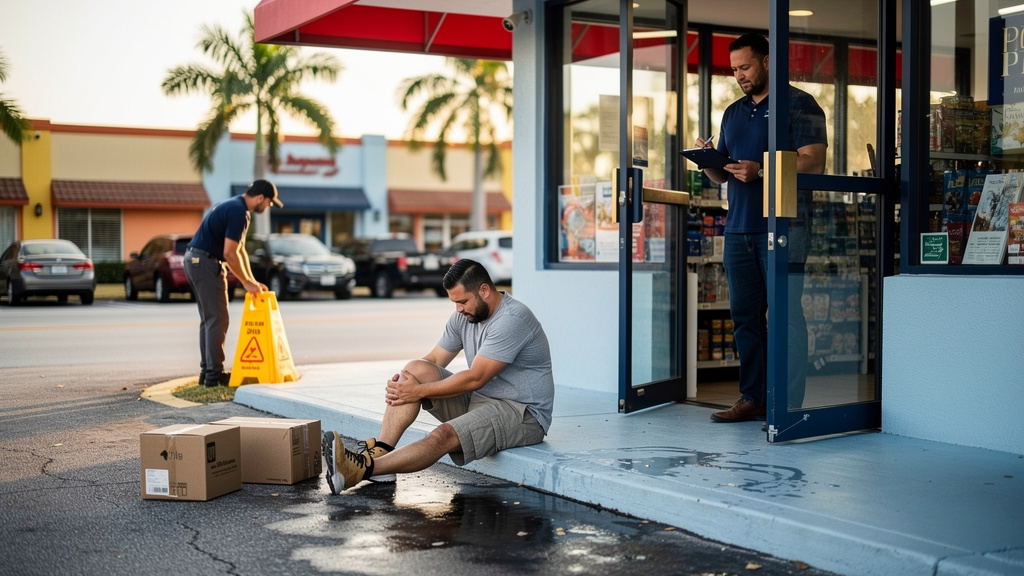
Yes. Workers’ comp from your employer covers your medical bills and lost wages, but it does not protect the property owner where you were hurt. If that owner’s negligence caused your fall, a wet floor, broken loading dock, poor lighting, you can bring a separate premises-liability lawsuit against them at the same time you receive comp benefits.
Why doesn’t my employer’s workers’ comp shield the property owner from a lawsuit?
Workers’ compensation provides a trade-off: you get guaranteed medical and wage benefits without having to prove fault, but in exchange you give up the right to sue your employer for additional damages. That immunity generally protects only your employer. It does not extend to third parties like the owner of a store, warehouse, or retail space where you were working when you fell. This is known as a third-party claim. For example, a delivery driver slipping in the receiving area of a grocery store on Okeechobee Road, a cleaning crew member falling in a Medley warehouse near the Palmetto Expressway, or a merchandiser hurt while stocking shelves, all can pursue the property owner separately. If the property owner is not your employer, it generally gets no protection from your employer’s workers’ comp immunity. The same can apply when the property belongs to a landlord rather than the business you were serving, depending on who controlled the area where you fell.
What do I actually have to prove against the property owner?
To win a premises liability case, you must show four things: the property owner owed you a duty of care, they breached that duty, their breach caused your injury, and you suffered actual damages. As someone on the property for a business purpose, like making a delivery or servicing equipment, you are considered a “business invitee,” which means the owner must keep the premises reasonably safe and fix or warn about hidden dangers. But ownership alone is not enough. You must prove they knew or should have known about the hazard and failed to act. Under Florida law, if you slipped on a spill or other transitory foreign substance, the rules are stricter. Florida Statute § 768.0755(1) requires proof that the business had actual knowledge (an employee saw or was told about it) or constructive knowledge (the condition existed long enough that ordinary care would have discovered it). Circumstantial evidence, such as a large puddle right next to employees who were working nearby, can help show the store should have known about it.
Slipped on a spill inside the business? Here is the specific rule Florida uses.
When your fall involves a liquid, grease, food debris, or any other transitory foreign substance inside a business, Florida Statute § 768.0755(1) controls your case. The mere presence of the substance is not proof of negligence. You must show the business either actually knew about it, such as a worker being told, or should have known through constructive knowledge. Constructive knowledge can be shown two ways: the substance had been there long enough to be discovered through reasonable inspection, or similar spills happened often enough that the business should have anticipated the risk. Circumstantial evidence matters. For example, a large, obvious spill right next to an employee who is restocking shelves may support constructive knowledge even without direct proof of how long it sat. A delivery driver slipping on a puddle from a leaking cooler in a store’s back room on Okeechobee Road could use the same logic if staff had walked past it for hours.
What about broken loading docks, uneven pavement, or bad lighting, does the same rule apply?
No. Florida Statute § 768.0755 applies only to transitory substances like spills. Structural hazards, such as broken dock plates, cracked pavement, dark stairwells, or malfunctioning freight elevators, are governed by general premises liability law. The property owner must maintain these areas in a reasonably safe condition. They also must warn of hidden dangers they know about. However, if a hazard is open and obvious, like a clearly visible gap in a loading dock, they may not need to warn, but they still have a duty to keep the area safe. Who owes the duty can depend on who controls the area: even if a lease assigns maintenance to a tenant, a landlord that controls an area such as a common service corridor may still owe a duty. Examples include technicians in Medley warehouses, delivery drivers using docks along W 49th St, or crews entering poorly lit service areas in Hialeah shopping centers. Your own fault matters too. Under Florida Statute § 768.81, if you ignored clear warnings or acted carelessly, your recovery is reduced by your share of fault, but you only lose your claim entirely if you are more than 50 percent at fault.
What evidence should I collect before I leave the property?
Act fast. Surveillance footage can be recorded over quickly, sometimes within days.
- Take photos and video of the exact spot where you fell, including the hazard and surrounding area. Include a shoe or water bottle for scale.
- Report the incident to a manager and ask for a written incident report. If they refuse, write down the manager’s name, time, and that they declined.
- Get names and phone numbers from every witness, other workers, responding employees, customers.
- Photograph ceiling or wall-mounted cameras near the scene; note their direction.
- Send a written preservation demand the same day or next morning via email or certified letter, stating the date, time, location, and requesting all footage from a window before and after the fall.
- See a doctor right away. Delayed treatment weakens the link between the fall and your injury. Do not give a recorded statement to the property owner’s insurance company until you speak with an attorney.
Is the property owned by the City of Hialeah or Miami-Dade County? You must send written notice first.
If your fall happened on government property, like the Hialeah or Okeechobee Metrorail stations, or inside a City of Hialeah facility, Florida Statute § 768.28(6) requires you to send a written notice of claim before filing a lawsuit. This notice must describe what happened, where, and when, and be delivered to the appropriate government office. Missing this step can end your case, even if it is otherwise strong. Private stores and warehouses do not require this notice, but government-owned transit facilities and municipal buildings do. This requirement is in addition to the standard two-year deadline to file suit under Florida Statute § 95.11, so do not wait. Confirm the correct notice procedure with an attorney right away.
My workers’ comp claim is already open, how does a third-party settlement or verdict affect it?
Your workers’ comp insurer typically has a lien on any money you recover from the property owner. This means they can seek repayment for medical bills and lost wages they already paid. For example, if you received $15,000 in comp benefits after a fall at a warehouse on W 49th St and later settle a third-party claim for $120,000, the comp carrier will assert a lien against that settlement. An experienced attorney can often negotiate a reduction of that lien, increasing your net recovery. Generally, the workers’ comp benefits you received do not lower the damages you can claim from the property owner; the lien is dealt with out of the recovery. Handling both claims together requires coordination between personal injury and workers’ comp law.
Frequently asked questions
I was making deliveries and slipped in the store’s back room, am I considered a ‘business invitee’ who gets the highest protection under Florida law?
Yes. Because you were on the property for a commercial purpose that benefited the business, delivering goods, you are legally a business invitee. Property owners owe invitees the highest duty of care: to keep the premises reasonably safe and fix or warn about hidden dangers.
What if there was no spill, I tripped on a broken dock plate or a dark stairwell. Can I still sue the property owner?
Yes. Florida Statute § 768.0755 only applies to spills or transient substances. Defects like broken metal plates, uneven steps, or poor lighting fall under general premises liability law. You must show the owner knew or should have known about the hazard and failed to repair it or warn you.
How long do I have to file a lawsuit against the property owner where I was hurt on the job?
For injuries that occurred on or after March 24, 2023, you have two years from the date of the fall to file a negligence lawsuit under Florida Statute § 95.11. This deadline applies even while your workers’ comp claim is open.
If I was partly at fault, say, I was distracted or not wearing slip-resistant shoes, can I still recover anything?
Yes, as long as you are not more than 50 percent at fault. Florida uses modified comparative negligence under Florida Statute § 768.81. If you are found 30 percent responsible, your recovery is reduced by 30 percent. Only if you are more than half at fault do you lose your claim entirely.
Will my workers’ comp carrier take money out of whatever I recover from the property owner?
Usually, yes. The carrier typically has a lien for benefits already paid and can seek reimbursement from your third-party recovery. However, an attorney can often negotiate that lien down, so you keep more of the settlement. You do not repay the carrier out of your own pocket, the lien comes from the recovery itself.
Related reading: I fell in a store in Hialeah. Can I make a claim? · The 14-day PIP rule in Florida: what happens if you wait to see a doctor after a Hialeah car accident · How long do I have to file an injury lawsuit in Florida? The two-year rule after HB 837 · The driver who hit me in Hialeah has no insurance. What now?
Hurt in an accident in Hialeah? Call Wolfson & Leon at (305) 285-7071 for a free consultation. We speak Spanish, and there is no fee unless we win.
Key facts
- When a slip happens on a transitory foreign substance inside a business, the injured person must prove the business had actual or constructive knowledge of the dangerous condition and failed to fix it. Source: Fla. Stat. § 768.0755(1)
- Florida's modified comparative negligence rule reduces a plaintiff's recovery by their share of fault and bars recovery entirely only if they are found more than 50 percent at fault. Source: Fla. Stat. § 768.81
- Before suing the City of Hialeah or Miami-Dade County, including at Metrorail stations such as the Hialeah or Okeechobee stops, an injured person must first serve a written notice of claim on the government entity. Source: Fla. Stat. § 768.28(6)
- The deadline to file a negligence lawsuit for injuries that occurred on or after March 24, 2023 is two years from the date of the injury. Source: Fla. Stat. § 95.11
- Constructive knowledge can be shown with evidence that the condition existed long enough that the business should have discovered it with ordinary care, or that the condition occurred regularly and was foreseeable. Source: Fla. Stat. § 768.0755(1)
Frequently asked questions
I was making deliveries and slipped in the store's back room, am I considered a 'business invitee' who gets the highest protection under Florida law?
Yes. A delivery driver, vendor, technician, or service worker who enters a business property for a commercial purpose is generally treated as a business invitee under Florida premises-liability law. That status means the property owner owes you the highest duty of care: to maintain the property in a reasonably safe condition, to inspect for hazards, and to warn of or fix dangerous conditions they knew or should have known about. Your employer's workers' comp covers you regardless, but invitee status strengthens your third-party premises claim against the property owner.
What if there was no spill, I tripped on a broken dock plate or a dark stairwell. Can I still sue the property owner?
Yes. Florida's transitory-substance statute (§ 768.0755) applies specifically to spills and similar temporary substances, but general premises-liability principles cover structural hazards like broken loading-dock plates, uneven flooring, defective stairs, and inadequate lighting. You still must prove the owner knew or should have known about the dangerous condition and failed to fix or warn of it. Florida courts have held that even an obvious danger does not eliminate the owner's duty to actually maintain the property in a safe condition, only the duty to warn is affected.
How long do I have to file a lawsuit against the property owner where I was hurt on the job?
For injuries occurring on or after March 24, 2023, Florida law gives you two years from the date of the injury to file a negligence lawsuit, under Fla. Stat. § 95.11. If the property is owned by a government entity such as the City of Hialeah or Miami-Dade County, you must also serve a written notice of claim before you can sue, which adds a step before the courthouse door. Missing either deadline can permanently bar your claim, so consult an attorney as soon as possible after the fall.
If I was partly at fault, say, I was distracted or not wearing slip-resistant shoes, can I still recover anything?
Possibly yes. Florida uses a modified comparative negligence rule under Fla. Stat. § 768.81, which reduces your recovery by your percentage of fault. Your recovery is only completely barred if you are found to be more than 50 percent at fault for the fall. Property owners and their insurers routinely argue that workers were distracted or improperly equipped, so documenting the hazard with photos immediately after the fall, before anything is cleaned up, is essential to countering those arguments.
Will my workers' comp carrier take money out of whatever I recover from the property owner?
Generally, yes. Florida workers' comp carriers typically hold a lien on any third-party recovery and have the right to be reimbursed for benefits they already paid you out of the proceeds. This does not mean you cannot pursue the property owner, it means the lien must be resolved as part of settling or finalizing any verdict. An attorney who handles both workers' comp and personal injury can negotiate the lien amount, which often reduces what the carrier actually takes back, leaving more in your pocket.
This article is general information about Florida law, not legal advice, and reading it does not create an attorney-client relationship. Every case is different and past results do not guarantee a similar outcome. For advice about your situation, call Wolfson & Leon at (305) 285-7071 for a free consultation.
Also available in: Versión en español
 Slip and fall
 Slipped in a Florida Supermarket? You Can Sue If the Store Knew
Yes, you can sue a Florida supermarket if the store knew about the hazard or should have known about it and failed to clean it up or warn you.…
 Slip and fall
 Where to Find a Slip and Fall Lawyer Near You in Hialeah
Wolfson & Leon has a Hialeah office at 1840 W 49th St, Suite 734, where Spanish- and English-speaking attorneys offer free consultations with no fee…
 Slip and fall
 I Fell at Work in Hialeah: Do I Need a Workers' Comp or Personal Injury Lawyer?
Workers' comp almost always covers a fall at work in Florida, and it is usually your only claim against your own employer. But if someone other than…