
How to Prove a Hialeah Grocery Store Should Have Known About the Spill
Under Fla. Stat. § 768.0755, you do not need proof that an employee saw the spill, you need circumstantial evidence that the hazard sat on the floor long enough that a reasonably careful store should have found it, or that the same kind of hazard happened regularly enough to be foreseeable. Physical details at the scene, dirty edges, footprints through the liquid, cart tracks, melted ice, are the 'plus factors' Florida courts require on top of the mere presence of a spill. Acting fast matters because the most powerful evidence, surveillance footage, can be overwritten within days.
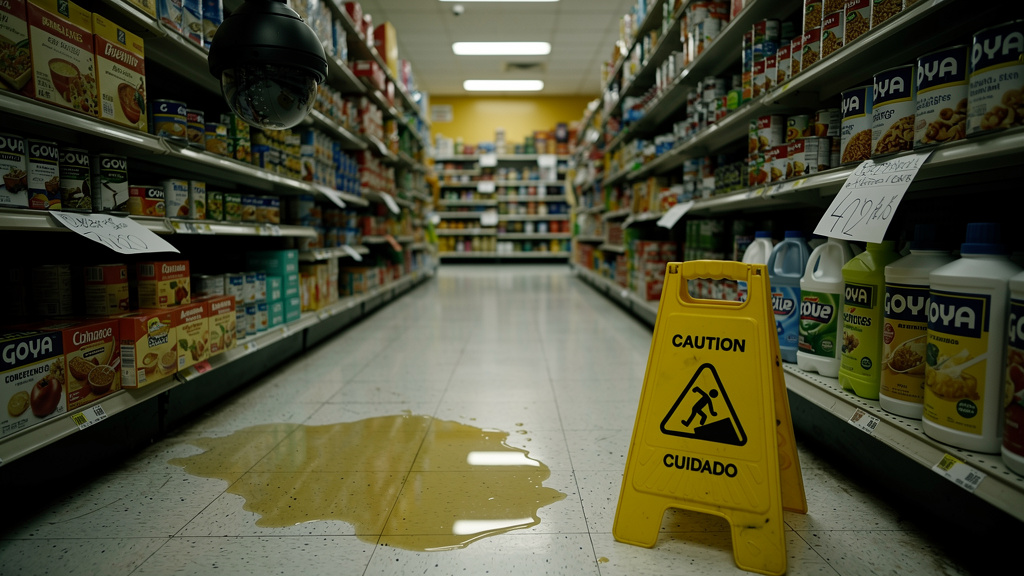
Under Florida law, you do not need proof that a grocery store employee actually saw the spill you slipped on. What matters is whether the store should have known about it, either because the spill sat long enough for a careful inspection to find it, or because similar spills happen often enough that the hazard was foreseeable. Physical clues like dirty edges, footprints, cart tracks, or melted ice help prove how long the spill was there. And time is critical: surveillance video, often the strongest evidence, can be erased automatically, sometimes within days.
Why is time the whole fight in a Florida slip-and-fall case?
Florida Statute § 768.0755 puts the burden on you to show the grocery store had actual or constructive knowledge of the dangerous condition. The mere presence of a spill is never enough. Florida courts have repeatedly held that a wet floor alone does not prove liability. Instead, you must offer circumstantial evidence that the spill existed long enough that a reasonably attentive employee should have discovered and cleaned it. There is no automatic cutoff; courts look at the specific facts, such as how long the hazard was there and whether employees were working nearby. If you’re worried because you did not report the fall right away, know this: while immediate reporting helps your credibility, failing to do so is not fatal to your claim. What matters is whether other evidence shows the store should have known.
What physical signs prove the spill had been sitting there a while?
Florida courts look for specific “plus factors” that suggest time passed before your fall. These details belong in your own description and photos taken at the scene. Footprints or shoe scuffs through the liquid show others walked through it before you. Shopping cart wheel tracks do the same and are often clear in phone photos. Dirt or grime mixed into the spill signals it was not fresh, a clean spill looks different from one that gathered debris. Drying or crusted edges with a wet center indicate evaporation over time. Melted ice near the spill helps estimate duration based on known melt rates. And sticky or tacky residue underfoot, common with juice or syrup, forms as liquids dry. Courts rely on these kinds of observations to infer how long a hazard existed. Take photos before the store cleans the area; those images may become key evidence.
What if the spill was predictable, not just a one-time accident?
Section 768.0755(1) offers a second path to liability: showing the hazard was recurring and therefore foreseeable, even if you cannot prove how long today’s specific spill sat. In Hialeah grocery stores, common recurring sources include produce-section misters that spray on a schedule, seafood or deli ice that melts all day, and leaking cooler units that drip in the same spot for days. During Hialeah’s rainy season (roughly June through September), afternoon storms mean water is tracked daily from the parking lot across the entrance threshold. If the store regularly mops that area or posts wet-floor signs during this season, that can suggest it knew the risk was predictable. Roof or HVAC condensation in older buildings can also create repeat drips in the same location. Proof of regularity comes from maintenance logs, employee statements, or prior work orders, not speculation.
What store records can prove the store knew, and how do you get them?
Key evidence lives in the store’s internal records, but you cannot get them by asking nicely. Sweep and inspection logs may show when an employee last checked the aisle, if the log shows a recent walk-by with no hazard noted, that hurts your case; a gap in the log helps it. Cleaning and maintenance records reveal whether known problems like leaking coolers were reported and fixed. Incident reports from past falls in the same spot can help prove regularity under § 768.0755(1). Customer complaint logs and equipment work orders may also exist, though record-keeping varies by chain. None of these are handed over voluntarily, they come out only through formal discovery after a lawsuit is filed. That is why hiring a lawyer early matters: waiting risks losing access to documents that could make or break your claim.
Why does surveillance video disappear so fast, and what do you do right now?
Many store security systems automatically overwrite footage after a set period, sometimes within days. Once it’s gone, it’s gone forever. Yet this video is often the most powerful proof, it can show when the spill appeared, how long it sat, whether employees walked past it, and if warning cones were used. Do not wait. Before leaving the store, take these photos with your phone: a wide shot of the aisle showing signage or missing cones; a close-up of the spill’s texture and edges; your shoes; overhead cameras and their angles; and a time-stamped photo of a clock or your phone screen. Then read our guide on supermarket fall Hialeah 30-day video window. An attorney can send a preservation letter the same day to stop the overwrite, but only if you act fast.
How does a lawyer actually preserve and request this evidence?
The moment you hire a lawyer, they send a litigation hold letter demanding the store preserve all evidence: surveillance footage, sweep logs, incident reports, maintenance records, and equipment service files. This letter warns that destroying evidence could lead to court sanctions. The attorney also submits a written demand for all video covering several hours before and after your fall. They may inspect the scene to map camera locations, drains, and misting systems. Once a lawsuit is filed, they use formal discovery to subpoena logs and reports. Even though you have two years to file under Fla. Stat. § 95.11 for injuries on or after March 24, 2023, waiting wastes precious evidence. If you are wondering whether to handle this alone, keep in mind that a store has little reason to preserve evidence for you unless it is formally asked to.
Frequently asked questions
Does it matter that no employee admitted seeing the spill before I fell?
No. Florida law does not require an admission. Constructive knowledge, proven through circumstantial evidence like time, recurrence, or physical clues, is enough.
Can I still have a case if I did not report the fall to the store manager before leaving?
Yes. While reporting helps, it is not required. Your case relies on other evidence showing the store should have known about the hazard.
What if the spill was near the entrance and it was raining that afternoon?
In Hialeah’s rainy season, stores are expected to manage water tracked in from storms. Regular mopping or wet-floor signs during this period can suggest they knew the risk was foreseeable.
How long do I have to file a lawsuit after slipping in a Florida grocery store?
For injuries on or after March 24, 2023, you have two years from the accident date under Fla. Stat. § 95.11.
Does a wet-floor sign mean the store is off the hook?
Not automatically. If the sign was placed improperly (wrong location, knocked over, or unrelated to the actual spill), or if the spill came from a recurring source the store failed to fix, liability may still exist.
Related reading: I fell in a store in Hialeah. Can I make a claim? · The 14-day PIP rule in Florida: what happens if you wait to see a doctor after a Hialeah car accident
Hurt in an accident in Hialeah? Call Wolfson & Leon at 305-965-3766 for a free consultation. We speak Spanish, and there is no fee unless we win.
Key facts
- Florida places the burden on the injured person to prove the store had actual or constructive knowledge of the dangerous condition and should have acted; the mere presence of a spill is not enough. Source: Fla. Stat. § 768.0755
- Constructive knowledge can be shown by circumstantial evidence that the dangerous condition existed for such a length of time that, in the exercise of ordinary care, the store should have known of it. Source: Fla. Stat. § 768.0755(1)(a)
- A second path to constructive knowledge exists: showing the condition occurred with regularity and was therefore foreseeable, which does not require proving how long the specific spill sat on the floor. Source: Fla. Stat. § 768.0755(1)
- Florida law sets no fixed minimum time; whether a hazard existed long enough for the store to know about it depends on the facts, such as whether employees were working nearby. Source: Fla. Stat. § 768.0755(1)(a)
- A personal injury lawsuit for injuries on or after March 24, 2023 must be filed within two years of the accident date. Source: Fla. Stat. § 95.11
Frequently asked questions
Does it matter that no employee admitted seeing the spill before I fell?
No. Florida law under Fla. Stat. § 768.0755 expressly allows constructive knowledge to be proven through circumstantial evidence, meaning physical details at the scene can substitute for any direct admission. Signs like dirty or drying edges, footprints through the liquid, or cart tracks are the 'plus factors' courts look for. The absence of a witness who saw the spill form is common; it is not fatal to a claim.
Can I still have a case if I did not report the fall to the store manager before leaving?
Failing to report at the scene can create a credibility challenge, the store may argue it had no notice of the incident, but it does not automatically end your claim. What matters most under Fla. Stat. § 768.0755 is whether the store had constructive knowledge of the hazard, which is established through physical evidence and records, not through your in-store report. If you have already left, contact an attorney promptly so that a preservation demand can be sent and video can be secured before it is overwritten.
What if the spill was near the entrance and it was raining that afternoon?
Rainy-season afternoon storms are routine in Hialeah from roughly June through September, and water tracked from the parking lot through the entrance corridor during that period can support a foreseeability argument under Fla. Stat. § 768.0755(1). If the store has a practice of placing mats, posting wet-floor signs, or increasing mopping frequency during rain, that history suggests the store recognized the recurring hazard. Evidence that the store knew this happened regularly and failed to act on a particular afternoon supports the regularity and foreseeability path to constructive knowledge.
How long do I have to file a lawsuit after slipping in a Florida grocery store?
For falls that happened on or after March 24, 2023, Florida law gives you two years from the date of the accident to file a personal injury lawsuit under Fla. Stat. § 95.11. Missing that deadline will almost certainly result in dismissal regardless of how strong the evidence is. Acting well before the deadline is critical because key evidence, especially surveillance footage, disappears within days, not months.
Does a wet-floor sign mean the store is off the hook?
Not necessarily. A warning cone shows the store was aware of a hazard, which can actually support the argument that it had notice. The central question under Fla. Stat. § 768.0755 remains whether the store had actual or constructive knowledge of the dangerous condition and failed to take adequate action to remedy it. A sign placed after the spill had already been present for an unreasonable amount of time, or placed in a position that did not adequately warn a customer approaching from a particular direction, may not defeat a claim.
This article is general information about Florida law, not legal advice, and reading it does not create an attorney-client relationship. Every case is different and past results do not guarantee a similar outcome. For advice about your situation, call Wolfson & Leon at 305-965-3766 for a free consultation.
Also available in: Versión en español
 Slip and fall
 Partly at Fault for Your Slip and Fall in Florida? You May Still Recover
Yes. Under Florida's modified comparative negligence rule, you can still recover damages from a property owner even if you were partly at fault for…
 Slip and fall
 Can You Trust the Slip-and-Fall Settlement Ranges You See Online?
No. The dollar ranges published on websites and quoted by AI assistants are directional benchmarks drawn from incomplete, mostly private data, they…
 Slip and fall
 Hurt in a Supermarket Fall: Who Pays Your Medical Bills Right Now?
After a supermarket fall in Florida, no one automatically pays your medical bills while your claim is pending, the store's insurer will not cut you…