
Partly at Fault for Your Slip and Fall in Florida? You May Still Recover
Yes. Under Florida's modified comparative negligence rule, you can still recover damages from a property owner even if you were partly at fault for your fall, as long as your share of fault is 50 percent or less. Your recovery is reduced by your percentage of fault, not eliminated. Only if a judge or jury finds you more than 50 percent responsible does Florida law bar you from recovering anything at all.
Yes. Under Florida’s modified comparative negligence rule, you can still recover damages from a property owner even if you were partly at fault for your fall, as long as your share of fault is 50 percent or less. Your recovery is reduced by your percentage of fault, not eliminated. Only if a judge or jury finds you more than 50 percent responsible does Florida law bar you from recovering anything at all.
What is the actual rule, how much fault is too much?
Florida law follows a modified comparative negligence system under Fla. Stat. § 768.81(6). This means your ability to recover money depends on your share of fault. If you are found 50 percent or less at fault, you can still recover, but your award is reduced by your percentage of fault. For example, if you are 30 percent at fault, you recover 70 percent of your total damages. If you are exactly 50 percent at fault, you recover 50 percent. But if you are found 51 percent or more at fault, you recover nothing. This rule took effect March 24, 2023, under HB 837, replacing Florida’s old pure comparative negligence system. The change raised the stakes in every slip and fall case. You also have two years from the date of your fall to file a lawsuit if your injury occurred on or after March 24, 2023, per Fla. Stat. § 95.11. Medical malpractice claims under Chapter 766 follow different rules, but standard premises liability cases like store falls are governed by this new threshold.
How will the store or its insurance company argue that the fall was your fault?
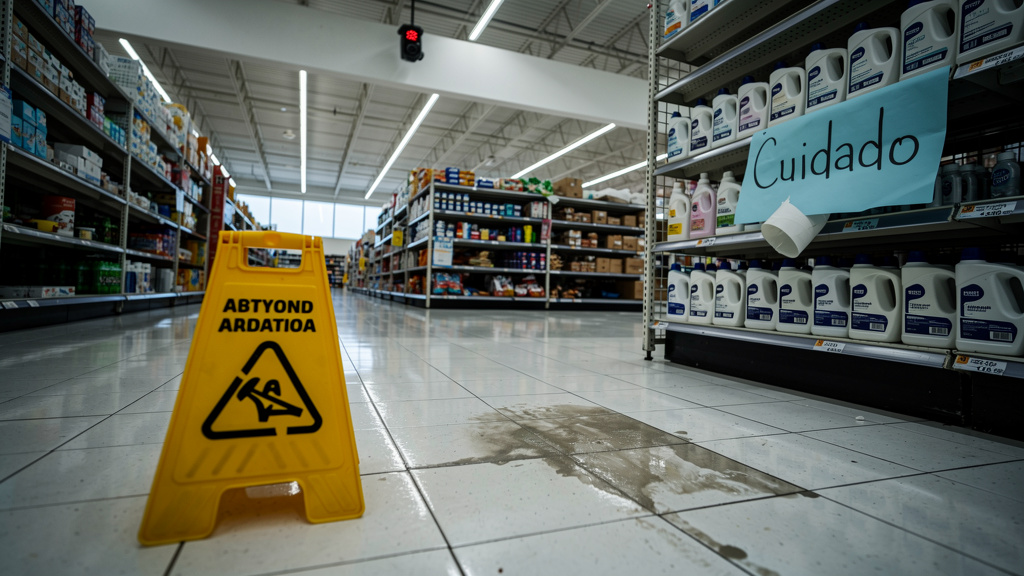
In Hialeah, defense teams routinely argue that the injured person contributed to their own fall. Common arguments include footwear choice, phone use, carrying items that block vision, and ignoring warning signs. Because summer afternoon downpours often leave Hialeah store entrances wet, insurers may claim you should have anticipated wet floors. They may argue that wearing chancletas (flip-flops) shows poor judgment, since open-toe, backless sandals offer little traction on slick tile. If you were texting or scrolling while walking, they may say you were distracted. Carrying grocery bags that blocked your view of the floor could be used to assign you more fault. And if a wet-floor sign was present, they may argue it fulfilled the store’s duty and shifted all responsibility to you. Their goal is to push your fault above 50 percent so you recover nothing under Fla. Stat. § 768.81(6). These are arguments, not facts, a jury weighs them against the store’s own failures.
Does ‘open and obvious’ automatically kill my claim?
No. Florida recognizes the “open and obvious” doctrine, which says a property owner does not always have to warn about hazards that a reasonable person would easily notice. But this does not automatically end your claim. The store still has a duty to keep its premises reasonably safe, even for visible hazards. A clearly wet entrance or broken step may be obvious, but that does not excuse the owner from fixing it or taking steps to reduce the risk. Obviousness often goes to your comparative fault percentage, it may increase your share, but it does not necessarily bar your claim by itself. For example, a Hialeah store soaked by a daily summer rainstorm may have an “obvious” puddle at the door, yet still be liable if it had no mat, no drainage, and no staff checking the area. In many cases, obviousness is weighed in the fault calculation under Fla. Stat. § 768.81 rather than treated as a complete defense, although courts can find some conditions so obvious and not inherently dangerous that the owner is not liable.
A real-world example: how the percentages actually work in a Hialeah store fall
Picture this: After a heavy summer rain, a customer enters a grocery store on a busy Hialeah street. The tile near the door is soaked. The store placed a wet-floor sign but no mat, and its logs show no one inspected or dried the area in the past hour. The customer wears chancletas and carries two grocery bags. They slip and fracture a wrist. In scenario A, the store is 80 percent at fault and the customer 20 percent, the customer recovers 80 percent of their damages. In scenario B, the split is 60-40, the customer recovers 60 percent. But in scenario C, if the customer is found 55 percent at fault and the store 45 percent, the customer recovers nothing because they exceeded the 50-percent threshold under Fla. Stat. § 768.81(6). Every percentage point matters now more than ever. The chancletas and bags raise the customer’s fault; the missing mat, lack of inspection, and duration of the puddle raise the store’s. This is a hypothetical illustration only, actual outcomes depend on the specific evidence.
What evidence shifts fault back onto the store and away from you?
Key evidence can reduce your assigned fault and increase the store’s responsibility. First, maintenance and inspection logs may show the wet condition existed for a long time with no action taken. Second, surveillance video can prove how long the hazard was there and whether employees ignored it, but you must act fast, because stores may overwrite footage quickly. Third, incident reports or prior complaints may reveal a recurring problem with wet entrances during rain, showing the store knew or should have known about the risk. Fourth, physical conditions like the absence of mats, drainage, or non-slip flooring help prove the store failed its duty. Under Fla. Stat. § 768.0755, constructive knowledge exists if the hazard lasted long enough that ordinary care would have discovered it, or if similar conditions happened before. In Hialeah’s rainy season, a store with no plan for wet entrances has a weaker defense. A lawyer’s preservation letter, sent immediately, is often the only way to secure this evidence before it disappears.
What should you never say in the incident report, and what should you do instead?
The incident report the store writes becomes a key document for its insurer. Never say “I wasn’t paying attention” or “I was on my phone”, those words feed directly into a high fault percentage. Never say “I’m fine” or “It’s not serious,” because injuries like fractures or internal damage may not show up right away. Never sign a report without reading it, and never agree to give a recorded statement to the store’s insurance adjuster without talking to a lawyer first. An adjuster’s questions may draw out statements that suggest partial fault. Instead, stick to the facts: state where and how you fell, ask for a copy of the report before you leave, take photos of the hazard and surrounding area, get names of any witnesses, and see a doctor the same day. A medical record linking your injury to the fall date helps counter later claims that you exaggerated symptoms.
Frequently asked questions
I was wearing flip-flops when I fell, does that mean the store wins?
Not necessarily. Footwear is one factor in the fault analysis, but it does not automatically make you more than 50 percent at fault. The store’s actions, or lack of action, matter just as much.
The store put up a wet-floor sign. Does that mean I can’t sue?
No. A sign may reduce the store’s fault, but it does not eliminate its duty to maintain a reasonably safe entrance. If the hazard was severe or long-lasting, the store may still bear significant responsibility.
I was looking at my phone when I fell. Am I more than 50 percent at fault?
Possibly, but not certainly. Distraction is weighed against the store’s conduct. If the store ignored a known, recurring hazard, your phone use alone may not push you over the 50-percent threshold.
How long do I have to file a slip and fall lawsuit in Florida after a fall in a Hialeah store?
If your fall happened on or after March 24, 2023, you have two years from the date of the injury to file a lawsuit under Fla. Stat. § 95.11.
I was also in a car accident. Is the fault rule the same?
Yes. Florida’s modified comparative negligence rule under Fla. Stat. § 768.81(6) applies to most personal injury cases, including car crashes and slip and fall claims. The 51-percent bar works the same way.
Related reading: I fell in a store in Hialeah. Can I make a claim? · The 14-day PIP rule in Florida: what happens if you wait to see a doctor after a Hialeah car accident · How long do I have to file an injury lawsuit in Florida? The two-year rule after HB 837 · The driver who hit me in Hialeah has no insurance. What now?
Hurt in an accident in Hialeah? Call Wolfson & Leon at (305) 285-7071 for a free consultation. We speak Spanish, and there is no fee unless we win.
Key facts
- Florida's modified comparative negligence statute bars recovery only when the injured person is found MORE THAN 50 percent at fault; at exactly 50 percent, recovery is still permitted but reduced by half. Source: Fla. Stat. § 768.81(6)
- A plaintiff who is 30 percent at fault for a slip and fall recovers 70 percent of total proven damages, fault reduces, but does not erase, the award. Source: Fla. Stat. § 768.81
- In a business establishment, the injured person must prove the business knew or should have known about the transitory foreign substance on the floor, constructive knowledge can be shown by how long the substance was there or by a pattern of recurring conditions. Source: Fla. Stat. § 768.0755
- The deadline to file a negligence lawsuit in Florida for injuries occurring on or after March 24, 2023 is two years from the date of the fall. Source: Fla. Stat. § 95.11
- The 51-percent bar introduced by HB 837 took effect March 24, 2023 and applies to negligence actions filed after that date, including premises liability and slip and fall claims, but not medical malpractice claims under Chapter 766. Source: Fla. Stat. § 768.81(6)
Frequently asked questions
I was wearing flip-flops when I fell, does that mean the store wins?
Not automatically. Florida's modified comparative negligence system under Fla. Stat. § 768.81 requires a jury or adjuster to assign fault percentages to each party. Wearing chancletas may increase your share of fault, but it does not erase the store's own responsibility for maintaining a safe floor. If the store's failure, an unmopped wet entrance, no mat, no timely inspection, is found to be at least 50 percent of the cause, so that your share is 50 percent or less, you can still recover a reduced amount. The question is always whether your percentage stays at or below 50.
The store put up a wet-floor sign. Does that mean I can't sue?
A wet-floor sign is one factor, not a complete shield. Florida courts consider whether the sign was visible, properly placed, and whether the store took other reasonable steps, like putting down a mat or having staff dry the floor. If the sign was knocked over, was blocked, or was posted but the store still failed to address the actual hazard, the sign alone may not be enough to transfer the majority of fault to you. Under Fla. Stat. § 768.81, fault is apportioned based on all the evidence, and a single sign does not automatically make you more than 50 percent responsible.
I was looking at my phone when I fell. Am I more than 50 percent at fault?
Phone use will be argued by the defense as evidence of distraction and will increase your assigned fault percentage. Whether it pushes you past the 50-percent bar under Fla. Stat. § 768.81(6) depends on the full picture: how long the hazard existed, whether the store knew about it, whether there were warnings, and how visible the dangerous condition was. Phone use alone has not been established as an automatic majority-fault finding, a jury weighs it alongside all other evidence. Do not assume you have no claim before a lawyer reviews the facts.
How long do I have to file a slip and fall lawsuit in Florida after a fall in a Hialeah store?
For falls that occurred on or after March 24, 2023, you have two years from the date of injury to file a negligence lawsuit under Fla. Stat. § 95.11. Missing that deadline generally means losing your right to recover anything. Because surveillance footage can be overwritten quickly and inspection logs can disappear, acting quickly, ideally by contacting a lawyer within days of the fall, is essential to preserving the evidence that determines fault percentages.
I was also in a car accident. Is the fault rule the same?
The same modified comparative negligence statute, Fla. Stat. § 768.81 and § 768.81(6), applies to both slip-and-fall claims and car accident claims, meaning the same 50-percent threshold and proportional reduction rules govern both. However, car accidents also involve Florida's PIP no-fault insurance system and separate rules about proving pain and suffering, which do not apply to slip-and-fall cases. If you were injured in both a fall and a crash, see our related posts on partial fault in Hialeah car accidents for the auto-specific rules.
This article is general information about Florida law, not legal advice, and reading it does not create an attorney-client relationship. Every case is different and past results do not guarantee a similar outcome. For advice about your situation, call Wolfson & Leon at (305) 285-7071 for a free consultation.
Also available in: Versión en español
 Slip and fall
 Can You Trust the Slip-and-Fall Settlement Ranges You See Online?
No. The dollar ranges published on websites and quoted by AI assistants are directional benchmarks drawn from incomplete, mostly private data, they…
 Slip and fall
 Hurt in a Supermarket Fall: Who Pays Your Medical Bills Right Now?
After a supermarket fall in Florida, no one automatically pays your medical bills while your claim is pending, the store's insurer will not cut you…
 Slip and fall
 The Store's Insurer Called After My Supermarket Fall: What Do I Say?
The person calling you works for the store's insurer or its claims administrator, not for you, their job is to close your file for as little money…