
Hit Outside a Crosswalk in Hialeah: Can You Still Get Compensation?
Yes. Crossing outside a crosswalk does not end your claim. Florida law requires every driver to exercise due care to avoid hitting any pedestrian at any time and any place, and as long as you are not found more than 50 percent at fault, you can still recover damages reduced by your share of fault.
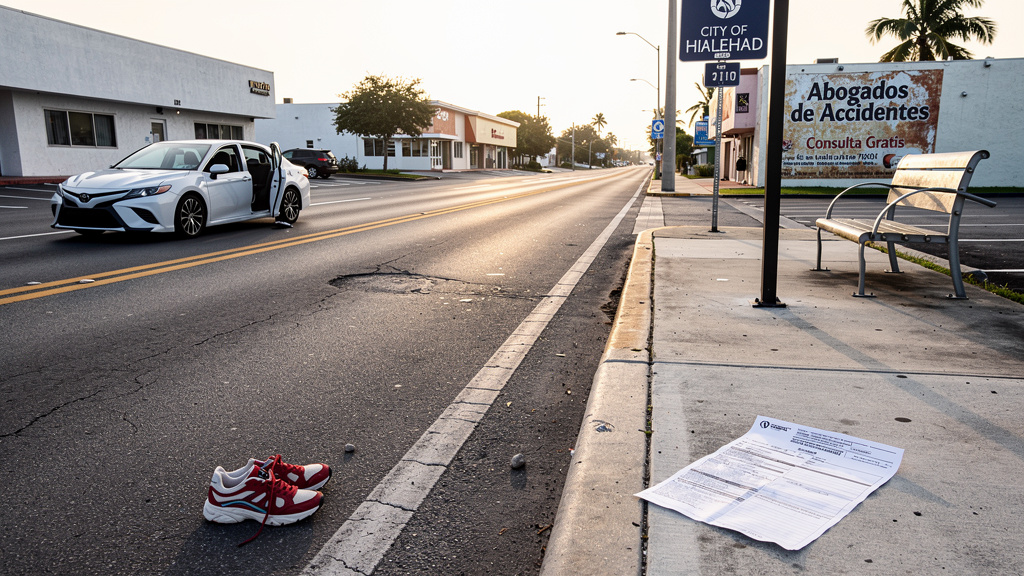
Yes. Crossing outside a crosswalk does not end your claim. Florida law requires every driver to exercise due care to avoid hitting any pedestrian at any time and any place, and as long as you are not found more than 50 percent at fault, you can still recover damages reduced by your share of fault.
Myth: ‘No crosswalk means no case’, is that actually true under Florida law?
That myth is false. Florida Statute § 316.130(15) states plainly: “Every driver of a vehicle shall exercise due care to avoid colliding with any pedestrian.” This duty applies whether you are in a marked crosswalk, an unmarked one, or halfway between two signals. It is separate from the right-of-way rules that apply inside crosswalks under § 316.130. Violating this duty is evidence of negligence on the driver’s part. On streets like Okeechobee Road and W 49th Street in Hialeah, where blocks stretch long between signals, pedestrians often have no practical alternative but to cross mid-block. That choice alone does not bar a claim, it just becomes one factor among many in assigning fault.
How does Florida divide fault when the pedestrian and the driver both did something wrong?
Florida uses modified comparative negligence under Fla. Stat. § 768.81(6). If you are found 50 percent or less at fault, you can still recover compensation, reduced by your percentage of fault. For example, if your total damages are $80,000 and you are assigned 35 percent fault, you recover $52,000. But if you are found more than 50 percent at fault, you recover nothing. Insurance adjusters know this cutoff and may argue for a fault percentage just over 50 to deny payment entirely. Before March 24, 2023, even a pedestrian who was mostly at fault could recover some amount; that is no longer the case. Learn more about how partial fault affects recovery in partially-at-fault Hialeah car accident recovery.
Myth: ‘It was dark so the accident was my fault’, what does the driver’s duty actually require at night?
Darkness does not excuse a driver from their duty to avoid hitting you. The duty of due care under § 316.130(15) still applies at night, which means using headlights properly and staying alert, especially on wide, multi-lane roads like Okeechobee Road and W 49th Street where nighttime pedestrian traffic includes people getting off buses or heading to overnight shifts. Drivers are also expected to keep their speed reasonable for the conditions, including how far their headlights let them see. Distracted driving, such as phone use, is even riskier at night. Poor street lighting may affect visibility, but it does not shift all responsibility to the pedestrian. The question is whether the driver took reasonable steps to see and avoid you, given the known conditions of that road.
Myth: ‘The police report says it was my fault, so my claim is over’, what does the report actually decide?
A crash report is not a final ruling on civil liability. The officer who wrote it likely did not witness the crash and may have relied heavily on the driver’s version. Traffic determinations and civil negligence are different legal questions. Under Fla. Stat. § 316.066, crash reports are confidential for 60 days except to parties, insurers, and attorneys. During that window, critical evidence, like traffic camera footage, witness statements, or the driver’s cell phone records, can be preserved. In court, a judge or jury decides fault using the preponderance-of-the-evidence standard, not the officer’s preliminary opinion. The report is one piece of evidence, and often not the most reliable.
Myth: ‘If I was partly at fault, my PIP won’t pay anything’, how does no-fault coverage actually work for pedestrians?
PIP pays regardless of fault, that is the point of Florida’s no-fault system. Under Fla. Stat. § 627.736, PIP covers 80 percent of reasonable medical bills and 60 percent of lost income, up to $10,000 if a doctor diagnoses an emergency medical condition; otherwise, up to $2,500. You must get initial treatment within 14 days of the crash or PIP pays nothing. Whose policy pays? First, your own auto insurance if you have one. If not, a resident relative’s policy. Only if neither exists does the striking driver’s PIP apply. PIP does not cover pain and suffering. To recover those damages from the at-fault driver, you must prove a permanent injury, significant and permanent scarring or disfigurement, or significant and permanent loss of an important bodily function under Fla. Stat. § 627.737(2).
What evidence actually determines how fault is divided, and why does it have to be gathered fast?
Fault hinges on concrete evidence, and much of it disappears quickly. Video from nearby businesses or traffic cameras may be overwritten in days. Cell phone records can show if the driver was texting. Vehicle event data reveals speed and braking patterns. Photograph the distance between the crash site and the nearest crosswalk, on Okeechobee Road, that gap can be several hundred feet, supporting your reasonableness. Document bus stop locations that place pedestrians near moving traffic without safe crossings. Skid marks, vehicle damage, and witness statements also matter. Every percentage point shifted away from you increases your recovery under § 768.81(6). You have two years from the crash date to file a lawsuit under Fla. Stat. § 95.11 for injuries on or after March 24, 2023. Do not wait, investigating early preserves options.
Frequently asked questions
Does jaywalking automatically mean I can’t sue the driver who hit me?
No. Jaywalking may increase your share of fault, but it does not bar your claim unless you are found more than 50 percent at fault. The driver still had a legal duty to avoid hitting you.
Will my PIP pay my medical bills even if the crash was partly my fault?
Yes. PIP is no-fault coverage. It pays regardless of who caused the crash, as long as you seek treatment within 14 days and meet the other requirements.
The police report blames me. Does that end my civil case?
No. The report is not binding in a civil lawsuit. Judges and juries decide fault based on all available evidence, not just the officer’s initial assessment.
How long do I have to file a lawsuit after being hit as a pedestrian in Florida?
You have two years from the date of the crash if your injury occurred on or after March 24, 2023, under Florida’s current statute of limitations.
Can I claim pain and suffering from the driver if I was hit outside a crosswalk?
Yes, but only if you can prove a permanent injury, significant and permanent scarring or disfigurement, or significant and permanent loss of an important bodily function under Florida law. Location of the crossing does not disqualify you, your injury type does.
Related reading: A car hit me while I was walking or biking in Hialeah. What are my rights? · I was in a car accident in Hialeah. What do I do now? · The 14-day PIP rule in Florida: what happens if you wait to see a doctor after a Hialeah car accident
Hurt in an accident in Hialeah? Call Wolfson & Leon at (305) 285-7071 for a free consultation. We speak Spanish, and there is no fee unless we win.
Key facts
- Every driver must exercise due care to avoid colliding with any pedestrian, regardless of whether the pedestrian is inside or outside a crosswalk. Source: Fla. Stat. § 316.130(15)
- A pedestrian found 50 percent or less at fault can recover compensation, reduced proportionally by their fault percentage; only a pedestrian found MORE THAN 50 percent at fault is barred from any recovery. Source: Fla. Stat. § 768.81(6)
- Florida's Personal Injury Protection (PIP) pays 80 percent of reasonable medical bills and 60 percent of lost income, up to $10,000 when a doctor finds an emergency medical condition, regardless of who caused the crash. Treatment must begin within 14 days of the crash or PIP pays nothing. Source: Fla. Stat. § 627.736
- Crash reports are confidential for 60 days after the crash, except to the parties, their insurers, and their attorneys. Source: Fla. Stat. § 316.066
- Drivers must yield the right of way to pedestrians in crosswalks, whether marked or unmarked, under Florida's general pedestrian traffic statute. Source: Fla. Stat. § 316.130
Frequently asked questions
Does jaywalking automatically mean I can't sue the driver who hit me?
No. Crossing outside a crosswalk means you had a duty to yield to vehicles under Florida law, but the driver still had an independent duty to exercise due care to avoid hitting you under Fla. Stat. § 316.130(15). If the driver was speeding, distracted, or failed to keep a proper lookout, that conduct is part of the fault equation. Under Fla. Stat. § 768.81(6), you can still recover compensation as long as you are found 50 percent or less at fault, your award is reduced by your percentage, not eliminated.
Will my PIP pay my medical bills even if the crash was partly my fault?
Yes. Florida's Personal Injury Protection coverage under Fla. Stat. § 627.736 pays regardless of who caused the crash. As a pedestrian, you look first to your own PIP policy if you own a vehicle, then to a resident relative's policy, and only if neither exists to the striking driver's PIP. PIP covers 80 percent of reasonable medical bills and 60 percent of lost income up to applicable limits, but you must receive initial treatment within 14 days of the crash or PIP pays nothing.
The police report blames me. Does that end my civil case?
No. A police report is one piece of evidence in a civil case, not a binding ruling on fault. The officer usually did not witness the crash and was making a traffic determination under a different standard than a civil negligence case. Under Fla. Stat. § 316.066, crash reports are confidential for 60 days except to the parties, their insurers, and their attorneys. Video footage, the driver's phone records, vehicle event data, and witness accounts can all tell a different story than what the initial report reflects.
How long do I have to file a lawsuit after being hit as a pedestrian in Florida?
For injuries occurring on or after March 24, 2023, you have two years from the date of the crash to file a personal injury lawsuit under Fla. Stat. § 95.11. That clock runs whether or not a traffic investigation is still open. Evidence, especially surveillance video, can disappear long before the deadline arrives, so contacting an attorney as early as possible is important regardless of when you plan to file.
Can I claim pain and suffering from the driver if I was hit outside a crosswalk?
Yes, if you can establish the driver's negligence and your injuries meet Florida's threshold. Under Fla. Stat. § 627.737(2), recovering pain and suffering damages from the at-fault driver requires a permanent injury, significant and permanent scarring or disfigurement, or significant and permanent loss of an important bodily function. PIP covers a portion of your medical bills and lost income regardless of fault, but it does not cover pain and suffering, that requires pursuing a claim against the at-fault driver's bodily injury liability coverage.
This article is general information about Florida law, not legal advice, and reading it does not create an attorney-client relationship. Every case is different and past results do not guarantee a similar outcome. For advice about your situation, call Wolfson & Leon at (305) 285-7071 for a free consultation.
Also available in: Versión en español
 Pedestrian and bicycle accidents
 Hit by a Car Without Owning One: Who Pays Your Medical Bills in Florida?
Florida's no-fault PIP system can still pay your first medical bills even if you don't own a car. The law looks first to any auto policy in your…
 Pedestrian and bicycle accidents
 Hit by a Car While Walking in Hialeah: What Is the First Step?
The first step is medical care, even if you feel fine enough to walk away, Florida law requires treatment within 14 days of the crash or you forfeit…
 Pedestrian and bicycle accidents
 Hit Crossing W 49th Street Outside the Crosswalk, Can I Still Recover?
Yes, crossing outside a marked crosswalk does not erase your right to recover. Florida law still requires every driver to exercise due care to avoid…