Hit and run in Miami-Dade: what to do when the driver who hit you leaves
After a hit and run in Miami-Dade, call 911 from the scene, get medical care, and report the crash to police within 24 hours even if the other driver is gone; then check your own auto policy for uninsured motorist (UM) coverage, which treats an unidentified hit-and-run driver as an uninsured driver and can pay for your injuries. Leaving the scene of a crash with injury is a felony in Florida (Fla. Stat. § 316.027), and cameras on nearby businesses, buses, and traffic signals often identify the vehicle if someone asks for the footage within days.
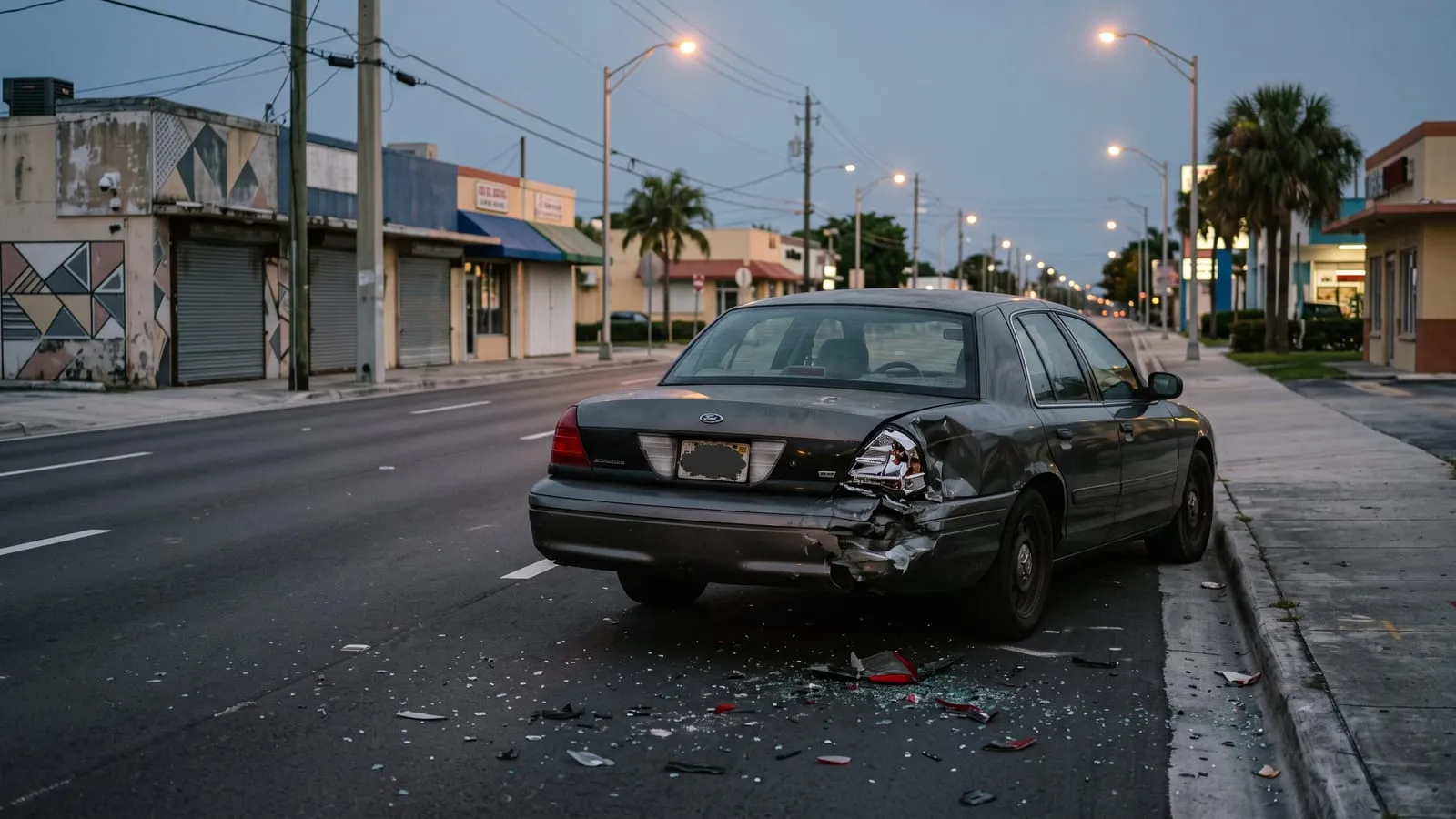
Miami-Dade County has reported more hit-and-run crashes than any other county in Florida for years, and Hialeah’s wide, fast arterials — W 49th St, Okeechobee Road, E 4th Ave, W 84th St — see a steady share of them. When the driver who hit you leaves, the crash feels like it happened to no one. It did not. Here is what to do, in order.
What should I do at the scene of a hit and run?
- Call 911. Say it is a hit and run and give the direction the car went. Do not chase it.
- Get medical care. If you are hurt, let the paramedics take you. If you refuse transport, see a doctor the same day. Florida’s PIP coverage on your own policy pays regardless of who was at fault, but only if you treat within 14 days (Fla. Stat. § 627.736(1)(a)).
- Write down everything you remember about the car: color, make, model, body damage, anything on the plate, stickers, whether it was a work vehicle, and the direction of travel. Memory fades within hours.
- Look for witnesses and get their phone numbers. In Hialeah someone almost always saw it. Ask.
- Look for cameras. Gas stations, pharmacies, supermarkets, and restaurants along W 49th St and Okeechobee Road run continuous video. So do Miami-Dade Transit buses and many traffic signals. Note the businesses in view of the crash.
- Photograph the scene, your car, debris, and skid marks. Debris from the other car — a mirror, a headlight housing — can carry a part number that identifies the make and model.
Is leaving the scene of an accident a crime in Florida?
Yes. Under Fla. Stat. § 316.062, every driver involved in a crash must stop, give their name, address, and vehicle registration, show their driver license on request, and render reasonable assistance to anyone injured, including calling for medical help. Leaving a crash that involves only property damage is a second-degree misdemeanor (Fla. Stat. § 316.061). Leaving a crash that involves injury is a third-degree felony, and leaving one that involves death is a first-degree felony with a mandatory minimum prison sentence (Fla. Stat. § 316.027(2)). The Aaron Cohen Life Protection Act, passed in 2014 after a Miami cyclist was killed by a driver who fled, increased those penalties.
The criminal case is the State’s. Your injury claim is separate, and it does not depend on the driver being convicted, or even charged.
Who pays for my injuries if the driver is never found?
Two coverages on your own policy, in this order:
PIP pays 80% of your medical bills and 60% of lost wages, up to $10,000, no matter who was at fault or whether they were identified (Fla. Stat. § 627.736).
Uninsured motorist (UM) coverage is the one that matters most. Under Fla. Stat. § 627.727, UM coverage applies to a hit-and-run by an unidentified vehicle, because an unidentified driver is treated as an uninsured one. UM pays what the at-fault driver’s insurance would have paid: medical bills beyond PIP, lost wages, and, if the injury is permanent, pain and suffering. It follows you as a pedestrian, a cyclist, or a passenger in someone else’s car, and it may be available under a policy belonging to a relative you live with, even if you have no car of your own.
Two things to know about UM in a hit and run:
- Most policies require that the crash be reported to police promptly, often within 24 hours, and that you notify your insurer within a set time. Do both.
- Insurers investigate hit-and-run UM claims closely because there is no other driver to contradict your account. Physical damage to your car, the police report, witness statements, and camera footage make the difference between a paid claim and a denied one.
If there is no UM coverage in your household, recovery is realistically limited to PIP and health insurance unless the driver is found. That is why we ask about every policy in the household on the first call.
How does Wolfson & Leon try to identify the driver?
We do not wait for the police. Within days of being retained, we send preservation letters to every business with a camera facing the crash location, request footage from Miami-Dade Transit if a bus route runs there, and, where a partial plate exists, work with the crash report and the officer to narrow the vehicle. Debris left at the scene is sent for identification. If the driver is identified, the claim becomes an ordinary crash claim against that driver’s insurance, and UM steps back into a secondary role. If the driver is never identified, the same evidence supports the UM claim.
What if I was the pedestrian or cyclist?
The same rules apply, and your own auto policy’s PIP and UM follow you even though you were not in a car. If you do not own a car, the PIP of a resident relative applies, and if there is none, Florida’s Personal Injury Protection can still reach you through the policy of the vehicle that hit you — which requires identifying it. See our page on pedestrian and bicycle accidents in Hialeah for how those claims work.
What are the deadlines?
Report to police immediately and to your insurer as soon as possible; check your policy for the exact UM notice requirement. The deadline to file a lawsuit for negligence in Florida is two years from the crash for crashes on or after March 24, 2023 (Fla. Stat. § 95.11). A UM claim is a contract claim against your insurer and generally has a longer deadline, but the evidence that wins it disappears in weeks. Call sooner.
Key facts
- Leaving the scene of a crash involving injury is a third-degree felony; involving death, a first-degree felony. Source: Fla. Stat. § 316.027(2)
- Every driver in a crash must stop, give their name, address, and registration, and render reasonable assistance to anyone injured. Source: Fla. Stat. § 316.062
- Uninsured motorist coverage applies to a hit-and-run by an unidentified vehicle; the insurer may require prompt reporting to police. Source: Fla. Stat. § 627.727
- PIP on your own policy pays first for medical bills, whether or not the other driver is found. Source: Fla. Stat. § 627.736
- Two years to file a negligence lawsuit for crashes on or after March 24, 2023. Source: Fla. Stat. § 95.11
Frequently asked questions
The police never found the driver. Can I still recover anything?
Yes, if you or a relative you live with has uninsured motorist (UM) coverage. UM treats an unidentified hit-and-run driver as uninsured. Your PIP also pays your first $10,000 in medical bills regardless. If there is no UM anywhere in the household, recovery is limited to PIP and health insurance.
I only got part of the license plate. Is that useful?
Very. A partial plate plus the make, model, and color, and the direction of travel, is often enough for Hialeah Police or Miami-Dade Police to identify the vehicle, especially combined with camera footage. Write it down immediately and give it to the officer.
The other driver stopped, gave me a fake name, and left. Is that a hit and run?
It can be. The duty under Fla. Stat. § 316.062 is to give your correct name, address, and registration and to show your license on request. A driver who gives false information has not complied and can be charged. Photograph the car and plate whenever a driver seems eager to leave.
My UM insurer is asking for a recorded statement. Do I have to give one?
Your own policy usually requires you to cooperate with your insurer, which can include a statement. But UM insurers defend hit-and-run claims aggressively because there is no other driver to blame. Talk to a lawyer before the statement so it is accurate and complete.
This article is general information about Florida law, not legal advice, and reading it does not create an attorney-client relationship with Wolfson & Leon. Every case is different and prior results do not guarantee a similar outcome. If you were hurt, talk to a lawyer about your own situation.
Also available in: Versión en español