
Hit by a Rental Truck in Hialeah: Who Pays for Your Injuries?
When a rental box truck or cargo van hits you in Hialeah, the renter's personal auto insurance is often the first liability source, ahead of the rental company's, although the order can depend on the rental agreement. Florida's no-fault law means your own PIP pays your initial medical bills regardless of who caused the crash. For losses PIP does not cover, you can pursue the at-fault renter's liability coverage, and, in some situations, the rental company's own policy; to claim pain and suffering, your injuries must meet Florida's permanent-injury threshold.
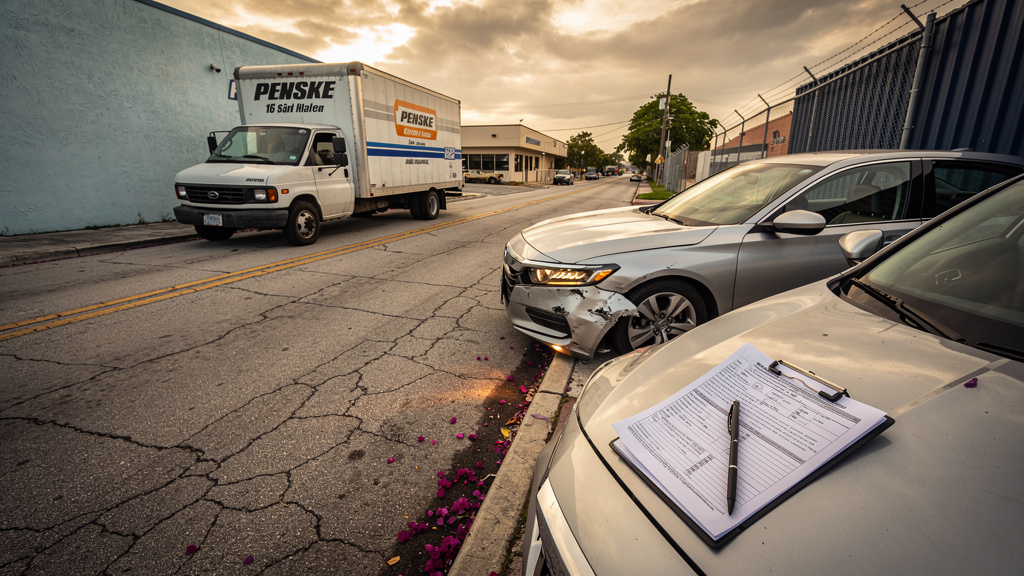
When a rental truck hits you in Hialeah, the person who rented the vehicle, and their personal auto insurance, is usually the first party responsible for your injuries, not U-Haul, Penske, or Fluid Truck. Florida’s no-fault law means your own PIP coverage pays your initial medical bills regardless of fault, and for losses PIP does not cover you can pursue the at-fault renter’s liability insurance and possibly other sources; pain and suffering requires meeting Florida’s permanent-injury threshold.
How do I know the truck was a rental, and why does that matter?
The crash report will list the registered owner of the vehicle that hit you. If that owner is U-Haul, Penske, Fluid Truck, or another rental company, you know right away the driver was a renter, not the owner. This matters because a federal law known as the Graves Amendment generally shields commercial rental companies from liability based only on owning the vehicle. In Hialeah, crashes on city streets like W 49th Street and Okeechobee Road are typically investigated by the Hialeah Police Department, while on the Palmetto Expressway the Florida Highway Patrol may respond. Under Fla. Stat. § 316.066, crash reports are confidential for 60 days except to the parties, their insurers, and their attorneys, so ask your lawyer to get it quickly. At the scene, photograph the truck’s logo, unit number on the rear door, and any rental paperwork visible inside the cab before the vehicle is moved.
My own PIP pays first, even though the rental truck driver caused the crash?
Yes. Florida is a no-fault state, so your own PIP insurance pays first, even if you did nothing wrong. This answers the common question: “Do I just go through my own insurance?” Yes, you must. Under Fla. Stat. § 627.736(1), PIP covers 80 percent of reasonable medical bills and 60 percent of lost wages, up to $10,000 if a doctor diagnoses an emergency medical condition, or only $2,500 if not. You must see a doctor within 14 days of the crash, or PIP pays nothing. PIP does not cover pain and suffering, car repairs, or bills beyond the cap. Many people ask why the medical bills come to them when the crash was not their fault. That’s Florida’s no-fault system, it shifts initial costs to your own policy, not the at-fault driver’s.
Who is actually liable, the renter, the rental company, or both?
Liability often starts with the individual who rented the truck and their personal auto insurance policy, although the order of coverage can depend on the rental agreement. Second, check if they bought supplemental liability insurance (SLI) at the U-Haul, Penske, or Fluid Truck counter, that can add extra coverage. Third, the rental company may have its own policy, but it is often not the first to pay. Under the Graves Amendment (49 U.S.C. § 30106), rental companies are generally shielded from liability based solely on vehicle ownership. Florida’s dangerous-instrumentality doctrine generally lets injured people hold a vehicle’s owner liable for the driver’s negligence, and Florida law limits that liability for lessors (Fla. Stat. § 324.021(9)(b)); however, the Graves Amendment generally prevents applying it to commercial rental companies, unless the company was independently negligent. Examples include renting a truck with known brake defects, ignoring a safety recall, or handing keys to someone visibly impaired or unqualified. Confirming SLI purchase and checking for independent negligence are critical early steps.
What if the driver was working for a moving or delivery company?
If the person driving the rental truck was on the job, for a moving company, delivery service, or gig platform, their employer may carry a separate commercial auto or motor carrier liability policy. This coverage may carry higher limits than a personal auto policy and can become an important source of recovery. Look for uniforms, business decals, dispatch apps on the driver’s phone, or a rental agreement showing a business name (not just an individual). Under some commercial policies, “Who Is An Insured” clauses may extend coverage to authorized drivers using a rented vehicle for work. In Miami-Dade, disputes over whether a rental truck was used commercially can turn on dispatch records or rental contracts. Never assume only the driver’s personal insurance applies, this layer could mean the difference between full recovery and severe undercompensation.
What if the renter had no insurance or not enough to cover my injuries?
If the at-fault renter has no liability insurance or too little, your uninsured/underinsured motorist (UM/UIM) coverage may step in. Under Fla. Stat. § 627.727, UM covers medical expenses beyond PIP, additional lost wages, and other injury-related losses, but not car damage. UM is optional in Florida, but insurers must offer it, and you must have rejected it in writing to lack it. Some people discover too late that they don’t have UM. Don’t assume you have UM, check your policy declarations page. And remember: even if the renter is uninsured, you may still pursue claims against their employer or the rental company if independent negligence is present.
Can I recover pain and suffering, and what if I was partly at fault?
You can only recover pain and suffering if your injury meets Florida’s serious-injury threshold under Fla. Stat. § 627.737(2): permanent injury, significant and permanent scarring or disfigurement, or permanent loss of an important bodily function. Minor injuries that fully heal usually don’t qualify. Florida also uses modified comparative fault (Fla. Stat. § 768.81(6)): you can still recover if you’re 50 percent or less at fault, but your damages are reduced by your share. If you’re more than 50 percent at fault, you recover nothing. Be cautious about statements at the scene or to adjusters, comments like “I didn’t see them coming” can be twisted to assign you blame. Insurers may also argue that your injuries come from pre-existing conditions. Finally, for crashes on or after March 24, 2023, you have two years to file a lawsuit under Fla. Stat. § 95.11, not four.
Frequently asked questions
What should I photograph at the scene if a rental truck hits me in Hialeah?
Take clear pictures of the truck’s front and side logos, the unit number on the rear doors, the driver’s license plate, any visible damage, and the rental agreement if it’s accessible through the window. Also photograph skid marks, traffic signals, and road conditions.
Does the rental company’s insurance, U-Haul, Penske, or Fluid Truck, pay my bills automatically?
No. The rental company’s insurance often does not pay first; liability usually starts with the renter’s personal auto policy, although the order can depend on the rental agreement. The rental company’s coverage may also apply under the rental agreement or if the company was independently negligent, such as failing to maintain the vehicle properly.
What if the Fluid Truck or U-Haul driver had no personal auto insurance?
If the renter lacks insurance, your options include your own UM coverage, any SLI they may have purchased at the counter, or a claim against the rental company if they were negligent. For pedestrians or cyclists without household PIP, the rental truck’s PIP might apply under specific conditions.
How long do I have to file a lawsuit after being hit by a rental truck in Hialeah?
For injuries occurring on or after March 24, 2023, Florida law gives you two years to file a negligence lawsuit under Fla. Stat. § 95.11. Earlier crashes may have a four-year deadline, but the current rule is two years.
Can I sue the rental company directly if the truck had mechanical problems?
Yes, if you can prove the company knew or should have known about a defect like brake failure, tire wear, or steering issues and failed to fix it. The Graves Amendment does not protect rental companies from claims based on their own negligence in maintaining or inspecting vehicles.
Related reading: A truck hit me in Hialeah. Is that different from a car accident? · The 14-day PIP rule in Florida: what happens if you wait to see a doctor after a Hialeah car accident · How long do I have to file an injury lawsuit in Florida? The two-year rule after HB 837 · The driver who hit me in Hialeah has no insurance. What now?
Hurt in an accident in Hialeah? Call Wolfson & Leon at (305) 285-7071 for a free consultation. We speak Spanish, and there is no fee unless we win.
Key facts
- Your own PIP policy must pay first, 80 percent of reasonable medical bills and 60 percent of lost wages up to $10,000 (or $2,500 if no emergency medical condition is found), regardless of who caused the crash. You must receive initial treatment within 14 days or PIP pays nothing. Source: Fla. Stat. § 627.736(1)
- The Graves Amendment (49 U.S.C. § 30106) generally shields rental companies like U-Haul, Penske, and Fluid Truck from vicarious liability based solely on vehicle ownership, so long as the company was not independently negligent. Source: 49 U.S.C. § 30106
- Florida's dangerous-instrumentality doctrine, which lets injured people hold vehicle owners liable for the negligence of the person driving, generally does not apply to commercial rental companies that had no independent fault, because of the Graves Amendment. Source: Fla. Stat. § 324.021(9)(b); 49 U.S.C. § 30106
- Pain and suffering damages from the at-fault renter require proof of a permanent injury, significant and permanent scarring or disfigurement, or permanent loss of an important bodily function. Without meeting that threshold, non-economic damages are not recoverable. Source: Fla. Stat. § 627.737(2)
- Florida's modified comparative fault rule bars recovery entirely only if the injured person is found more than 50 percent at fault; below that threshold, damages are reduced in proportion to the injured person's share of fault. Source: Fla. Stat. § 768.81(6)
Frequently asked questions
What should I photograph at the scene if a rental truck hits me in Hialeah?
Photograph the rental company's logo on the cab or side panel, the unit number typically printed on the rear door, and the license plate on both the truck and any other vehicles involved. Also photograph the driver's license, any rental agreement documents visible in the cab, the damage to all vehicles, the position of the vehicles in the roadway, and any traffic signs or signals nearby. If the crash happened on W 49th Street, Okeechobee Road, or the Palmetto Expressway (SR 826), note whether Hialeah Police or Florida Highway Patrol responded, because that tells you which agency has the report. These photos are irreplaceable once the truck is returned to the rental yard.
Does the rental company's insurance, U-Haul, Penske, or Fluid Truck, pay my bills automatically?
No. Your own PIP policy pays your initial medical bills first under Fla. Stat. § 627.736(1), regardless of who caused the crash. The order between the rental company's policy and the renter's personal auto insurance depends largely on the rental agreement, and under a federal law known as the Graves Amendment (49 U.S.C. § 30106), rental companies are generally shielded from vicarious liability based on ownership alone. Whether the rental company's coverage applies at all depends on the rental agreement, whether supplemental liability insurance was purchased, and whether the company was independently negligent.
What if the Fluid Truck or U-Haul driver had no personal auto insurance?
If the renter who struck you carried no personal auto insurance, your own uninsured motorist (UM) coverage under Fla. Stat. § 627.727 may pay for your medical expenses beyond PIP limits, lost wages, and other bodily injury losses. UM coverage is optional in Florida, you must check your own policy to confirm you have it, since it can only be declined in writing. If you have neither UM coverage nor an employer's commercial policy to pursue, an attorney can investigate whether the rental company's own policy or any other responsible party's coverage applies.
How long do I have to file a lawsuit after being hit by a rental truck in Hialeah?
For injuries that occurred on or after March 24, 2023, Florida law gives you two years from the date of the crash to file a personal injury lawsuit under Fla. Stat. § 95.11. Missing that deadline generally bars your claim entirely, even if the evidence is strong. Because insurance investigations, coverage disputes, and medical treatment take time, it is important to consult an attorney well before the deadline approaches.
Can I sue the rental company directly if the truck had mechanical problems?
Yes. The Graves Amendment (49 U.S.C. § 30106) generally protects rental companies from liability based solely on vehicle ownership, but it does not protect a company that was independently negligent. If U-Haul, Penske, or Fluid Truck rented a truck with known brake defects, ignored safety recalls, or failed to maintain the vehicle properly, those facts can support a direct negligence claim against the rental company itself. Proving this requires maintenance records, inspection logs, and sometimes expert analysis, evidence that must be preserved quickly before it is lost or overwritten.
This article is general information about Florida law, not legal advice, and reading it does not create an attorney-client relationship. Every case is different and past results do not guarantee a similar outcome. For advice about your situation, call Wolfson & Leon at (305) 285-7071 for a free consultation.
Also available in: Versión en español
 Truck accidents
 National, Trucking-Only, or Local Miami-Dade Firm: Which Should You Hire After a Truck Crash?
There is no single right answer, but the choice turns on three concrete things: who will actually handle your file day to day, how familiar that…
 Truck accidents
 Where to Find a Truck Accident Lawyer in Miami-Dade and What to Do First
Start with personal referrals, the Florida Bar's online member directory, legal directories like Avvo or Martindale-Hubbell, and the websites of…
 Truck accidents
 After a truck crash, the trucking company's evidence starts disappearing. Here is how a preservation letter stops it
After a commercial truck crash, a preservation (spoliation) letter should demand that the carrier keep the driver's electronic logging device…