
Rear-Ended in a Chain-Reaction Crash on the Palmetto: Who Pays?
Your own PIP coverage pays first, regardless of who caused the crash, covering 80 percent of your medical bills up to the statutory limit as long as you see a doctor within 14 days. After PIP, fault is divided among every driver who contributed to the chain reaction under Florida's modified comparative negligence law, and each at-fault driver's bodily injury coverage pays only their proportional share. If the driver who started the pileup carries no bodily injury insurance, common in Miami-Dade, your own uninsured/underinsured motorist coverage is often the only real source of recovery for your pain, suffering, and losses above PIP.
Your own PIP coverage pays first, regardless of who caused the crash, covering 80 percent of your medical bills up to the statutory limit as long as you see a doctor within 14 days. After PIP, fault is divided among every driver who contributed to the chain reaction under Florida’s modified comparative negligence law, and each at-fault driver’s bodily injury coverage pays only their proportional share. If the driver who started the pileup carries no bodily injury insurance, common in Miami-Dade, your own uninsured/underinsured motorist coverage is often the only real source of recovery for your pain, suffering, and losses above PIP.
What actually happens when you’re the middle car in a rush-hour pileup on SR 826?
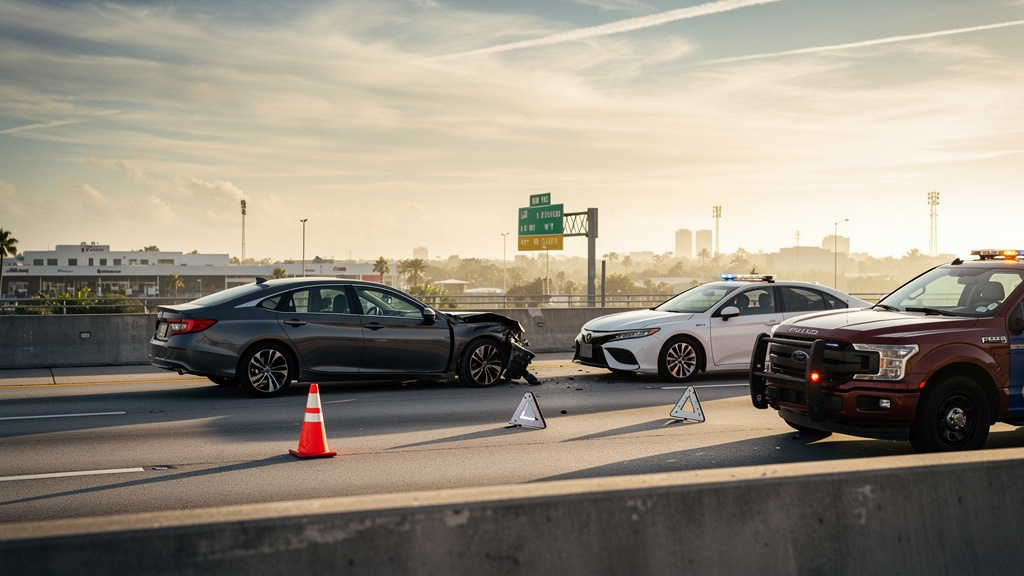
Picture this: You are stopped in stop-and-go traffic on the Palmetto Expressway near Okeechobee Road just after 5 p.m., brake lights glowing red ahead of you. Suddenly, you are struck hard from behind. The impact shoves your vehicle into the car in front of you. Now there are three damaged cars, two collision points on your vehicle (rear and front), and at least three insurance companies, all looking to shift blame. This is not a simple rear-end crash. It is a chain-reaction event where the Rear Driver likely caused the initial impact, but the Front Car may also share some fault if their brake lights were out or they braked unexpectedly. Depending on where the crash occurred on the expressway, the responding agency may differ, which affects the crash report you receive. On the expressway, the report may come from the Florida Highway Patrol rather than Hialeah Police, so ask the officer at the scene which agency is handling the crash. Either way, insurers will argue over percentages, not total liability.
Why is your own PIP the very first call, no matter who caused the crash?
In Florida, your own Personal Injury Protection (PIP) pays your medical bills first, even if you did nothing wrong. Under Fla. Stat. § 627.736, your PIP policy covers 80 percent of reasonable medical expenses and 60 percent of lost wages, up to $10,000 if a qualified medical professional determines you suffered an emergency medical condition. If no such determination is made, the cap drops to $2,500. Crucially, you must begin treatment within 14 calendar days of the crash. Miss that deadline and your PIP pays nothing, even if you paid premiums for years. Your own PIP applies first; only if you lack coverage does it shift to a household relative’s policy. Do not wait for the other driver’s insurer, they have no duty to cover your initial medical costs. And despite Florida’s no-fault label, you can still pursue damages for pain and suffering if you meet the permanency threshold under Fla. Stat. § 627.737(2).
How does Florida split fault among three or more drivers in the same crash?
Florida uses modified comparative negligence, meaning every driver who contributed to the crash gets assigned a percentage of fault. Under Fla. Stat. § 768.81(6), if you are found to be 10 percent at fault, for example, because you were following too closely, you lose 10 percent of your total recovery. But you can still collect 90 percent from the other at-fault parties. Importantly, Florida abolished joint and several liability, so each driver pays only their share. For example, in a pileup the Rear Driver might be 70 percent at fault for tailgating, the Front Car 20 percent for a burned-out brake light, and you, the Middle Car, 10 percent. Insurers may try to assign more fault to the middle driver, so evidence is critical. You lose all recovery only if you are found MORE THAN 50 percent at fault.
What if the driver who started the pileup has no bodily injury coverage, which happens constantly in Miami-Dade?
Many drivers in Miami-Dade carry only the state-minimum PIP and property damage coverage, with zero bodily injury liability insurance. Florida does not require it. When that happens, your own Uninsured/Underinsured Motorist (UM/UIM) coverage becomes your best, and often only, option for recovering damages beyond PIP, including pain and suffering, future medical costs, and lost earning capacity. Under Fla. Stat. § 627.727, UM coverage must be offered by your insurer and can only be rejected with a written, signed waiver. Check your policy declarations page now, you may already have it. If the at-fault driver has low limits that fall short of your losses, UIM coverage fills the gap. Keep in mind that in a UM claim your own insurer is on the other side of the claim and will evaluate it carefully.
You’re being pushed into the car ahead, does the front driver have a claim against you, and what do you do right now at the scene?
The driver in front of you may try to hold you responsible for their damage, but if you were pushed forward by the force of the rear impact, you generally are not liable. Still, you must prove it. First, photograph every angle of all vehicles before anyone moves, especially your rear bumper (hit by the Rear Driver) and front bumper (which struck the Front Car). This shows the sequence of impacts. Second, if your vehicles block traffic, Fla. Stat. § 316.061(1) requires drivers in a crash with only vehicle damage (no injuries) to make every reasonable effort to move their vehicles out of the travel lanes, so take your photos first only if you can do it quickly and safely. Report the crash to your own insurer immediately, not the Rear Driver’s. Their adjuster works for the other side. Do not give a recorded statement to any other insurer until you speak with a lawyer.
What evidence untangles a pileup, and how long do you have to act?
Key evidence includes:
- The official crash report diagram (accessible to you, your insurer, and your attorney under Fla. Stat. § 316.066, though confidential to others for 60 days)
- Photos of all vehicle damage patterns (front and rear on your car prove you were pushed)
- Witness names and phone numbers
- Skid marks or debris fields
- Event data recorder (black box) downloads
- Dashcam or traffic camera footage
Vehicles get repaired quickly, cameras overwrite footage within days, and memories fade. Preserve what you can now. For crashes occurring on or after March 24, 2023, you have two years from the date of the crash to file a lawsuit under Fla. Stat. § 95.11, not from the date you discovered an injury. That deadline applies even in multi-vehicle pileups. If a government vehicle was involved, Florida law requires written notice to the agency before you can sue, so act quickly. For more on handling a Palmetto crash, see our guide: palmetto-expressway-crash-what-to-do.
Frequently asked questions
I was rear-ended and pushed into the car in front of me. Can that front driver sue me for their damage?
They can file a claim, but if you were struck from behind and had no control over the forward motion, you typically are not legally responsible. Documenting the rear impact on your vehicle is essential to show you were an intermediary, not the cause.
Florida is a no-fault state, does that mean I can’t go after the driver who hit me?
No. PIP covers initial medical costs regardless of fault, but if you suffer a permanent injury, significant scarring, or permanent loss of an important bodily function, you can pursue a claim against the at-fault driver for pain and suffering under [Fla. Stat. § 627.737(2)].
The driver who rear-ended me has no insurance. What are my options in Florida?
Your own Uninsured Motorist (UM) coverage is likely your primary recourse. It is optional but automatically included unless you signed a written rejection. Check your policy and notify your insurer promptly.
How long do I have to file a lawsuit after a chain-reaction crash on the Palmetto?
Two years from the date of the crash if it happened on or after March 24, 2023, per [Fla. Stat. § 95.11]. The presence of multiple vehicles does not extend this deadline.
The insurance adjuster is saying the damage to my car is minor, so my injuries must not be serious. Is that true?
No. Vehicle damage does not reliably predict injury severity. Soft-tissue injuries like whiplash often occur in low-speed impacts. Medical evaluation, not bumper dents, determines the extent of harm.
Related reading: I was in a car accident in Hialeah. What do I do now? · The driver who hit me in Hialeah has no insurance. What now? · A truck hit me in Hialeah. Is that different from a car accident?
Hurt in an accident in Hialeah? Call Wolfson & Leon at 305-965-3766 for a free consultation. We speak Spanish, and there is no fee unless we win.
Key facts
- PIP pays 80 percent of reasonable medical bills and 60 percent of lost wages up to $10,000 (emergency medical condition) or $2,500 (no EMC finding), regardless of fault, but only if you begin treatment within 14 days of the crash. Source: Fla. Stat. § 627.736
- Your own PIP policy pays first; only if you have no PIP of your own does coverage shift to a household relative's policy, and only then, for pedestrians and cyclists who are Florida residents, to the striking vehicle's PIP. Source: Fla. Stat. § 627.736(4)(e)
- Under modified comparative negligence, your recovery is reduced by your share of fault and eliminated entirely only if you are found MORE THAN 50 percent at fault. Source: Fla. Stat. § 768.81(6)
- Florida does not require drivers to carry bodily injury liability insurance, making uninsured and underinsured motorist coverage a critical, and often the primary, source of compensation after a pileup. Source: Fla. Stat. § 627.727
- The deadline to file a personal injury lawsuit for crashes occurring on or after March 24, 2023 is two years from the date of the crash. Source: Fla. Stat. § 95.11
Frequently asked questions
I was rear-ended and pushed into the car in front of me. Can that front driver sue me for their damage?
Generally, a middle car that is pushed into the vehicle ahead by a rear impact is not considered at fault for the front car's damage, because the force originated from behind. However, if evidence shows you were also following too closely before the crash, a portion of fault could be assigned to you under Florida's comparative negligence rules. Documenting your rear damage clearly, with photographs taken before vehicles move, is the most important thing you can do to show you were pushed rather than the initiating driver. An attorney can review the crash sequence and protect you if the front driver's insurer tries to assign you blame.
Florida is a no-fault state, does that mean I can't go after the driver who hit me?
No-fault means your own PIP coverage pays your initial medical bills regardless of who caused the crash, it does not mean the at-fault driver escapes responsibility. If your injuries meet Florida's permanency threshold (a permanent injury, significant and permanent scarring or disfigurement, or permanent loss of an important bodily function), you can step outside the no-fault system and pursue a claim against the at-fault driver for pain and suffering, future medical costs, and other damages beyond PIP. Under Fla. Stat. § 627.737(2), the threshold is real, and serious injuries such as disc herniations, surgeries, or lasting neurological symptoms can qualify when a doctor finds the injury permanent. PIP is the floor, not the ceiling.
The driver who rear-ended me has no insurance. What are my options in Florida?
Florida does not require drivers to carry bodily injury liability insurance, so this situation is common, especially in Miami-Dade. Once your PIP benefits are exhausted, your own uninsured motorist (UM) coverage under Fla. Stat. § 627.727 becomes your primary recovery tool for pain, suffering, and losses above PIP limits. Check your declarations page immediately, UM coverage can only be waived with a written signed rejection, so you may have it without realizing it. If the at-fault driver has some bodily injury coverage but not enough, your underinsured motorist (UIM) coverage can fill the gap between their policy limits and your actual damages.
How long do I have to file a lawsuit after a chain-reaction crash on the Palmetto?
For crashes occurring on or after March 24, 2023, Florida's statute of limitations for personal injury negligence claims is two years from the date of the crash under Fla. Stat. § 95.11. Multiple impacts in the same event do not reset the clock, it runs from the day of the overall crash. If any vehicle involved belonged to a government entity, Florida law requires written notice to the agency before a lawsuit can be filed. Evidence in pileup cases, vehicle data, dashcam footage, witness memories, disappears quickly, so waiting is one of the most costly mistakes you can make.
The insurance adjuster is saying the damage to my car is minor, so my injuries must not be serious. Is that true?
No, and this is one of the most common tactics insurers use in rear-end and chain-reaction cases. Low visible vehicle damage does not reliably rule out soft-tissue injuries, disc herniations, or concussions. The 'low-impact' argument can create doubt, especially for people who are not yet represented. Getting prompt medical evaluation, following your treatment plan, and keeping a detailed record of symptoms over time are the best ways to counter this argument. Do not accept a settlement offer before you know the full scope of your injuries.
This article is general information about Florida law, not legal advice, and reading it does not create an attorney-client relationship. Every case is different and past results do not guarantee a similar outcome. For advice about your situation, call Wolfson & Leon at 305-965-3766 for a free consultation.
Also available in: Versión en español
 Car accidents
 Rear-Ended in Florida: Are They Automatically at Fault or Not?
Usually, but not automatically. Florida courts start with a rebuttable presumption that the rear driver was negligent, but insurers can challenge…
 Car accidents
 Yes, Hialeah Car Accident Lawyers Handle Rear-End Crashes, Here Is How
Yes, rear-end collisions are among the most common cases handled by car accident lawyers in Hialeah, and the attorneys at Wolfson & Leon, located at…
 Car accidents
 5 Myths About What an Accident Lawyer in Miami Actually Charges
Personal injury lawyers in Miami handle accident cases on a contingency fee basis, no upfront payment, no hourly bill, and no fee at all unless they…