
My Uber Crash Bills Are More Than PIP Covers, Who Pays the Rest?
Florida PIP covers 80 percent of your medical bills up to $10,000, or only $2,500 if no doctor finds an emergency medical condition, and that gap disappears fast after a serious Uber crash. Once PIP runs out, the next sources are your health insurance, the rideshare liability policy that applied at the moment of the crash, and your own uninsured motorist coverage if the at-fault driver had no bodily injury policy. To recover anything beyond bills, pain, suffering, permanent limitations, your injury must meet Florida's permanent-injury threshold under Fla. Stat. § 627.737(2).
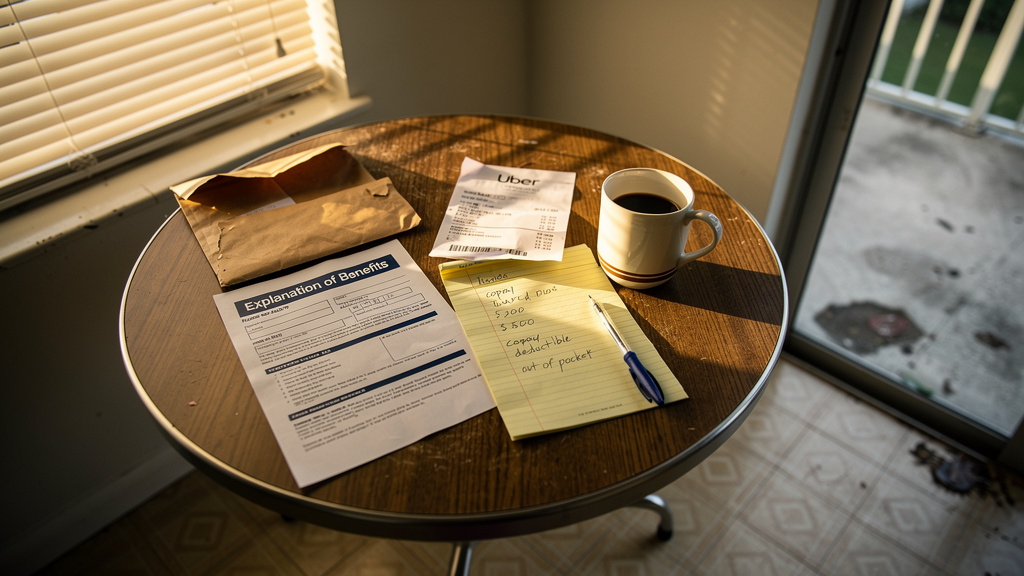
Florida PIP covers 80 percent of your medical bills up to $10,000 only if a doctor finds you had an emergency medical condition at the time of the Uber crash. If no such finding is made, PIP coverage drops to just $2,500. That gap vanishes fast in serious crashes. Once PIP is exhausted, your health insurance may cover more, and the rideshare liability policy, depending on the driver’s app status, can step in. If the other driver had no bodily injury coverage, your own uninsured motorist (UM) policy could apply. To recover anything beyond medical bills, like pain and suffering, Florida law requires proof of a permanent injury or significant scarring under Fla. Stat. § 627.737(2).
Why did PIP stop paying so quickly, and what is the $2,500 trap?
Florida’s PIP system has two tiers. Under Fla. Stat. § 627.736(1), PIP pays 80 percent of reasonable medical expenses and 60 percent of lost wages, but only up to $10,000 if a physician certifies an emergency medical condition. Without that certification, the cap falls to $2,500. A single emergency room visit after a crash on Okeechobee Road or the Palmetto Expressway can easily exceed $2,500, leaving you responsible for the rest. You also must seek treatment within 14 days of the crash or lose all PIP benefits entirely. Importantly, your own auto insurance policy pays your PIP first, not the Uber driver’s, even if you were just a passenger. If you have no policy, it may come from a relative in your household. If neither exists, a passenger generally turns to the PIP covering the vehicle they were riding in (during an accepted Uber ride, the TNC’s coverage), while a pedestrian or cyclist who is a Florida resident turns to the striking vehicle’s PIP.
What exactly counts as an ‘emergency medical condition’ and why does it matter so much?
An emergency medical condition is defined by Fla. Stat. § 395.002(8) as one with acute symptoms so severe that without immediate care, your health could be in serious jeopardy, or you could suffer serious impairment of bodily function or organ dysfunction. The treating physician, not the insurance adjuster, makes this determination. Insurers often challenge it to limit benefits to the $2,500 tier. In Miami-Dade, seriously injured crash victims may be taken to a trauma center such as Jackson Memorial’s Ryder Trauma Center, followed by ongoing care at Palmetto General, Hialeah Hospital, or local clinics. If your EMC is documented early, you access the full $10,000 in PIP. If not, even necessary follow-up care may go unpaid, pushing bills into collections sooner than expected.
After PIP runs out, can my health insurance, Medicare, or Medicaid pick up the rest?
Yes, private health insurance, Medicare, or Medicaid may cover costs once PIP is exhausted or for the 20 percent of medical bills PIP does not pay. However, the exact order of payment and whether your plan will accept those charges depends on your specific policy terms and the rules that apply to your plan. Many Hialeah-area providers will bill your health insurer for continued physical therapy, imaging, or specialist visits after PIP ends. Be aware that these insurers often assert a lien against any future settlement, meaning they expect repayment from your recovery. Some drivers carry MedPay, an optional add-on to their auto policy, that can help cover the 20 percent PIP gap, but it is not required in Florida. Always check your own policy documents before assuming secondary coverage will apply.
Which insurance policy, the driver’s or Uber’s, is actually responsible for my remaining bills?
The answer hinges entirely on the Uber driver’s app status at the exact moment of impact. Under Fla. Stat. § 627.748(7)(c), when the driver has accepted your ride and is en route or carrying you, Uber must provide at least $1 million in liability coverage. This policy is primary, meaning it pays first, and applies even if the driver’s personal auto insurer denies coverage because rideshare activity is excluded. If the driver was merely logged in but had not yet accepted a trip (Period 1), lower limits may apply, though still backed by Uber’s policy per state law. Do not assume the driver’s personal insurer is responsible; many exclude rideshare use altogether. Trip records, GPS data, and app logs are critical to proving which coverage applies, and those are often only accessible through legal channels or formal requests.
What if the driver who hit us had no insurance, does my own UM coverage apply?
If the at-fault driver carried no bodily injury liability insurance, or too little to cover your losses, your own uninsured/underinsured motorist (UM/UIM) coverage can step in. UM is optional in Florida but must be formally rejected in writing; many policyholders unknowingly keep it. If the crash happened after the Uber driver accepted your ride, the TNC’s UM coverage under Fla. Stat. § 627.748 also applies. Under Fla. Stat. § 627.727, this coverage can pay for medical bills, lost wages, and non-economic damages if you meet the permanent-injury threshold. Your UM claim is separate from PIP and rideshare liability, but timing matters. For crashes on or after March 24, 2023, you have two years under Fla. Stat. § 95.11 to file a negligence lawsuit against the at-fault driver; a lawsuit against your own UM insurer may follow a different deadline, so confirm it with a lawyer if negotiations stall.
Can I recover more than just my medical bills, and how does my treatment get paid while the case is pending?
You can recover more than bills, but only if your injury meets Florida’s permanent-injury threshold under Fla. Stat. § 627.737(2). That means proving either a permanent injury within reasonable medical probability, a significant and permanent loss of an important bodily function, or significant and permanent scarring. If you meet this standard, you may seek compensation for pain and suffering, mental anguish, loss of enjoyment of life, future medical needs, and reduced earning capacity. While your case is pending, some Hialeah and Miami-Dade providers may agree to treat you on a letter of protection (LOP), deferring payment until the case resolves. The LOP is paid from your recovery, but it creates a debt to the provider, so discuss the implications with a lawyer. Also remember: Florida uses modified comparative negligence. Your recovery is reduced by your share of fault and barred only if you are more than 50 percent at fault under Fla. Stat. § 768.81(6).
Frequently asked questions
I always thought PIP meant my insurance would just pay my medical bills, why am I still getting collection notices?
PIP only covers 80 percent of bills up to $10,000 (or $2,500 without an emergency medical condition finding). It does not cover the remaining 20 percent or amounts beyond the cap. Providers often bill patients for those uncovered portions if no secondary insurance steps in.
I was a passenger in the Uber, whose PIP pays my initial bills?
Your own auto insurance policy pays first, even as a passenger. If you do not have a car or policy, PIP may come from a resident relative’s policy. If neither applies, a passenger generally turns to the PIP covering the Uber (during an accepted ride, the TNC’s coverage), and a pedestrian or cyclist to the vehicle that struck them, but never the Uber driver’s PIP for a passenger with their own coverage.
Does it matter whether the Uber driver had accepted my ride or was still waiting for a request when the crash happened?
Yes. Coverage levels change based on app status. When the driver has accepted your ride and is transporting you, Uber’s $1 million liability policy applies. If the driver was only logged in but had not accepted a trip, lower limits may apply. App data is key to proving which period applied.
How long do I have to file a lawsuit if the settlement offer isn’t enough?
For crashes occurring on or after March 24, 2023, Florida law gives you two years from the date of the crash to file a negligence lawsuit under Fla. Stat. § 95.11. Do not wait until the last month to act, evidence disappears and memories fade.
Can I still see a doctor if I cannot pay upfront while my claim is being resolved?
Possibly. Some clinics in Hialeah and Miami-Dade may accept letters of protection, allowing you to receive care now and pay later from your settlement. Ask your provider directly, but confirm the arrangement with a lawyer first to understand how it affects your case.
Related reading: I was in an Uber or Lyft accident in Hialeah. Whose insurance pays? · The driver who hit me in Hialeah has no insurance. What now? · I was in a car accident in Hialeah. What do I do now? · The 14-day PIP rule in Florida: what happens if you wait to see a doctor after a Hialeah car accident
Hurt in an accident in Hialeah? Call Wolfson & Leon at (305) 285-7071 for a free consultation. We speak Spanish, and there is no fee unless we win.
Key facts
- PIP pays 80 percent of reasonable medical bills up to $10,000 only when a physician determines an emergency medical condition exists; without that finding the cap is $2,500. Source: Fla. Stat. § 627.736(1)
- An emergency medical condition is a condition with acute symptoms severe enough that the absence of immediate medical attention could reasonably be expected to place the patient's health in serious jeopardy. Source: Fla. Stat. § 395.002(8)
- When an Uber driver has accepted a trip and is en route or carrying a passenger, Florida law requires qualifying liability coverage of at least $1 million to be in place. Source: Fla. Stat. § 627.748(7)(c)
- Uninsured motorist coverage is optional in Florida and must be rejected in writing; it can pay when the at-fault driver carries no bodily injury liability coverage or not enough to cover your losses. Source: Fla. Stat. § 627.727
- To recover pain and suffering, or any non-economic damages, from the at-fault driver, Florida requires proof of a permanent injury, permanent loss of an important bodily function, or significant and permanent scarring or disfigurement. Source: Fla. Stat. § 627.737(2)
Frequently asked questions
I always thought PIP meant my insurance would just pay my medical bills, why am I still getting collection notices?
PIP only pays 80 percent of covered bills, so a 20-percent balance remains on every charge even before the $10,000 cap is reached. If no doctor documented an emergency medical condition, your total medical benefit cap was $2,500, which one ER visit can exceed entirely. The collection notices represent what neither PIP nor any other payer has yet covered, and resolving them usually requires pursuing the at-fault party's liability coverage or your own health insurance.
I was a passenger in the Uber, whose PIP pays my initial bills?
Your own PIP policy pays first, regardless of who caused the crash, under Fla. Stat. § 627.736(4)(e). If you do not have your own policy, a resident relative's PIP policy is next in line. The Uber driver's PIP or the TNC's policy does not step in first simply because you were in their vehicle, Florida's priority order puts your personal policy first.
Does it matter whether the Uber driver had accepted my ride or was still waiting for a request when the crash happened?
It matters enormously. Once a driver accepts a trip and through the moment the passenger exits, Florida law under Fla. Stat. § 627.748(7)(c) requires qualifying liability coverage of at least $1 million to be in place. If the driver was logged into the app but had not yet accepted a ride, the coverage available is far lower. Establishing the driver's exact app status at the moment of impact, through app records and trip logs, can be the single most important fact in the case.
How long do I have to file a lawsuit if the settlement offer isn't enough?
For injuries from crashes that occurred on or after March 24, 2023, Florida's statute of limitations under Fla. Stat. § 95.11 gives you two years from the date of the crash to file a personal injury lawsuit. Missing that deadline typically eliminates your right to sue entirely. Do not wait until your bills are in collections to consult an attorney, by then, critical deadlines and evidence may already be at risk.
Can I still see a doctor if I cannot pay upfront while my claim is being resolved?
Some medical providers in South Florida, including clinics in the Hialeah area, may treat injury patients under a letter of protection, an arrangement in which the provider agrees to defer payment until a settlement or court verdict is reached and is then paid from those proceeds. This arrangement allows treatment to continue without out-of-pocket payment during the claims process, though the specifics vary by provider and the terms of the agreement are worth reviewing carefully with an attorney.
This article is general information about Florida law, not legal advice, and reading it does not create an attorney-client relationship. Every case is different and past results do not guarantee a similar outcome. For advice about your situation, call Wolfson & Leon at (305) 285-7071 for a free consultation.
Also available in: Versión en español
 Uber and Lyft accidents
 I Was Injured Driving for Uber in Hialeah, Who Pays My Medical Bills?
Uber's liability coverage is designed to protect other people, passengers, pedestrians, and other drivers, not you as the Uber driver. Personal…
 Uber and Lyft accidents
 What Your Lawyer Does First After an Uber or Lyft Crash in Florida
In the first weeks after an Uber or Lyft crash, your lawyer's job is to find every insurance policy that could pay, lock down the app data that…
 Uber and Lyft accidents
 Hurt in an Uber Crash and Still in the Hospital: How to Hire a Lawyer From Bed
Yes. A family member can call Wolfson & Leon on your behalf any time of day, and an attorney can come to your hospital room or your home for a free…