
Doctors Found a Sponge Left Inside Me From Surgery: Do I Have a Case?
Yes, and Florida law gives you a significant head start. Under Fla. Stat. § 766.102, discovering a surgical sponge, clamp, forceps, or similar instrument inside your body is prima facie evidence of negligence, meaning the object itself can serve as evidence that the standard of care was breached. You still need to show that the retained object caused you harm and follow Florida's mandatory presuit process, but this rule gives you a head start that ordinary malpractice cases do not have.
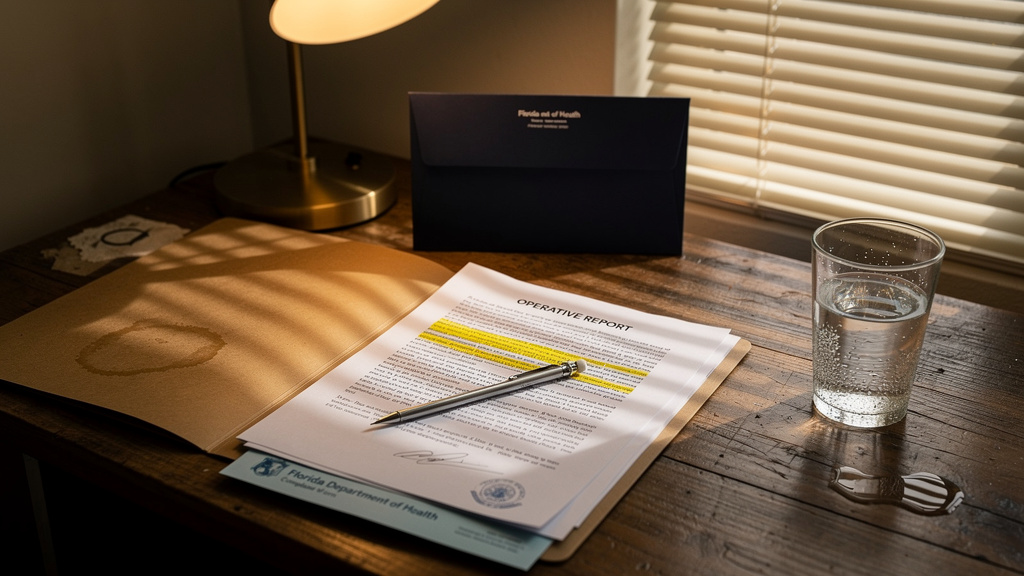
Yes. Finding a surgical sponge or instrument left inside your body after an operation is strong evidence of medical negligence under Florida law. Fla. Stat. § 766.102 states that the mere presence of a foreign object like a sponge, clamp, forceps, or surgical needle is prima facie evidence of negligence. This means the object itself can serve as evidence that the standard of care was breached. You still must show the retained item caused harm and follow Florida’s mandatory presuit steps, but this legal presumption gives your claim a powerful starting point.
What is a ‘never event,’ and does a retained sponge or instrument qualify?
A “never event” is a term used by hospitals and safety organizations to describe serious, preventable errors that should never happen during medical care. Retained surgical items, such as sponges, gauze, clamps, forceps, surgical needles, catheter fragments, retractors, and guidewires, are among these events. Wrong-site surgery, wrong-patient procedures, and operating on the wrong body part are also classified as never events. These mistakes are considered entirely avoidable when proper counting protocols, team communication, and safety checks are followed. The Joint Commission lists retained foreign objects as one of the most frequently reported sentinel events nationwide. While “never event” is a medical term, not a legal one, Florida law reflects this judgment: the discovery of such an object is prima facie evidence of negligence under Fla. Stat. § 766.102.
How does Florida law treat a retained object differently from other malpractice cases?
In most medical malpractice claims, you must prove four things: duty, breach, causation, and damages. For a retained surgical item, Florida law removes one major hurdle. Under Fla. Stat. § 766.102, the discovery of a foreign body such as a sponge, clamp, forceps, surgical needle, or similar surgical paraphernalia is prima facie evidence of negligence. That means the object itself can serve as evidence that the provider breached the standard of care, and the defense will have to respond to that evidence. However, this does not automatically prove the object caused your injury, that you suffered real damages, or that your claim meets all legal deadlines. Possible defenses include claims that the item was intentionally placed (like a drain left for healing), that counts were correctly documented, or that your symptoms came from another condition. These cases are not automatic wins: the case still depends on organized evidence and timely action.
Who is responsible, the surgeon, the hospital, or someone else?
Responsibility for a retained surgical item is rarely just one person’s fault. Potential defendants include the operating surgeon, the circulating nurse, the scrub technologist, the anesthesiologist, and the hospital itself. Hospitals can be held liable for systemic failures, such as outdated counting procedures, poor team training, or communication breakdowns during surgery. Patient-safety research has found that retained surgical items often result from system failures, not just individual error. The key records to identify fault include the operative report, nursing notes, and especially the sponge and instrument count sheets. Discrepancies or last-minute corrections in these logs often reveal where the process broke down. In rare cases, liability may extend to equipment manufacturers if a fragment detached from a device. Because multiple parties may share responsibility, you need an attorney to review all the records before deciding who to pursue. Do not assume the surgeon alone is at fault.
What records do I need, and how do I get them right now?
You have a legal right to your medical records under Fla. Stat. § 456.057. Immediately request these specific documents: (1) the operative report, (2) preoperative assessment and consent forms, (3) nursing and circulating-nurse notes, (4) sponge and instrument count sheets, (5) anesthesia record, (6) postoperative and recovery-room notes, (7) all imaging studies showing the retained object, (8) pathology reports if the item was analyzed after removal, (9) records from the surgery or visit where it was discovered, and (10) discharge instructions. Send a written request to the hospital’s medical records department asking them to preserve the physical object (if available), imaging files, count sheets, and surgical logs. During the presuit process, providers must supply relevant records within 10 business days at a reasonable cost. Also ask whether the hospital filed an adverse incident report with state authorities, Florida law may require reporting of certain serious events, though this varies by circumstance.
When does the clock start, and how long do I have to file?
In Florida, you generally have two years from the date you discovered, or reasonably should have discovered, the retained object to file a medical malpractice claim. This is not necessarily the date of your original surgery. However, a four-year statute of repose applies in most adult cases, meaning you cannot sue more than four years after the surgery, even if you only found the object later. Limited exceptions exist: if fraud or intentional concealment is proven, the deadline may extend to seven years; minors have additional protections. Do not wait until you are fully healed before acting. The presuit investigation alone takes months, attorney review, expert opinion, Notice of Intent, and a mandatory 90-day screening period, so your practical deadline is well before the legal one. Discovering the object does not create an unlimited filing period, and waiting can cost you the right to sue entirely.
What can I recover, and what does the presuit process look like?
If your claim proceeds, you may recover compensation for: (1) medical bills related to removing the object and treating complications like infection, (2) lost wages during recovery, (3) reduced earning capacity if you have lasting disability, (4) pain and suffering, and (5) future medical expenses if ongoing care is needed. A hospital refund for the original surgery does not cover these losses, and may ignore insurance liens, future costs, or income damage. Florida requires a mandatory presuit process before any lawsuit. First, an attorney must conduct a reasonable investigation and obtain a verified written opinion from a qualified medical expert confirming negligence. Second, a formal Notice of Intent must be served on every potential defendant. Third, a 90-day screening period begins, no lawsuit can be filed during this time, though parties may settle. Because this process affects your timeline, acting quickly after discovery is essential.
Frequently asked questions
Is a retained sponge automatically a winning malpractice case in Florida?
No. Florida law treats the discovery of a retained sponge as prima facie evidence of negligence, which is a strong legal advantage. However, you must still prove the object caused actual harm, meet all deadlines, and complete the presuit process. Outcomes depend on the facts of each case.
The hospital offered to refund the cost of my surgery. Should I accept?
A refund may cover part of your out-of-pocket expense but usually does not account for lost wages, pain, future treatment, or insurance liens. Accepting it could limit your legal rights. Consult an attorney before signing any release or agreement.
I had my surgery months ago and just discovered the retained object. Is it too late to sue?
Possibly not. Florida’s two-year clock typically starts when you discover the object, not when the surgery occurred. But the four-year outer limit may apply. An attorney can review your dates and advise whether your claim is still viable.
Multiple people were in the operating room. How do I know who is responsible?
Liability often involves several parties, surgeon, nurses, techs, and the hospital. Count sheets, operative reports, and team notes help pinpoint where the failure occurred. An attorney will analyze these records to determine responsibility.
Can I get copies of my operative report and surgical count sheets from the hospital?
Yes. Under Fla. Stat. § 456.057, you have the right to all your medical records, including operative reports and count sheets. Submit a written request to the medical records department as soon as possible.
Hurt in an accident in Hialeah? Call Wolfson & Leon at 305-965-3766 for a free consultation. We speak Spanish, and there is no fee unless we win.
Key facts
- Under Fla. Stat. § 766.102, discovery of a foreign body such as a sponge, clamp, forceps, or surgical needle inside a patient is prima facie evidence of negligence, meaning the object itself can serve as evidence the standard of care was breached. Source: Fla. Stat. § 766.102
- Florida medical malpractice claims generally must be filed within two years from the date the injury was discovered, or reasonably should have been discovered, with a four-year outer limit from the date of the original surgery in most adult cases. Source: Fla. Stat. § 95.11; Fla. Stat. § 766.106
- Before filing a lawsuit, Florida law requires the claimant to complete a presuit investigation, obtain a corroborating verified medical expert opinion, and serve a Notice of Intent on each prospective defendant; after service, a 90-day screening period begins during which no lawsuit may be filed. Source: Fla. Stat. § 766.106
- Patients in Florida have the right to obtain copies of their medical records, including operative reports and pathology reports, from any healthcare provider or hospital. Source: Fla. Stat. § 456.057
- Retained surgical objects are classified as 'never events' in the medical field, errors considered so preventable that, with proper safety protocols in place, they should not occur at all. Source: Wolfson & Leon
Frequently asked questions
Is a retained sponge automatically a winning malpractice case in Florida?
Not automatically, but Florida law gives you a strong starting point. Under Fla. Stat. § 766.102, the discovery of a retained surgical object is prima facie evidence of negligence, which means the object itself can serve as proof that the standard of care was violated. However, you still need to show that the retained object caused your specific injuries, comply with Florida's mandatory presuit investigation and notice process, and file within the applicable deadline. The defense can still dispute causation, the identity of the responsible party, and damages.
The hospital offered to refund the cost of my surgery. Should I accept?
Do not accept any payment or sign any documents from the hospital or its insurer before speaking with a malpractice attorney. A refund of surgical fees generally does not compensate you for the second surgery to remove the object, lost wages, pain and suffering, infection treatment, future medical care, or outstanding insurance liens. Accepting a settlement, even informally, may release your legal rights to those additional damages.
I had my surgery months ago and just discovered the retained object. Is it too late to sue?
It may not be too late, but you need to act immediately. Florida's discovery rule generally starts the two-year clock from when you discovered, or reasonably should have discovered, the retained object, not necessarily the date of the original surgery. However, a four-year outer limit applies in most adult cases regardless of when you discovered the problem, and Florida's mandatory presuit investigation takes months before a lawsuit can even be filed. Consult an attorney the same week the object is found.
Multiple people were in the operating room. How do I know who is responsible?
Responsibility often extends to more than one party, the surgeon, circulating nurse, scrub technologist, and the hospital itself can all bear liability depending on which protocols failed. The operative report, sponge and instrument count sheets, and nursing notes typically show where the breakdown occurred. An attorney will review all of those records and, if necessary, retain a medical expert to identify which providers or institutional failures caused the object to be left behind.
Can I get copies of my operative report and surgical count sheets from the hospital?
Yes. Under Fla. Stat. § 456.057, Florida patients have the right to obtain copies of their medical records from any healthcare provider or facility, including operative reports, nursing notes, and related documents. Request the records in writing and simultaneously ask in writing that the physical object, all imaging, count sheets, and pathology reports be preserved while your claim is being evaluated.
This article is general information about Florida law, not legal advice, and reading it does not create an attorney-client relationship. Every case is different and past results do not guarantee a similar outcome. For advice about your situation, call Wolfson & Leon at 305-965-3766 for a free consultation.
Also available in: Versión en español
 Medical malpractice
Surgery Went Wrong: Who Do You Sue, Surgeon, Anesthesiologist, or Hospital?
The answer depends on who employed each member of your surgical team and what specifically caused the harm. In Florida, surgeons and…
 Medical malpractice
Surgical Error in Florida: What Damages Can You Actually Recover?
If a surgeon or hospital in Florida performed an operation that fell below the accepted standard of care and that failure caused you measurable…
 Medical malpractice
Does a Different Second Opinion Mean You Can Sue for Misdiagnosis in Florida?
A different second opinion is not enough by itself to win a misdiagnosis case in Florida. You must also show that the first doctor's diagnostic…