
I Slipped and Fell at PortMiami: Who Is Responsible for My Injuries?
Responsibility for a slip-and-fall at PortMiami depends on exactly where you fell and who controlled that space at the time: the cruise line, a private terminal operator, or Miami-Dade County may each owe you a duty of care, and more than one party can share fault. Florida law and federal maritime law may both apply, and the deadlines to act are shorter than in a typical Florida personal injury case. Identifying the right defendant before those deadlines expire is the most critical step after getting medical attention.
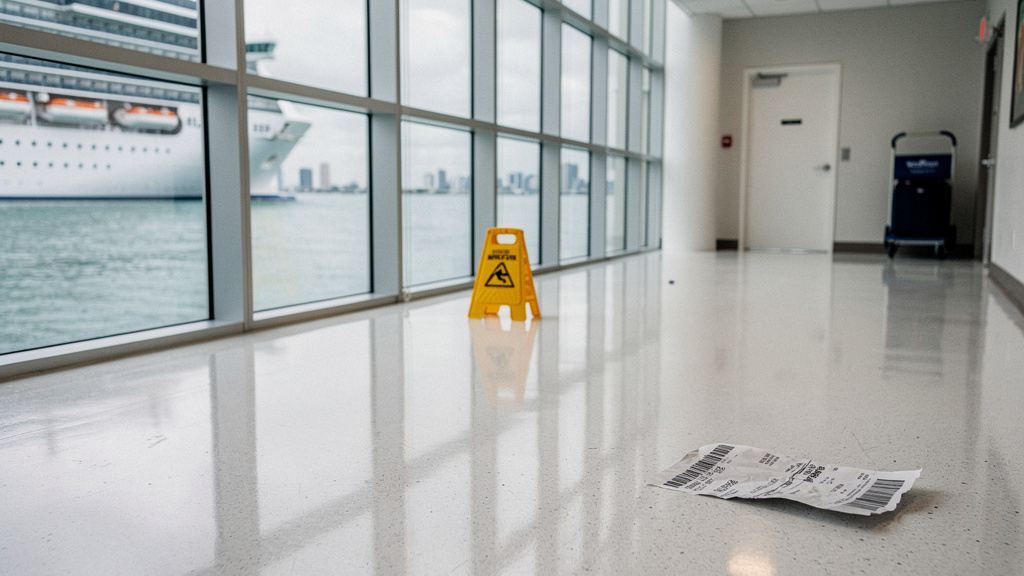
Responsibility for a slip-and-fall at PortMiami depends on exactly where you fell and who controlled that space at the time. The cruise line, a private terminal operator, or Miami-Dade County may each owe you a duty of care, and more than one party can share fault. Florida law and federal maritime law may both apply, and the deadlines to act are shorter than in a typical Florida personal injury case. Identifying the right defendant before those deadlines expire is the most critical step after getting medical attention.
Where exactly did you fall, and why does that location change everything?
PortMiami is not one single legal entity. Liability shifts depending on which zone you were in when you fell. You need to know this to understand who might be responsible:
- Terminal floor and check-in/waiting areas: These spaces may be managed by a private terminal operator or directly by the cruise line under a lease from Miami-Dade County. Who controls the area determines who must keep it safe.
- Luggage hall / baggage claim: This is a common location for falls. A publicly reported lawsuit involved a passenger who slipped on an unaddressed liquid in the Terminal A luggage hall at PortMiami on Dodge Island while retrieving bags after disembarking the Wonder of the Seas.
- Gangway / boarding ramp: This is the walkway connecting the ship to the terminal. Responsibility here may rest with the cruise line, the terminal operator, or both. Maritime law may apply, and the legal standard may differ from Florida premises liability rules.
- Aboard the vessel: If you fell after stepping onto the ship, your claim is likely governed by federal maritime law, not Florida’s slip-and-fall statutes.
Who actually controls each part of a PortMiami terminal?
PortMiami sits on Dodge Island and is owned by Miami-Dade County. But ownership does not mean the county runs every corner of every terminal. Some terminals may be operated by private companies under lease or management agreements with the county, and this varies by terminal. Cruise lines may also control parts of the terminal during embarkation or disembarkation, directing passenger flow and branding the space as their own.
A real-world example shows how complex this gets: a lawsuit over a fall in Terminal A named the cruise line and two separate terminal operating entities. The plaintiff argued theories like joint venture and apparent agency, suggesting multiple parties shared responsibility. This illustrates why identifying the correct defendant requires digging into operational agreements and precise incident details. That investigation starts with an attorney, not a guess.
When is Miami-Dade County a defendant, and what written notice is required before you can sue?
If any part of the area where you fell was operated by Miami-Dade County or one of its agencies, sovereign immunity applies. That means you cannot simply file a lawsuit. Under Florida Statute § 768.28(6), you must first submit a written notice of claim to the county. Missing this step can permanently bar your case, no matter how serious your injuries.
This notice requirement is not optional if the county is involved. Do not assume you have years to figure this out. Notice requirements have their own timing rules, and you should consult an attorney promptly to confirm what applies to your claim.
Florida’s wet-floor law for businesses versus maritime rules on the gangway, which standard applies to your fall?
If you fell inside the terminal, like in the luggage hall, you’re likely under Florida’s transitory foreign substance statute (Fla. Stat. § 768.0755). To win, you must prove the business operator either knew about the hazardous condition, such as a spilled liquid, or should have known about it because it existed long enough that ordinary care would have uncovered it. An unaddressed puddle with no cones, signs, or cleaning is the classic example.
If you fell on the gangway, the ramp between ship and shore, the rules may shift. Federal maritime law could apply instead of Florida premises law. This is a gray zone. Courts look at who controlled the gangway, how it was maintained, and whether the injury occurred before or after crossing onto the vessel. The legal standard changes based on that analysis, so pinpointing your exact location matters down to the inch.
What should you do before you leave the port, and why does it matter so much?
Evidence vanishes fast in a busy cruise terminal. Follow these steps immediately:
- Report the fall to port security, cruise staff, or terminal personnel. Demand a written incident report and get the number or a copy.
- Photograph the spot where you fell, the substance on the floor, and whether there were warning signs or cones.
- Take pictures of visible injuries like bruises or cuts.
- Get names and contact info from any witnesses, passengers, workers, or crew.
- See a doctor the same day. Delay hurts your health and weakens your claim.
- Do not give a recorded statement to insurers or terminal reps before talking to a lawyer.
Insurers may use gaps in your story or missing evidence to dispute or reduce your claim. Your early actions protect you before they get involved.
Can your own actions reduce or eliminate what you can recover?
Yes, but not always completely. Under Florida Statute § 768.81(6), your recovery is reduced by your percentage of fault. Only if you are found more than 50 percent at fault do you get nothing. For example, if you were distracted by your phone or ran through a clearly marked wet area, the defense will argue you share blame, but partial fault does not end your claim.
Also, check your cruise ticket contract. Many impose a written notice requirement (often within six months) and often require a lawsuit to be filed within one year of the incident; check your own ticket. This is shorter than Florida’s standard two-year deadline under Fla. Stat. § 95.11 for injuries on or after March 24, 2023. Courts generally enforce these deadlines. Locate your ticket now and give it to an attorney immediately.
Frequently asked questions
Can I sue both the cruise line and the terminal operator for the same fall?
Yes. If both entities had control over the area or contributed to the unsafe condition, you can name both as defendants. A publicly reported lawsuit over a PortMiami fall did exactly that, alleging joint responsibility through agency or operational overlap.
What if I slipped on the gangway, is that the cruise line’s fault or the port’s?
It depends on who controlled the gangway at the time. Often, the cruise line manages it during boarding and disembarkation, but arrangements vary. Because maritime law may apply, this requires legal analysis, not assumption.
Do I have to give Miami-Dade County written notice before I can sue?
Yes, if your claim involves any area operated by the county or its agencies. Florida Statute § 768.28(6) requires this pre-suit notice. Skipping it can kill your case, even if you’re well within the filing deadline.
My cruise ticket says I only have one year to file a lawsuit. Is that really enforceable?
Often, yes. Federal courts generally enforce the notice and lawsuit deadlines in cruise ticket contracts, which often require written notice within six months and a lawsuit within one year, even though Florida’s general negligence deadline is two years. Check your own ticket and have a lawyer review it.
What if I was partly at fault for my own fall, can I still recover anything?
Yes, as long as you are not more than 50 percent at fault. Florida uses modified comparative negligence, so your award would be reduced by your share of blame, but you would not be barred entirely.
Hurt in an accident in Hialeah? Call Wolfson & Leon at 305-965-3766 for a free consultation. We speak Spanish, and there is no fee unless we win.
Key facts
- Florida's transitory foreign substance statute requires a slip-and-fall plaintiff in a business establishment to prove the operator had actual or constructive knowledge of the hazardous condition, such as an unaddressed liquid on the floor, before liability attaches. Source: Fla. Stat. § 768.0755
- Before suing Miami-Dade County or any of its agencies (including port authority operations it controls), an injured person must present a written notice of claim; failure to do so can bar the lawsuit entirely. Source: Fla. Stat. § 768.28(6)
- Florida follows modified comparative negligence: a plaintiff's recovery is reduced by their own percentage of fault and is completely barred only if they are found more than 50 percent at fault. Source: Fla. Stat. § 768.81(6)
- Many cruise line passenger ticket contracts impose a written notice requirement and a shortened contractual deadline to file suit, often one year from the injury date, which is stricter than Florida's standard two-year negligence filing period. These deadlines should be verified against the specific ticket contract. Source: Fla. Stat. § 95.11
- When more than one party, such as a cruise line and a terminal operator, contributed to a fall, Florida's comparative fault statute apportions damages among them according to each party's percentage of fault. Source: Fla. Stat. § 768.81
Frequently asked questions
Can I sue both the cruise line and the terminal operator for the same fall?
Yes. When more than one party controlled the area where you fell, Florida law allows claims against all of them. A lawsuit arising from a fall in the PortMiami Terminal A luggage hall, for example, has named both a cruise line and separate terminal operating companies as defendants in the same case. Florida's comparative fault rules then allocate responsibility among all defendants based on each one's share of negligence.
What if I slipped on the gangway, is that the cruise line's fault or the port's?
The gangway sits at the boundary between the terminal and the ship, and responsibility depends on who operated and maintained it at the time of the fall. In some arrangements the cruise line controls the gangway; in others the terminal operator does. Because federal maritime law may also apply to gangway injuries, the applicable legal standard can differ from Florida's standard wet-floor rule. An attorney should investigate the specific operational agreement in place at the time of your fall before determining which party to pursue.
Do I have to give Miami-Dade County written notice before I can sue?
Yes, if Miami-Dade County or any agency it controls was responsible for the area where you fell, Florida law requires you to provide written notice before filing a lawsuit. This requirement comes from Fla. Stat. § 768.28(6), and failing to comply can permanently bar your claim. The specific timing and formatting of that notice should be confirmed with an attorney as soon as possible after the injury.
My cruise ticket says I only have one year to file a lawsuit. Is that really enforceable?
Courts have regularly enforced the shortened filing deadlines written into cruise passenger ticket contracts, even though Florida's general negligence statute of limitations is two years for injuries occurring on or after March 24, 2023. Many cruise contracts also require written notice to the cruise line within six months of the incident, before the lawsuit deadline even runs. You should locate your ticket contract immediately and have an attorney review it, because missing a contractual deadline can end your case regardless of how strong your underlying claim is.
What if I was partly at fault for my own fall, can I still recover anything?
Under Florida's modified comparative negligence rule (Fla. Stat. § 768.81), your recovery is reduced by your own percentage of fault, but you can still recover as long as you were not more than 50 percent responsible for the accident. If a jury finds you were, say, 20 percent at fault for not watching where you were walking, your total damages award would be reduced by 20 percent. Only if you are found more than 50 percent at fault does Florida law bar your recovery entirely.
This article is general information about Florida law, not legal advice, and reading it does not create an attorney-client relationship. Every case is different and past results do not guarantee a similar outcome. For advice about your situation, call Wolfson & Leon at 305-965-3766 for a free consultation.
Also available in: Versión en español
 Slip and fall
Who Is Liable When Someone Gets Hurt in a Cruise Ship Accident at PortMiami?
The cruise line is usually the first party to look at, but liability at PortMiami often spreads across several defendants: the terminal operator,…
 Slip and fall
Yes, a Lawyer Can Come to You in the Hospital After a Fall
Yes. Wolfson & Leon sends attorneys to patients at Hialeah Hospital, Palmetto General, and other area facilities, no need to wait until discharge.…
 Slip and fall
Are 'Top-Rated Slip and Fall Attorney' Lists for Hialeah Actually Reliable?
Those lists are built by directories with their own ranking formulas, paid placement, profile completeness, and review volume can all influence who…