
Rear-Ended on Okeechobee Road: What Is My Claim Actually Worth?
There is no flat number: the value of a rear-end claim on Okeechobee Road is built from the injuries you sustained, the treatment you received, the income you lost, how fault is divided, and, critically, the insurance coverage actually available to pay you. Your own PIP policy pays first regardless of fault, but the bigger money comes only if your injury is permanent and the other driver carries bodily injury coverage or you carry UM coverage. An attorney can map those layers against your specific facts; a statewide average cannot.
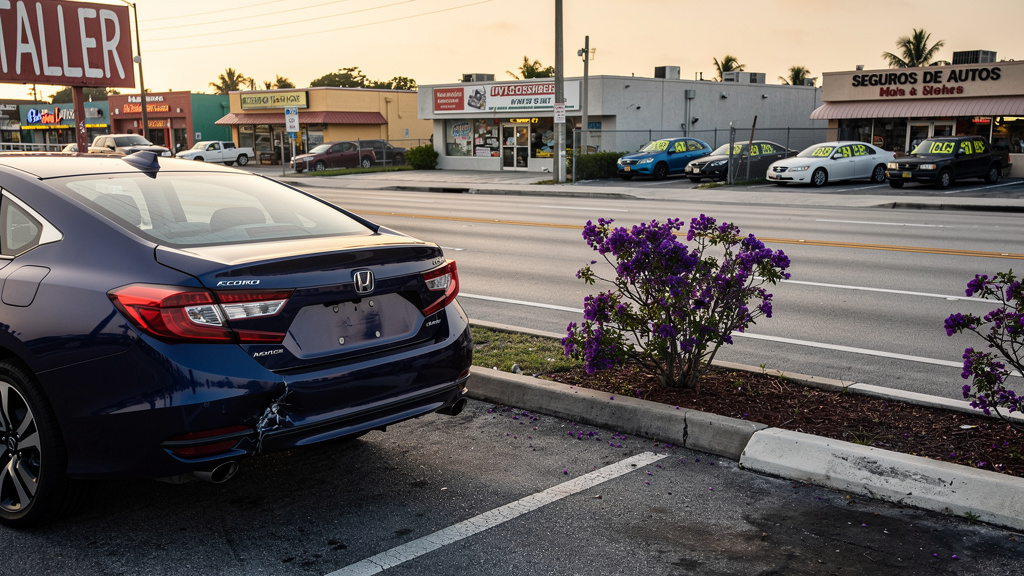
There is no flat number: the value of your rear-end claim on Okeechobee Road depends on your actual injuries, documented medical treatment, lost wages, how fault is divided, and what insurance coverage is available to pay you. Your own PIP policy pays first regardless of fault, but compensation for medical costs and lost wages beyond PIP requires either bodily injury coverage from the at-fault driver or your own uninsured motorist coverage, and pain and suffering also requires proof that your injury meets Florida’s permanent injury threshold.
Why can’t anyone give me a real number over the phone?
Because your claim is not an average, it is built from five specific facts: the severity and permanence of your injury, the medical treatment you received and documented, the income you actually lost, whether you share any fault for the crash, and what insurance policies exist to pay you. Statewide settlement averages mean nothing for your case on Okeechobee Road (US 27), where frequent stop-and-go traffic causes many low-to-moderate-speed rear impacts that often result in disputed soft tissue injuries like whiplash. You may be asking, “Do I need a lawyer?” or “Will their insurance just try to screw me?” Those are smart questions. The other driver’s insurer will look for reasons to deny permanence or assign you blame. If a lawsuit becomes necessary, it would be filed in Miami-Dade Circuit Court (11th Judicial Circuit), not based on a guess but on your actual records and evidence.
Layer 1: What does my own PIP actually pay after a crash on Okeechobee Road?
Your own Personal Injury Protection (PIP) policy pays 80 percent of reasonable medical bills and 60 percent of documented lost wages, but only if you see a doctor within 14 days of the crash [Fla. Stat. § 627.736(1)(a)]. Miss that deadline and your PIP pays nothing, even if the other driver clearly caused the crash. The amount available depends on whether a treating physician or ER provider determines you had an “emergency medical condition.” If yes, PIP covers up to $10,000; if not, the cap drops to $2,500. This decision is why prompt evaluation at Hialeah Hospital or Palmetto General Hospital matters, it sets your financial ceiling early. Remember, your own policy pays first; if you don’t have one, your household relative’s policy applies; only if neither exists does the striking vehicle’s PIP cover you, and only if you were a pedestrian or cyclist who lives in Florida [Fla. Stat. § 627.736(4)(e)].
Layer 2: Does the driver who hit me have insurance that covers my injuries?
Florida does not require drivers to carry bodily injury (BI) liability coverage, only PIP and property damage coverage are mandatory. That means the person who rear-ended you on Okeechobee Road may legally have zero BI insurance to pay for your injuries. If they do carry BI, it becomes the primary source for medical costs beyond PIP, lost wages beyond PIP’s limits, and pain and suffering, but only if you meet the permanent injury threshold. Their policy limit generally caps what their insurer will pay, no matter how serious your harm. On a busy corridor like Okeechobee Road, commercial trucks, delivery vehicles, or rideshare drivers may be involved; these often carry higher BI limits than private cars, but you won’t know until an attorney requests the coverage declaration. Don’t assume “no BI” means “no case”, your own UM coverage may apply instead.
Layer 3: What if the other driver has no insurance or not enough?
If the at-fault driver lacks BI coverage or their limits are too low, your uninsured/underinsured motorist (UM) coverage may step in [Fla. Stat. § 627.727]. UM is optional in Florida but must be rejected in writing, if you never signed a rejection form, you likely have it. UM can cover medical expenses, lost wages, and pain and suffering when the other driver is uninsured or underinsured. In Florida, UM policies come in two types: stacked and non-stacked. Stacked UM lets you combine limits across all vehicles on your policy, potentially increasing your available coverage [Fla. Stat. § 627.727(9)]. Given the high volume of traffic and uninsured drivers on urban arterials like Okeechobee Road, UM coverage often becomes the real path to meaningful recovery. Pull your insurance declaration page, it lists your UM status and limits.
Can I get paid for pain and suffering, and how are my medical bills valued?
You can seek payment for pain and suffering only if your injury meets Florida’s threshold: a permanent injury within reasonable medical probability, significant and permanent loss of an important bodily function, significant and permanent scarring or disfigurement, or death [Fla. Stat. § 627.737(2)]. A temporary neck strain that heals in weeks likely doesn’t qualify; a herniated disc confirmed by MRI and requiring surgery might. Separately, Florida’s 2023 tort reform law changed how medical bills are valued in court. Now, the amount you can recover for past medical expenses is generally limited to what was actually paid or owed under applicable rates, not the full amount billed by providers. This rule is still being interpreted by courts, so outcomes may vary. Also, if you used a letter of protection to receive treatment, new disclosure rules now apply under the same reform.
What can reduce, or destroy, my claim’s value, and what protects it?
Several factors can weaken or eliminate your claim. If you’re found more than 50 percent at fault, say, because your brake lights were out, you stopped suddenly without cause, or rolled backward, you recover nothing [Fla. Stat. § 768.81(6)]. Even 20 percent fault reduces your recovery by that amount. Missing the 14-day PIP window [Fla. Stat. § 627.736(1)(a)] cuts off your primary medical coverage. Gaps in treatment let insurers argue your injury wasn’t serious. Giving a recorded statement to the at-fault driver’s adjuster without legal advice can also hurt you, their goal is to find inconsistencies or admissions. And remember, for crashes on or after March 24, 2023, you have exactly two years to file a lawsuit [Fla. Stat. § 95.11]. Crash reports from Okeechobee Road are confidential for 60 days except to parties, insurers, and attorneys, so act promptly to secure yours.
Frequently asked questions
I waited more than 14 days to see a doctor after the crash, do I still have a claim?
You may still have a claim against the at-fault driver if they carried bodily injury coverage or you have UM coverage, but your own PIP benefits are likely forfeited. Without PIP, your early medical costs must be covered another way, which can affect your leverage in negotiations.
The driver who rear-ended me on Okeechobee Road has no insurance. What do I do?
Check your own auto policy for uninsured motorist (UM) coverage. If you didn’t reject it in writing, UM can cover your damages as if the at-fault driver had insurance. Report the crash to your carrier immediately and request a copy of your declaration page.
My neck hurts but the doctor says it may not be permanent, can I still recover anything?
You can still recover PIP benefits for medical bills and lost wages if you treated within 14 days. However, without a permanent injury (or equivalent threshold finding), you cannot recover pain and suffering from the at-fault driver or through UM, even if the crash wasn’t your fault.
How does it affect my claim if I was partly at fault for the crash?
If you’re 50 percent or less at fault, your recovery is reduced by your percentage of fault. If you’re more than 50 percent at fault, you recover nothing. Rear-end collisions usually favor the struck driver, but insurers may argue unsafe stopping, sudden backing, or disabled lights to shift blame.
How long do I have to sue the driver who rear-ended me on Okeechobee Road?
For crashes occurring on or after March 24, 2023, you have two years from the date of the collision to file a personal injury lawsuit in Miami-Dade Circuit Court [Fla. Stat. § 95.11]. This deadline is strict, missing it ends your right to sue.
Related reading: I was in a car accident in Hialeah. What do I do now? · The driver who hit me in Hialeah has no insurance. What now? · The 14-day PIP rule in Florida: what happens if you wait to see a doctor after a Hialeah car accident · How long do I have to file an injury lawsuit in Florida? The two-year rule after HB 837
Hurt in an accident in Hialeah? Call Wolfson & Leon at (305) 285-7071 for a free consultation. We speak Spanish, and there is no fee unless we win.
Key facts
- Your own PIP pays 80 percent of reasonable medical bills and 60 percent of lost wages up to $10,000, but only if a doctor finds an emergency medical condition; without that finding the cap is $2,500. Treatment must begin within 14 days of the crash or PIP pays nothing. Source: Fla. Stat. § 627.736(1)(a)
- Florida does not require drivers to carry bodily injury liability coverage, so the at-fault driver who rear-ended you may legally carry no coverage that pays for your injuries. Source: Florida Financial Responsibility Law
- Pain and suffering compensation from the at-fault driver requires proof of a permanent injury, permanent loss of an important bodily function, or significant permanent scarring or disfigurement. Source: Fla. Stat. § 627.737(2)
- If you are found more than 50 percent at fault you recover nothing; if you are 50 percent or less at fault your recovery is reduced by your share of fault. Source: Fla. Stat. § 768.81(6)
- The deadline to file a personal injury lawsuit for crashes on or after March 24, 2023 is two years from the date of the collision. Source: Fla. Stat. § 95.11
Frequently asked questions
I waited more than 14 days to see a doctor after the crash, do I still have a claim?
You likely lose your PIP benefits entirely if you did not receive initial medical treatment within 14 days of the crash, which is a strict statutory requirement under Fla. Stat. § 627.736(1)(a). However, losing PIP does not automatically end every avenue of recovery, you may still pursue a claim against the at-fault driver's bodily injury coverage or your own UM coverage if the injuries are serious enough. The 14-day rule affects your own no-fault benefits, not necessarily your right to pursue the at-fault driver. Speak with an attorney immediately to assess what options remain.
The driver who rear-ended me on Okeechobee Road has no insurance. What do I do?
If the at-fault driver has no bodily injury liability coverage, your own uninsured motorist (UM) coverage under Fla. Stat. § 627.727 becomes the primary source of recovery for injuries beyond what PIP covers. UM coverage must be rejected in writing to be excluded from your policy, if you did not sign a written rejection, you likely have it. Pull your declarations page and check your UM limits; if you have stacked UM under § 627.727(9), those limits may be higher. This is one of the most common and most important scenarios on a high-traffic road like Okeechobee Road.
My neck hurts but the doctor says it may not be permanent, can I still recover anything?
Yes, but your recovery is limited. Without a finding of permanent injury, significant permanent loss of a bodily function, or significant permanent scarring under Fla. Stat. § 627.737(2), you cannot recover pain and suffering from the at-fault driver. You can still recover economic damages, medical bills and lost wages, first through your PIP up to its cap, and potentially through the at-fault driver's bodily injury coverage beyond that. The permanence question often turns on medical evidence gathered over weeks or months of treatment, which is one reason consistent care with thorough documentation matters from day one.
How does it affect my claim if I was partly at fault for the crash?
Under Florida's modified comparative negligence rule, Fla. Stat. § 768.81(6), your recovery is reduced by your percentage of fault, so if you are found 20 percent at fault on a $100,000 claim, you recover $80,000. If you are found more than 50 percent at fault, you recover nothing at all. In a rear-end collision on Okeechobee Road, insurers may argue you contributed to the crash if your brake lights were not working, you stopped suddenly without cause, or you were in a location creating an unreasonable hazard. Collecting a police report, photos, and witness information immediately after the crash is the best way to protect against inflated fault assignments.
How long do I have to sue the driver who rear-ended me on Okeechobee Road?
For crashes that occurred on or after March 24, 2023, Florida law gives you two years from the date of the collision to file a personal injury lawsuit, under Fla. Stat. § 95.11. Missing that deadline will almost certainly result in your case being dismissed and your right to sue being lost permanently. Two years sounds like a long time but building a strong case, obtaining medical records, securing expert opinions on permanence, and negotiating with insurers before filing, takes time. Contact an attorney well before the deadline, not the week before it.
This article is general information about Florida law, not legal advice, and reading it does not create an attorney-client relationship. Every case is different and past results do not guarantee a similar outcome. For advice about your situation, call Wolfson & Leon at (305) 285-7071 for a free consultation.
Also available in: Versión en español
 Car accidents
 How Much Does an Accident Lawyer in Miami Charge? A Plain Answer
In Miami, accident lawyers work on a contingency fee, meaning you pay nothing upfront and owe no attorney fee at all unless money is recovered for…
 Car accidents
 Partly at Fault for a Hialeah Crash? Here Is What You Can Still Recover
Yes, but only if your share of the fault is 50 percent or less. Under Florida's modified comparative negligence law (FL § 768.81), your compensation…
 Car accidents
 The other driver's insurance adjuster wants a recorded statement. Do I have to give one?
No. After a car accident in Florida you have no legal duty to give a recorded statement to the other driver's insurance company, and their adjuster…