
Hit by an Uninsured Driver While Walking or Biking in Hialeah: Who Pays?
In Florida, the insurance that covers your medical bills after being hit by an uninsured driver while on foot or on a bike follows you as a person, not the vehicle. If you own an insured car, your own PIP pays first; if you don't, a household relative's PIP may apply; and only if neither exists does the striking driver's PIP become your source. A UM policy attached to any household auto policy may also cover the larger losses PIP leaves behind.
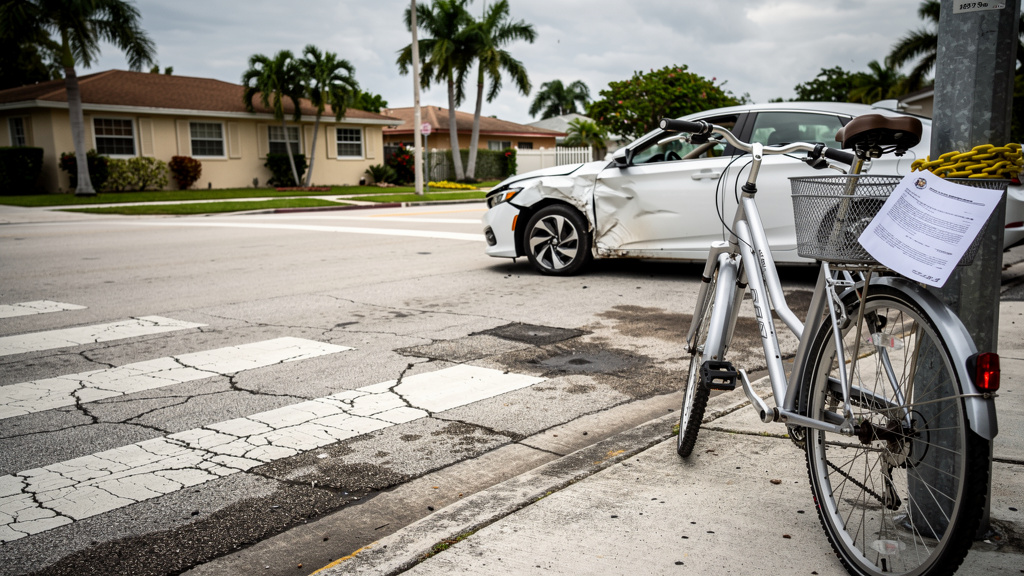
If you were hit by an uninsured driver while walking or biking in Hialeah, you are not automatically left with no coverage. Florida law follows a “person-based” insurance system for pedestrians and cyclists. Your medical bills may be covered through personal injury protection (PIP) from your own auto policy if you have one, a household relative’s policy if you live with someone who does, or only as a last resort, the striking driver’s PIP. Uninsured motorist (UM) coverage on any household policy may also cover losses that PIP does not.
I don’t own a car, so does any insurance cover me at all?
You do not need to own a car to have insurance coverage after being struck. Under Florida law, PIP coverage follows you as a person, not the vehicle you were using. The priority order is strict: first, your own PIP if you own an insured car; second, the PIP of a relative who lives with you and has an active policy, this includes a spouse, parent, sibling, or adult child under the same roof; third, and only if neither of those exists, the PIP from the car that hit you. This corrects a common myth that having no car means no coverage. PIP pays 80 percent of reasonable medical bills and 60 percent of lost wages, up to $10,000 if a doctor diagnoses an emergency medical condition; otherwise, the limit drops to $2,500, and you must get initial treatment within 14 days or PIP pays nothing [Fla. Stat. § 627.736(1)(a)].
What about UM coverage, does it apply if I wasn’t in my car?
Yes, uninsured motorist (UM) coverage can protect you even if you were on foot or on a bike. Florida law requires insurers to offer UM coverage, and it must be rejected in writing, many drivers have it without realizing it [Fla. Stat. § 627.727]. UM fills critical gaps left by PIP: it can cover the 20 percent of medical costs PIP does not pay, the 40 percent of lost wages PIP never covers, and, if your injury meets Florida’s serious-injury threshold, pain and suffering. That threshold includes permanent injury, significant scarring, or permanent loss of a bodily function [Fla. Stat. § 627.737(2)]. If you live with a relative who carries UM, their policy may extend to you as a resident relative. Coverage details vary by policy; confirm yours with an attorney. This matters for a common question: who pays when a relative is hit on a bicycle by a driver who had no insurance?
What traffic laws protect pedestrians and cyclists in Hialeah?
Drivers owe specific legal duties to people walking or biking. In Hialeah, at marked crosswalks like those on W 49th Street at Okeechobee Road, drivers must yield to pedestrians [Fla. Stat. § 316.130]. Failing to do so is a statutory violation, and counts as evidence of fault. Drivers must also use due care to avoid colliding with any pedestrian or person riding a bicycle [Fla. Stat. § 316.130(15)]. For cyclists, state law requires drivers to pass with at least three feet of clearance [Fla. Stat. § 316.083(1)], and cyclists must follow general road rules [Fla. Stat. § 316.2065]. On sidewalks, local rules may allow biking unless signs prohibit it, but check current Hialeah municipal code before relying on that. These laws create clear fault standards when drivers ignore them.
What if the driver or insurer says the crash was partly my fault?
Florida uses modified comparative negligence [Fla. Stat. § 768.81], meaning your recovery is reduced by your share of fault, but only barred entirely if you are found more than 50 percent responsible. For example, if total damages are calculated at $100,000 and you are 30 percent at fault, you recover $70,000. Insurers often argue jaywalking or improper cycling (like riding against traffic) to increase your fault percentage. Crossing outside a marked crosswalk isn’t illegal everywhere, but it can affect fault under [Fla. Stat. § 316.130]. Importantly, if your UM claim is handled by the same insurer covering your household policy, they may argue against your full recovery, a conflict worth understanding. Partial fault does not kill your case unless it exceeds half.
What do I do in the first 14 days after being hit?
Act quickly and in order. First, call 911 and insist on a police report, it’s accessible immediately to you and your lawyer, even though public access is blocked for 60 days [Fla. Stat. § 316.066]. Second, get a medical evaluation within 14 days, this is a hard deadline under [Fla. Stat. § 627.736(1)(a)]. Miss it, and you lose all PIP benefits, even with serious injuries. Third, notify the correct insurer based on the PIP priority order: yours, then a household relative’s, then the striking driver’s. Fourth, do not give a recorded statement to any insurance adjuster without legal advice, you risk saying something that reduces or voids your claim. Fifth, know you have two years to file a lawsuit for crashes on or after March 24, 2023 [Fla. Stat. § 95.11], but policy notice deadlines may be shorter. Wolfson & Leon handles cases entirely in Spanish.
What can I actually recover, and is it worth pursuing?
It is usually worth pursuing, even with an uninsured driver, because your recovery likely comes from insurance, not the driver’s pocket. PIP covers 80 percent of medical bills and 60 percent of lost wages (up to $10,000 or $2,500). UM coverage can pay the rest of your medical and wage losses and, if your injury is serious enough, pain and suffering. Suing the at-fault driver directly is legally possible, but if they have no insurance or assets, a common issue in Florida, collecting a judgment may be impossible. Focus instead on the PIP and UM policies that already exist to protect you. You are not starting from zero just because the other driver had no insurance.
Frequently asked questions
I was on a bike, not in a car, does PIP still apply to me?
Yes. Florida PIP applies to pedestrians and cyclists injured in crashes with motor vehicles. The same three-tier priority order applies: your policy first, then a household relative’s, then the striking vehicle’s.
I don’t own a car and no one in my house has car insurance. Is there any coverage at all?
In that rare case, the striking driver’s PIP would be your only source, but if they have no insurance at all, PIP benefits may be unavailable. You would then rely on health insurance, out-of-pocket care, or potential UM from other sources. An attorney can review all options.
Can my own UM coverage pay if I was hit while walking, not driving?
Often, yes. UM coverage generally protects you as a named insured or resident relative even if you were not in a vehicle, but policy terms vary. It applies if the at-fault driver is uninsured or underinsured.
The driver ran a red light at W 49th St and Okeechobee Road and hit me in the crosswalk. Does that make them automatically at fault?
Running a red light is a clear violation of traffic law and counts as strong evidence of fault. While not “automatic” legal liability, it heavily weighs in your favor because Florida treats a traffic-law violation as evidence of negligence.
Will filing a PIP or UM claim raise my insurance premiums?
Florida law generally bars insurers from adding a surcharge because of a crash unless the insurer determines in good faith that you were substantially at fault. UM claims generally should not raise rates for victims, but outcomes depend on your carrier and policy terms. Ask your attorney before assuming premium hikes.
Related reading: A car hit me while I was walking or biking in Hialeah. What are my rights? · The 14-day PIP rule in Florida: what happens if you wait to see a doctor after a Hialeah car accident · How long do I have to file an injury lawsuit in Florida? The two-year rule after HB 837 · The driver who hit me in Hialeah has no insurance. What now?
Hurt in an accident in Hialeah? Call Wolfson & Leon at 305-965-3766 for a free consultation. We speak Spanish, and there is no fee unless we win.
Key facts
- PIP must pay 80 percent of reasonable medical bills and 60 percent of lost wages up to $10,000, but only if you get medical treatment within 14 days of the crash; without an emergency medical condition diagnosis the cap drops to $2,500. Source: Fla. Stat. § 627.736(1)(a)
- For a pedestrian or cyclist who is a Florida resident, the order of PIP priority is: first the injured person's own policy, then a resident relative's policy, and only then the policy on the vehicle that struck them. Source: Fla. Stat. § 627.736(4)(e)
- Uninsured motorist coverage is optional in Florida, but it can be left off a policy only if the policyholder rejects it in writing; it generally protects the named insured and resident relatives even when they were not in a vehicle at the time of the crash, though policy terms vary. Source: Fla. Stat. § 627.727
- A driver who fails to yield to a pedestrian in a marked crosswalk violates Florida's pedestrian right-of-way statute, and that statutory violation is itself evidence of the driver's fault. Source: Fla. Stat. § 316.130
- Florida uses modified comparative negligence: a victim's recovery is reduced by their percentage of fault and is completely barred only if they are found more than 50 percent responsible. Source: Fla. Stat. § 768.81
Frequently asked questions
I was on a bike, not in a car, does PIP still apply to me?
Yes. Florida PIP follows the insured person, not the vehicle. If you own an insured car, your own PIP applies first even though you were riding a bike when you were hit. If you don't own a car, the PIP of a relative living in your household may apply next. Only if neither exists can you access the PIP of the driver who struck you, under Fla. Stat. § 627.736(4)(e). You must receive medical treatment within 14 days of the crash or you forfeit all PIP benefits.
I don't own a car and no one in my house has car insurance. Is there any coverage at all?
If no household auto policy exists, you may still access PIP through the policy on the vehicle that struck you, under Fla. Stat. § 627.736(4)(e). You can also pursue a direct claim against the at-fault driver personally, though collecting from someone without insurance or assets is often difficult. Health insurance can cover ongoing medical costs, and an attorney can help identify any other potentially liable parties, for example, a vehicle owner who is different from the driver.
Can my own UM coverage pay if I was hit while walking, not driving?
Possibly. Fla. Stat. § 627.727 ties UM coverage to the named insured and resident relatives, not to a specific vehicle. Many policy forms extend this protection to incidents that happen on foot or on a bike, but coverage details vary by policy. Because UM is optional in Florida and policies differ, you should have an attorney review your specific policy language before assuming this coverage applies to your situation.
The driver ran a red light at W 49th St and Okeechobee Road and hit me in the crosswalk. Does that make them automatically at fault?
Failing to yield to a pedestrian in a marked crosswalk violates Fla. Stat. § 316.130, and Florida courts treat a traffic-law violation as evidence of the driver's negligence. This makes it easier to establish liability. However, Florida's modified comparative fault rules under Fla. Stat. § 768.81 still allow an insurer to argue you share some fault, so documenting everything at the scene, witness information, photos, the police report, is important.
Will filing a PIP or UM claim raise my insurance premiums?
Florida law prohibits insurers from surcharging or non-renewing your policy solely because you were involved in a crash, unless the insurer determines in good faith based on its claim file that you were substantially at fault. When an uninsured driver hits you while you are walking or biking, there is typically nothing in the file to support a fault finding against you. If an insurer attempts a surcharge in that situation, that action may itself be a violation of Florida law.
This article is general information about Florida law, not legal advice, and reading it does not create an attorney-client relationship. Every case is different and past results do not guarantee a similar outcome. For advice about your situation, call Wolfson & Leon at 305-965-3766 for a free consultation.
Also available in: Versión en español
 Pedestrian and bicycle accidents
 Hit by a Car on Your Bike in Hialeah: What to Do Next
Call 911, stay at the scene, and get medical care within 14 days, that deadline controls whether your Personal Injury Protection benefits pay…
 Pedestrian and bicycle accidents
 Hit Outside a Crosswalk in Hialeah: Can You Still Get Compensation?
Yes. Crossing outside a crosswalk does not end your claim. Florida law requires every driver to exercise due care to avoid hitting any pedestrian at…
 Pedestrian and bicycle accidents
 Hit by a Car Without Owning One: Who Pays Your Medical Bills in Florida?
Florida's no-fault PIP system can still pay your first medical bills even if you don't own a car. The law looks first to any auto policy in your…