
Who Pays My Medical Bills After a Boating Accident on Biscayne Bay?
The careless operator, the boat's owner, or the rental or charter company may be legally responsible for your medical bills and other losses after a Biscayne Bay boating accident, and if they carry insurance, that policy is the first place to look. Unlike a car crash in Florida, there is no mandatory Personal Injury Protection on boats, so there is no automatic first-dollar coverage waiting for you, and the boat owner may carry no liability insurance at all. That means identifying every possible source of coverage, the operator's policy, the owner's policy, a business's commercial policy, and your own health insurance, is the first practical step after any boating injury.
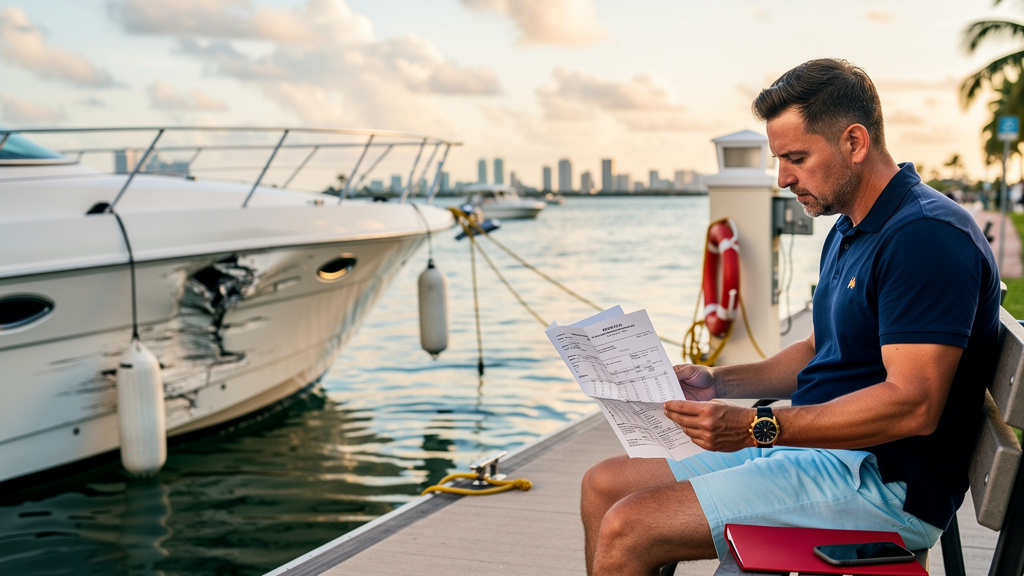
If you were hurt in a boating accident on Biscayne Bay, the person or company legally responsible for your medical bills is typically the careless operator, the boat’s owner, or a rental or charter business. Unlike car crashes in Florida, there is no automatic Personal Injury Protection (PIP) coverage for boating injuries, and the boat owner may carry no liability insurance at all. That means your first practical step is to identify every possible source of payment: the operator’s policy, the owner’s policy, a commercial policy if it was a charter or rental, and your own health insurance.
Why doesn’t my car’s PIP cover me on a boat?
Your auto insurance’s PIP benefit does not apply to boating accidents. Florida law defines “motor vehicle” for PIP purposes in a way that excludes watercraft. Under Fla. Stat. § 627.732(3), only land-based vehicles qualify. This means the $10,000 (or $2,500) in automatic medical and wage loss coverage you would get after a car crash simply does not exist on a boat. Many people mistakenly believe that because Florida is a “no-fault” state for cars, they will automatically get some payment after any accident. That is not true for boats. On Biscayne Bay, there is no mandatory first-dollar coverage waiting for you.
Is there any boat insurance, and who has to pay if there isn’t?
Liability insurance is often optional for private recreational boat owners in Florida. This can make uninsured operators a problem for people injured on Biscayne Bay. However, some owners do have coverage through a watercraft endorsement on their homeowner’s policy, a separate boat policy, or an umbrella policy. If the operator was driving someone else’s boat, a frequent scenario when Hialeah families go out on relatives’ vessels launched from Haulover or Crandon, the owner may also be liable. Commercial operations like charters and rentals are more likely to carry insurance due to marina rules, lender requirements, or licensing regulations. If no insurance exists, options include pursuing the at-fault party’s personal assets or relying on your own health insurance while your claim is pending. A vessel owner can face a civil claim even when someone else was driving.
Who is the operator, and what does ‘careless operation’ actually mean?
Under Florida law, careless operation includes speeding, failing to keep a proper lookout, ignoring water traffic, or operating unsafely in congested conditions. These acts can violate Fla. Stat. § 327.33 and can support a civil claim for resulting injuries. Biscayne Bay’s mix of kayaks, paddleboards, high-speed center consoles, rental jet skis, and party boats makes safe operation especially important on weekends and holidays. A civil negligence claim must prove four things: the operator owed you a duty of care, breached that duty, caused your injuries, and those injuries resulted in real losses. The criminal and civil systems run separately, so a civil claim does not depend on a criminal conviction. Boating under the influence (BUI) can strengthen a negligence claim and may support punitive damages, but proving negligence does not require a BUI conviction.
What if I was hurt on a rental jet ski or a charter boat?
Rental and charter companies face different liability rules than private boat owners. Florida law imposes duties on rental operators around safety instruction, vessel condition, and recordkeeping. If they fail in those duties and you’re hurt, they may be liable, but you must prove their specific negligence, not just that they provided the vessel. Charter companies can also be held responsible for the actions of their captains or crew under agency principles. Commercial operators are more likely to carry insurance and have deeper resources than private owners. However, courts have dismissed claims where injured people could not show the company did something wrong.
What happens if I was partly at fault, does that kill my claim?
Florida uses modified comparative negligence. If you are found to be 50 percent or less at fault, you can still recover damages, reduced by your share of fault. If you are more than 50 percent at fault, you cannot recover anything. For example, $100,000 in damages with 20 percent fault equals $80,000 recovery. However, if your accident occurred on navigable federal waters, which includes much of Biscayne Bay, federal maritime law may apply instead. Maritime law generally uses pure comparative negligence, meaning any level of fault reduces but does not bar recovery. Because this distinction depends on facts like location and vessel type, early legal consultation matters. Also, insurance adjusters often argue that gaps in medical treatment mean your injuries came from something else. Seeing a doctor right away helps protect against that tactic.
If no boat insurance exists, what actually pays my bills while the claim is pending?
While your claim is pending, your own health insurance is usually the first to pay medical bills, subject to deductibles and copays. Medicare or Medicaid may cover costs if you qualify. Some doctors and hospitals will treat you on a lien, meaning they wait to be paid from your eventual settlement. Be aware that health insurers and government programs often have a right to be repaid from any recovery you receive. Accepting an early settlement offer before understanding your full medical needs and future wage loss can leave you short. Reddit users often ask, “Do I just go through my own insurance?” Yes, you can use it as a bridge, but managing liens properly requires attention. The two-year statute of limitations under Fla. Stat. § 95.11 applies to most negligence injuries on or after March 24, 2023, though maritime claims may have different deadlines.
Frequently asked questions
The boat owner wasn’t even driving, can I still sue them?
Yes. Under Florida law, the boat’s owner can be held liable for injuries caused by someone operating their vessel with permission. This is common when family or friends borrow a boat.
Will my car insurance PIP help at all after a boat accident?
No. Florida’s PIP law applies only to motor vehicles as defined by statute, which excludes watercraft. Your auto policy’s PIP benefit does not extend to boating injuries.
I was partly at fault because I didn’t hold on when the boat hit a wake, does that bar my claim?
Not necessarily. As long as you are found to be 50 percent or less at fault under Florida law, you can still recover damages, reduced by your share of fault. Federal maritime law may offer even more flexibility.
How long do I have to file a lawsuit after a Biscayne Bay boating accident?
Most negligence claims must be filed within two years under Florida law if the injury occurred on or after March 24, 2023. If federal maritime law applies, the deadline may be different, and it depends on the facts.
The rental jet ski company says I signed a waiver, does that mean I can’t recover anything?
Not always. Waivers may not protect companies from liability for their own negligence, such as failing to maintain equipment or provide proper instructions. Whether a waiver holds up depends on its wording and what went wrong.
Hurt in an accident in Hialeah? Call Wolfson & Leon at 305-965-3766 for a free consultation. We speak Spanish, and there is no fee unless we win.
Key facts
- Florida's PIP statute defines 'motor vehicle' in a way that excludes watercraft, so your auto policy's PIP benefit does not follow you onto a boat. Source: Fla. Stat. § 627.732(3)
- Liability insurance is often optional for private recreational boats in Florida, so an at-fault operator may have no coverage. Source: Fla. Stat. ch. 327
- Careless operation of a vessel, traveling too fast, ignoring traffic, or failing to keep a proper lookout, is prohibited and can support a civil claim for resulting injuries. Source: Fla. Stat. § 327.33
- Florida's modified comparative negligence law bars recovery only if the injured person is found MORE THAN 50 percent at fault; below that threshold, damages are reduced proportionally. Source: Fla. Stat. § 768.81(6)
- Florida law sets safety requirements for businesses that rent vessels (liveries), including giving renters safety instruction before the rental. Source: Fla. Stat. § 327.54
Frequently asked questions
The boat owner wasn't even driving, can I still sue them?
Yes. In Florida, the owner of a vessel can be held liable for injuries caused by someone they permitted to operate it, even if the owner was not on board. If you were a guest on a relative's or friend's boat, a common situation for Hialeah families, you generally retain the right to pursue compensation through the owner's liability coverage without that being a personal betrayal, because the claim runs through insurance.
Will my car insurance PIP help at all after a boat accident?
Almost certainly not. Florida's PIP statute defines the vehicles it covers in a way that excludes watercraft, so your auto policy's no-fault benefits do not extend to injuries on a boat. This catches many people off guard because they assume that being in a 'no-fault state' means automatic coverage for any injury, but that rule is specific to motor vehicles. Your car's PIP may be completely irrelevant to a Biscayne Bay boating claim, though your own health insurance and the boat operator's liability policy are the practical places to start.
I was partly at fault because I didn't hold on when the boat hit a wake, does that bar my claim?
Not automatically. Under Florida's modified comparative negligence law, you can still recover damages as long as you are not found MORE THAN 50 percent responsible for your own injury. Your recovery is reduced proportionally, if a court finds you 25% at fault on a $80,000 claim, you receive $60,000. The complication on Biscayne Bay is that if the accident occurred on federally navigable waters, maritime law may apply a pure comparative negligence standard with no percentage cutoff at all. An attorney who handles both Florida personal injury and maritime law needs to evaluate which system governs your specific facts.
How long do I have to file a lawsuit after a Biscayne Bay boating accident?
For most personal injury claims under Florida law, the deadline is two years from the date of the accident for incidents on or after March 24, 2023. However, boating accidents on navigable waters may fall under federal maritime law, which can carry a different limitations period, and claims against government entities require written notice to the agency before suing. Because the rules are technical and the correct deadline depends on the specific facts of your case, you should speak with an attorney as early as possible, waiting can forfeit rights that cannot be recovered.
The rental jet ski company says I signed a waiver, does that mean I can't recover anything?
Not necessarily. A liability waiver signed before a rental may limit some claims, but Florida courts scrutinize these agreements carefully, and waivers generally cannot protect a business from its own gross negligence or statutory violations. If the rental company put a mechanically unsafe jet ski in the water, failed to provide required safety instructions, or rented in violation of state law, those failures may support a claim regardless of what you signed. The enforceability of any waiver is a fact-specific legal question, and you should not assume a waiver ends your options before consulting an attorney.
This article is general information about Florida law, not legal advice, and reading it does not create an attorney-client relationship. Every case is different and past results do not guarantee a similar outcome. For advice about your situation, call Wolfson & Leon at 305-965-3766 for a free consultation.
Also available in: Versión en español
 Personal injury
How to Find and Get to Wolfson & Leon's Hialeah Office on W 49th Street
Wolfson & Leon's Hialeah office is at 1840 W 49th St, Suite 734, Hialeah, FL 33012, reachable by phone at 305-965-3766. The phone is answered 24…
 Personal injury
How to Contact Wolfson & Leon's Hialeah Office: Phone, Address, and More
You can reach Wolfson & Leon's Hialeah office by calling 305-965-3766, which is answered by a person 24 hours a day, seven days a week. The office…
 Personal injury
Just Had a Boating Accident on Biscayne Bay: What to Do Right Now
Call 911 or hail the U.S. Coast Guard on VHF Channel 16 immediately, then stay at the scene, leaving is a criminal offense under Florida law.…