
Every Deadline a Florida Pedestrian Faces After a Crash
Florida pedestrian accident victims face multiple separate deadlines that stack on top of each other: you must see a doctor within 14 days to preserve PIP benefits, you may need to send written notice to a government agency before you can sue at all, and you have two years from the crash date to file a personal injury lawsuit if the crash happened on or after March 24, 2023. Missing any single deadline can permanently cut off that specific right, regardless of how strong the rest of your case is.
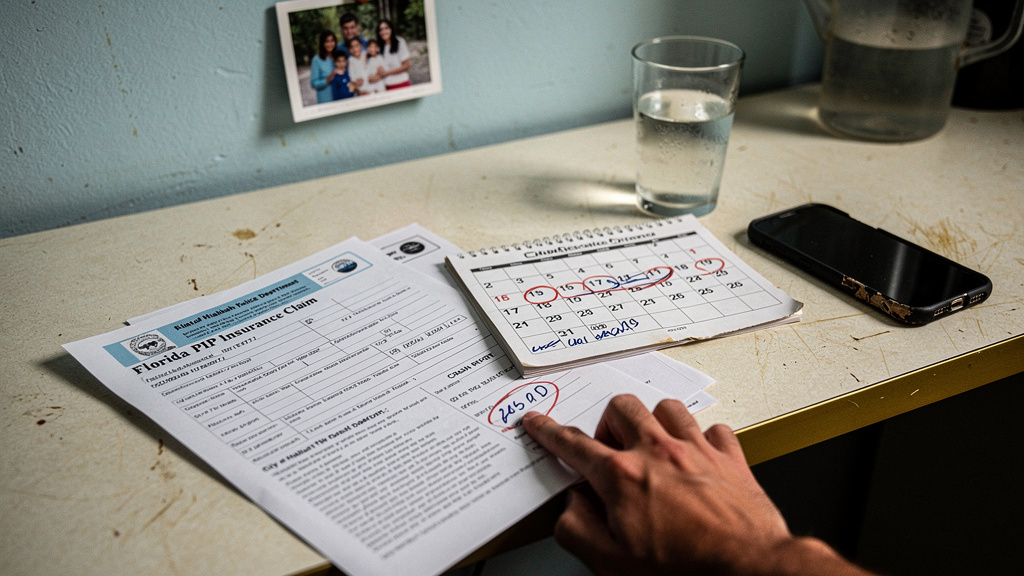
Florida pedestrian accident victims face multiple separate deadlines that stack on top of each other. You must see a doctor within 14 days to preserve PIP benefits, you may need to send written notice to a government agency before you can sue at all, and you have two years from the crash date to file a personal injury lawsuit if the crash happened on or after March 24, 2023. Missing any single deadline can permanently cut off that specific right, regardless of how strong the rest of your case is.
Days 0 to 14: Why Is Seeing a Doctor This Urgent?
The 14-day window is not a recommendation. It is a hard cutoff under Florida law [Fla. Stat. § 627.736(1)(a)]. If you do not get evaluated by a qualified medical provider within 14 days of being hit, your own auto insurer can deny all PIP benefits, even though you paid for that coverage. This has nothing to do with who caused the crash. PIP pays 80 percent of reasonable medical bills and 60 percent of lost wages, but only up to $10,000 if a physician finds an emergency medical condition. Without that finding, the cap drops to $2,500. Your own policy pays first. If you do not own a car, the policy of a relative who lives with you comes next. Only if neither exists does the striking driver’s PIP apply [Fla. Stat. § 627.736(4)(e)]. Many online posts wrongly treat the 14-day rule as the only deadline that matters. It is not. It governs only your access to PIP. The lawsuit deadline is separate and runs for two years.
Days 1 to 60: What Is the Crash Report and Who Can See It?
The official crash report is confidential for 60 days after it is filed [Fla. Stat. § 316.066]. During that time, only the people involved in the crash, their insurers, and their attorneys can obtain a copy. In Hialeah and Miami-Dade, reports are handled by the Hialeah Police Department or another law enforcement agency, depending on location. After 60 days, the report becomes public. But waiting is risky. Nearby businesses often overwrite surveillance footage within days. The report itself may contain key details like witness names, road conditions, or initial fault observations. These can shape your entire case. Getting the report early through an attorney helps secure evidence before it disappears.
Soon After: Which Insurers Do You Need to Notify, and How Fast?
You must notify your own auto insurer immediately. If you do not have a policy, notify the insurer of a resident relative. This triggers both your PIP benefits and any uninsured motorist (UM) coverage you may have. UM coverage is optional under Florida law, but it can be left off a policy only by a signed written rejection [Fla. Stat. § 627.727]. Given South Florida’s high rate of uninsured drivers, this coverage can be critical. Each insurance policy sets its own notice deadline for UM or bodily injury claims, so there is no single state-mandated number of days. Do not assume you have weeks. More importantly, do not give a recorded statement to any insurer without first talking to a lawyer. Drivers and adjusters often claim pedestrians “came out of nowhere.” A careless statement can lock in that narrative before you understand your rights.
Was the Vehicle a Government Vehicle? The Notice Requirement You Cannot Skip
If the vehicle that hit you was operated by Miami-Dade Transit, the City of Hialeah, or the Florida Department of Transportation, special rules apply. Before you can file a lawsuit, you must serve a formal written notice of claim on the agency [Fla. Stat. § 768.28(6)]. This is not optional. Failing to send this notice on time can bar your case entirely, even if the government driver was clearly at fault. The notice has its own timing rules, separate from the two-year statute of limitations. For a state agency such as the Florida Department of Transportation, the claim also goes to the Florida Department of Financial Services. In Miami-Dade, these lawsuits are generally filed in the 11th Judicial Circuit. Because many victims are unaware this step exists, it is easy to miss in crashes involving public vehicles. If you suspect the vehicle was government-owned, consult an attorney immediately, do not wait.
Two Years to Sue: What Does the Lawsuit Deadline Actually Mean?
For crashes on or after March 24, 2023, you have exactly two years from the date of the accident to file a lawsuit in court [Fla. Stat. § 95.11]. For older crashes, the deadline was four years. The clock starts on the day you were hit, not when treatment ends, not when you finish missing work, and not when you send a demand letter. Talking to the other driver’s insurer does not stop the clock. If you miss the deadline, your claim is gone forever, no matter how severe your injuries or how clear the other driver’s fault. Filing a lawsuit means submitting a formal complaint to the 11th Judicial Circuit Court in Miami-Dade County. While Florida law allows limited tolling in certain situations [Fla. Stat. § 95.051], those exceptions are narrow and fact-specific. Never assume your deadline is extended without legal confirmation.
What If the Pedestrian Was a Child, or the Pedestrian Died?
If a child is hit, Florida law includes tolling provisions that may pause the statute of limitations [Fla. Stat. § 95.051]. However, the pause applies only in limited situations, so the extension is not automatic or indefinite. Families should not assume they have extra years. Evidence disappears quickly, and insurers still act fast. Consult an attorney as soon as possible, just as you would in an adult case. If the pedestrian died, only one wrongful death lawsuit may be filed [Fla. Stat. § 768.20]. It must be brought by the personal representative of the deceased person’s estate on behalf of all survivors. Multiple family members cannot file separate suits. The time limit for these cases generally begins on the date of death, but the exact rule depends on several factors. An attorney must review the facts to determine the correct deadline.
Frequently asked questions
I don’t own a car. Does PIP still apply to me after being hit as a pedestrian in Florida?
Yes. If you do not own a car, PIP coverage may come from a relative who lives with you. Only if neither you nor a household relative has auto insurance will the striking driver’s PIP apply. This order is set by law [Fla. Stat. § 627.736(4)(e)].
Does filing an insurance claim stop the two-year lawsuit deadline from running?
No. The two-year clock runs from the date of the crash regardless of whether you are negotiating with an insurer. A lawsuit must be filed in court before the deadline passes, or your claim is barred permanently.
Can I still recover compensation if I was jaywalking when I was hit?
Potentially, yes. Florida follows modified comparative negligence. You can still recover if you are 50 percent or less at fault. Your damages would be reduced by your share of fault, but you are not automatically barred just because you were crossing outside a crosswalk.
The vehicle that hit me was a Miami-Dade Transit bus. Do I just file a lawsuit like any other case?
No. You must first serve a formal written notice of claim on Miami-Dade County under [Fla. Stat. § 768.28(6)]. Skipping this step can result in your case being dismissed, even if the bus driver was clearly at fault.
Can I get pain and suffering money from the driver who hit me?
Only if you suffered a permanent injury, significant and permanent scarring or disfigurement, or permanent loss of an important bodily function [Fla. Stat. § 627.737(2)]. Minor or temporary injuries do not qualify for pain and suffering damages from the at-fault driver, though you may still recover economic losses through PIP or UM coverage.
Related reading: A car hit me while I was walking or biking in Hialeah. What are my rights? · My family member was killed in an accident in Hialeah. Who can bring a claim? · How long do I have to file an injury lawsuit in Florida? The two-year rule after HB 837 · The 14-day PIP rule in Florida: what happens if you wait to see a doctor after a Hialeah car accident
Hurt in an accident in Hialeah? Call Wolfson & Leon at 305-965-3766 for a free consultation. We speak Spanish, and there is no fee unless we win.
Key facts
- A pedestrian who does not receive medical evaluation within 14 days of the crash loses access to PIP benefits entirely, the insurer owes nothing for medical bills. Source: Fla. Stat. § 627.736(1)(a)
- The Florida crash report is confidential for 60 days after it is filed; during that window only the parties, their insurers, and their attorneys may obtain it. Source: Fla. Stat. § 316.066
- Before suing a government entity, including Miami-Dade Transit or the City of Hialeah, the injured person must first serve a written notice of claim under the Florida waiver-of-sovereign-immunity statute; failure to do so bars the lawsuit. Source: Fla. Stat. § 768.28(6)
- For crashes occurring on or after March 24, 2023, the deadline to file a personal injury lawsuit in Florida is two years from the date of the accident; the prior deadline was four years. Source: Fla. Stat. § 95.11
- In a wrongful death claim, only one lawsuit may be filed and it must be brought by the personal representative of the estate on behalf of all survivors. Source: Fla. Stat. § 768.20
Frequently asked questions
I don't own a car. Does PIP still apply to me after being hit as a pedestrian in Florida?
Possibly yes. Florida's PIP priority rules look first to any auto insurance policy you hold yourself. If you have none, they look next to a policy held by a relative who lives in the same household as you. Only if neither of those policies exists does the striking driver's PIP cover you as a pedestrian. If you have no auto policy and no household relative with one, the driver's insurer becomes the fallback source of PIP. The order matters, never assume the driver's insurance is your first stop.
Does filing an insurance claim stop the two-year lawsuit deadline from running?
No. Filing a claim with an insurer, exchanging demand letters, or actively negotiating a settlement does not pause the Florida statute of limitations. The two-year clock runs from the date of the crash, independently of any insurance activity. Negotiations sometimes drag on close to the deadline; if talks stall at 23 months, you may have only weeks left to file a lawsuit. The filing deadline and the insurance process are legally separate obligations.
Can I still recover compensation if I was jaywalking when I was hit?
Possibly. Florida uses a modified comparative negligence system under Fla. Stat. § 768.81(6). If you are found to be 50 percent or less at fault for the crash, your compensation is reduced by your exact share of fault, for example, 25 percent fault means 25 percent less recovery. You are barred from any recovery only if you are found to be more than 50 percent at fault. Jaywalking may be cited as a contributing factor, but it does not automatically eliminate your claim.
The vehicle that hit me was a Miami-Dade Transit bus. Do I just file a lawsuit like any other case?
No, a government-vehicle crash triggers additional pre-suit requirements under Fla. Stat. § 768.28(6). Before filing a lawsuit against Miami-Dade Transit or any other government entity, you must first serve a written notice of claim on the agency. The government then has a statutory period to investigate before you may sue. Because this notice requirement runs on its own timeline, separate from the two-year lawsuit deadline, you should consult an attorney immediately after any crash involving a government vehicle, do not wait.
Can I get pain and suffering money from the driver who hit me?
Only if your injuries meet a threshold set by Florida law. Under Fla. Stat. § 627.737(2), a pedestrian can seek pain and suffering damages from the at-fault driver only when the injuries involve a permanent injury, significant and permanent scarring or disfigurement, or permanent loss of an important bodily function. Soft-tissue injuries that fully resolve may not clear this bar even if they were painful and caused real disruption to your life. Your treating physician's documentation of the injury's permanence is central to this determination.
This article is general information about Florida law, not legal advice, and reading it does not create an attorney-client relationship. Every case is different and past results do not guarantee a similar outcome. For advice about your situation, call Wolfson & Leon at 305-965-3766 for a free consultation.
Also available in: Versión en español
 Pedestrian and bicycle accidents
 As a Pedestrian Hit by a Car in Florida, Which Insurance Pays for What?
When a car hits you on foot in Florida, the first insurance that pays is usually your own PIP, or a household relative's PIP, regardless of who…
 Pedestrian and bicycle accidents
 Hit by a Car in a Hialeah Parking Lot: Who Pays and What to Do
Being hit by a car in a Hialeah parking lot, whether at Westland Mall, a supermarket plaza, or any shopping center along W 49th Street, is a real…
 Pedestrian and bicycle accidents
 Family Member Hit by Car on La 49 in Hialeah: What to Do Today
Your first move is finding which hospital took your family member, people hurt on that corridor may be taken to nearby hospitals such as Palmetto…