
Which Papers Still Arrive in English When Your Injury Case Runs in Spanish?
In Florida, crash reports, insurer letters, medical bills, court filings, and settlement releases are produced in English by law or by institutional practice, they will not automatically arrive in Spanish even when your attorney handles your case entirely in Spanish. Each document carries a specific deadline or legal consequence, so receiving one in English does not mean you can set it aside. The rule is simple: photograph every English document the moment it arrives and send the photo to your attorney before you respond, sign, or ignore anything.
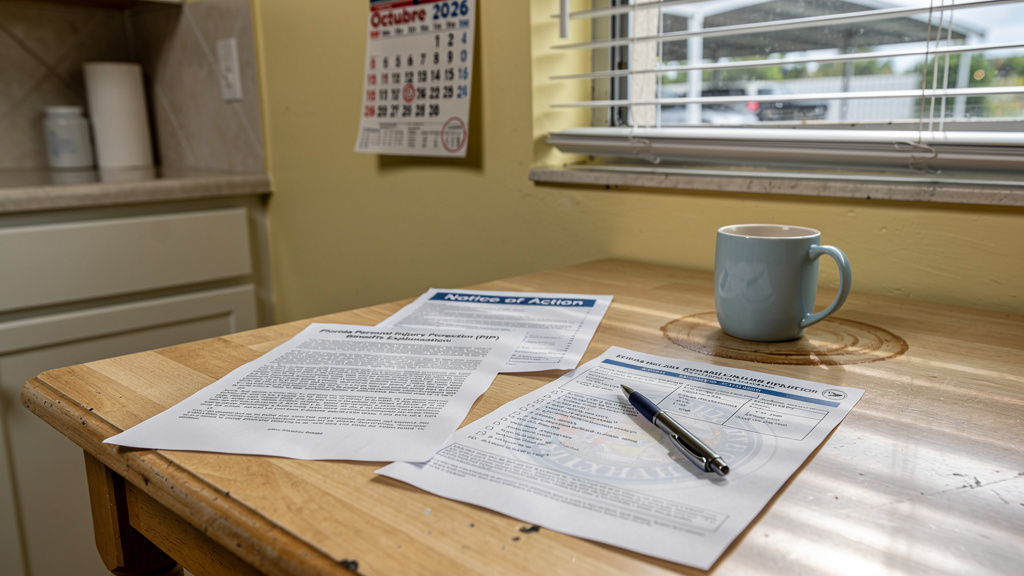
In Florida, crash reports, insurer letters, medical bills, court filings, and settlement releases are produced in English by law or by institutional practice, they will not automatically arrive in Spanish even when your attorney handles your case entirely in Spanish. Each document carries a specific deadline or legal consequence, so receiving one in English does not mean you can set it aside. The rule is simple: photograph every English document the moment it arrives and send the photo to your attorney before you respond, sign, or ignore anything.
Why do official papers stay in English even when everything else in my case is in Spanish?
Three separate systems produce English-only documents regardless of your language: Florida law enforcement, private insurers, and the courts. Crash reports are state forms filed in English under Florida Statute § 316.066. Insurance companies use English templates for PIP letters, EUO notices, and denials because their corporate claim departments operate in English. The Miami-Dade Circuit Court (11th Judicial Circuit) issues all filings, orders, and notices in English under court rules. This is not your lawyer’s choice or the insurer’s hostility, it is how these institutions function. Your attorney expects this. Forward every English paper as soon as it arrives, and they will track deadlines and explain what to do next.
What is the crash report and how do I get a copy through the Florida Crash Portal?
The Florida Uniform Traffic Crash Report (Long Form) includes the officer’s narrative, a diagram of the scene, vehicle and driver information, contributing cause codes, and whether citations were issued. Insurers and attorneys rely on it early in your case, but it does not decide legal fault, an officer’s opinion is just one piece of evidence. Under Florida Statute § 316.066, the report is confidential for 60 days after the crash. During that window, only the parties, their insurers, and their lawyers can access it. After 60 days, it becomes public. If your crash was handled by the Hialeah Police Department, your attorney can pull the report using the DR number given at the scene through the Florida Crash Portal. Do not wait, give that DR number to your lawyer right away.
What are PIP letters, and what happens if I ignore the examination-under-oath notice?
You will likely receive two types of English letters from your PIP insurer: requests for recorded statements and notices for an examination under oath (EUO). A recorded statement should never be given without first consulting your attorney. An EUO is more serious, it is a sworn session with the insurer’s attorney and a court reporter, conducted in English unless an interpreter is arranged. Florida Statute § 627.736(6)(g) lets the insurer require your cooperation as a condition of paying benefits. If you miss or refuse the EUO without legal guidance, the insurer may deny your claim. Remember what is at stake: PIP covers 80 percent of reasonable medical bills and 60 percent of lost wages, up to $10,000 if an emergency medical condition is documented, or $2,500 if not. The EUO notice will name a date, time, and location, photograph it and send it to your attorney the same day.
What are the medical bills, records, and lien letters telling me, and why do they matter at settlement?
Medical providers bill in English. Your PIP insurer sends an explanation of benefits (EOB) in English that shows what it paid, what it denied, and what balance remains. Both are key evidence of your damages. Some providers treat you under a letter of protection (LOP) or send a lien letter stating they expect payment from your settlement. That English lien letter directly affects how much you take home, forward it immediately. Under Florida Statute § 456.057 (and Fla. Stat. § 395.3025 for hospital records), you have the right to copies of your medical records, and providers must follow confidentiality rules before releasing them to others. Your attorney will send a HIPAA-compliant authorization to obtain them properly. Do not request or sign anything about your records on your own. Depending on the circumstances, lien enforceability varies, and your attorney will need to review each one carefully.
If a lawsuit is filed, what English court papers will I receive, and what is extra if the injured person is a minor?
If negotiations fail, your case may be filed in the Miami-Dade Circuit Court (11th Judicial Circuit). All court documents, complaints, summonses, discovery requests, deposition notices, motions, and orders, are in English. You do not respond to these yourself, but you might receive a deposition notice or hearing notice at home. Forward it to your attorney right away. If the injured person is under 18, Florida Statute § 744.387 often requires a judge to approve the settlement (for example, after a lawsuit is filed or when the settlement is larger). When it does, an English petition is filed, a hearing may happen, and the court issues an English order. Parents or guardians may be asked to sign English documents, but nothing should be signed without a clear Spanish explanation from your attorney. Court interpreters are available for hearings, but written filings remain in English.
The settlement release: the one English document you must never sign before getting a Spanish explanation
A settlement release is a binding contract that ends all claims from the crash, including future injuries, unknown claims, and unnamed parties. Once signed, you cannot come back later for more money, even if your condition worsens. Do not sign it at the scene, at an insurance office, or anywhere your attorney has not reviewed it. Your attorney must read every paragraph and explain it fully in Spanish before you sign. If a check is attached, cashing it may count as accepting the release. Prevention is key, photograph the release and send it to your attorney first. For minors, remember that when court approval is required under Florida Statute § 744.387, the release is not valid without it.
Frequently asked questions
Can I ask the Hialeah Police or the insurance company to send me documents in Spanish?
You can ask, but official documents from the police, insurers, and the courts generally remain in English. Your attorney will translate what you need.
What happens if I miss the deadline on an English letter I did not understand?
Missing a deadline, like an EUO date or a court filing response, can hurt your case or lead to a denial of benefits. That is why you must photograph and forward every English document the day it arrives. Your attorney tracks all deadlines once they have the paper.
The crash report says something that makes me look at fault. Does that decide my case?
No. A police report is not a final ruling on fault. Officers often lack full facts at the scene. Your attorney will investigate independently and may challenge the report’s conclusions using witness statements, photos, or traffic camera footage.
My child was hurt in the crash. Do we need a judge’s approval to settle the case?
Often, yes. Under Florida Statute § 744.387, many settlements for a minor, including any settlement after a lawsuit is filed, must be approved by a circuit judge to protect the child’s interests. Your attorney will file the necessary English petition and guide you through the hearing.
A doctor’s office is sending me a bill even though I thought PIP would cover it. What does this English bill mean?
It may mean PIP already paid its share (80 percent of the bill), and the provider is billing you for the remainder. Or PIP denied part of the charge. Send the bill and the matching EOB from your insurer to your attorney, they will verify what you truly owe.
Hurt in an accident in Hialeah? Call Wolfson & Leon at 305-965-3766 for a free consultation. We speak Spanish, and there is no fee unless we win.
Key facts
- Florida crash reports are confidential for 60 days after the crash except to the parties involved, their insurers, and their lawyers, and copies can be requested through the Florida Crash Portal. Source: Fla. Stat. § 316.066
- A PIP insurer may require an injured person to submit to an examination under oath (EUO) as a condition of paying benefits; the notice and scheduling letter arrive in English from the insurer. Source: Fla. Stat. § 627.736(6)(g)
- Patients have the right to request copies of their medical records; providers may charge for copies and must follow specific authorization procedures before releasing records to others. Source: Fla. Stat. § 456.057
- When the injured person is a minor, a Florida court often must approve the settlement (for example, after a lawsuit is filed or when the settlement is larger), and the approval order is issued in English by the Miami-Dade circuit court (11th Judicial Circuit) under Fla. Stat. § 744.387. Source: Fla. Stat. § 744.387
- PIP pays 80 percent of reasonable medical expenses and 60 percent of lost wages up to $10,000 if an emergency medical condition is documented, or up to $2,500 if it is not; the insurer communicates all of this in English. Source: Fla. Stat. § 627.736
Frequently asked questions
Can I ask the Hialeah Police or the insurance company to send me documents in Spanish?
You can ask, but official documents generally remain in English. The Florida Crash Portal, PIP insurer letters, and court filings are issued in English as a matter of institutional practice and state form requirements. Some large insurers have Spanish-speaking adjusters who can explain a letter verbally, but the controlling written document will remain in English. Your attorney's job is to translate and interpret every significant document for you before any action is required.
What happens if I miss the deadline on an English letter I did not understand?
Missing an insurer deadline, especially on an examination-under-oath notice, can give the insurer grounds to suspend or deny PIP benefits under Fla. Stat. § 627.736(6)(g). Missing a court deadline can result in a default judgment or dismissal. The moment any paper arrives, photograph it and send it to your attorney, that single habit eliminates almost all deadline risk on the client's side.
The crash report says something that makes me look at fault. Does that decide my case?
No. The crash report is evidence, not a verdict. Under Florida's modified comparative negligence rule (Fla. Stat. § 768.81), fault is allocated by percentage, and you can still recover compensation as long as you are not found more than 50 percent at fault. The officer's narrative and cause codes are one input among many, surveillance video, witness statements, vehicle damage patterns, and expert reconstruction can all change the picture. Your attorney reviews the report specifically to identify inaccuracies that can be addressed.
My child was hurt in the crash. Do we need a judge's approval to settle the case?
Often, yes. Under Fla. Stat. § 744.387, when the injured person is a minor, a Florida circuit court often must review and approve the settlement (for example, after a lawsuit is filed or when the settlement is larger) to ensure it is in the child's best interest. In Miami-Dade County this means a petition is filed in the 11th Judicial Circuit. The process involves English legal filings and potentially a brief court hearing. When court approval is required, a release is not binding on the minor without that order, so ask your attorney whether your child's case needs this step.
A doctor's office is sending me a bill even though I thought PIP would cover it. What does this English bill mean?
PIP covers 80 percent of reasonable medical expenses (not 100 percent), and only up to $10,000 if an emergency medical condition was documented or $2,500 if it was not, under Fla. Stat. § 627.736. The remaining balance, the 20 percent co-pay portion and any amount above the PIP cap, may become the subject of a lien against your eventual settlement, or it may be covered by health insurance. Do not pay a medical bill or sign a payment plan without first sending it to your attorney, because the amount and the provider's legal right to collect from your settlement must be evaluated before any payment is made.
This article is general information about Florida law, not legal advice, and reading it does not create an attorney-client relationship. Every case is different and past results do not guarantee a similar outcome. For advice about your situation, call Wolfson & Leon at 305-965-3766 for a free consultation.
Also available in: Versión en español
 Personal injury
 How Your Injury Case Works in Spanish, Step by Step: First Call to Final Signature
A Spanish-speaking injury victim in Hialeah can handle every stage of a personal injury case entirely in Spanish, from a 24/7 phone intake through a…
 Personal injury
 Yes, Wolfson & Leon Handles Your Whole Personal Injury Case in Spanish
Yes. At Wolfson & Leon's Hialeah office, a client can go from the first phone call through settlement or trial entirely in Spanish. Most attorneys…
 Personal injury
 Hialeah or Anywhere in Miami: Which Personal Injury Lawyer Should You Hire?
Florida law and Miami-Dade courts are identical no matter where your lawyer's office sits, so a personal injury claim filed by a Hialeah attorney…